 02 Oct 2026
What if the best first step toward advanced joint repair therapy isn’t choosing a treatment, but finding out what’s causing the problem? Ongoing pain can make relief feel urgent, especially when claims about cartilage regeneration promise more than the evidence can support. A useful plan starts with a careful assessment, not an assumption that one approach fits every joint.
You deserve to understand what a treatment is intended to address, what recovery may involve, and whether a non-surgical plan suits your needs. This guide explains how clinicians evaluate joint symptoms, how examination and imaging can inform a personalized plan, and what current evidence can and cannot tell you about repair and regenerative approaches. You’ll also find practical questions to discuss with your clinician about realistic goals, potential risks, and when surgery may still be considered. In Fresno, an orthopedic consultation can help clarify next steps. Physical therapy can be part of a broader recovery plan when clinically appropriate. The goal is a more informed path toward better movement, not a promise of cartilage regrowth or surgery avoidance.
Key Takeaways
- Advanced joint repair therapy describes a range of care approaches, not one standard procedure. The right direction depends on the cause and extent of your symptoms.
- Organize your symptom history, prior injuries, mobility changes, and daily challenges to make an orthopedic assessment more useful.
- Understand how established care differs from emerging research, and why promising findings don’t guarantee cartilage repair or pain relief.
- Before discussing a care plan, prepare questions about diagnosis, realistic benefits, risks, limitations, and follow-up.
- In Fresno, an orthopedic consultation and physical therapy can help shape a personalized plan to support joint function when clinically appropriate.
What Advanced Joint Repair Therapy Means for Joint Pain
Advanced joint repair therapy is a broad description for care intended to address joint problems and support function. It isn’t one standardized procedure or a guaranteed cure. The plan depends on what’s causing your symptoms, which joint is involved, and the extent of the problem. For one person, the priority may be improving strength and mobility. For another, a clinician may consider care aimed at a particular injured structure. The term alone doesn’t identify the right treatment or establish whether damaged tissue can be restored.
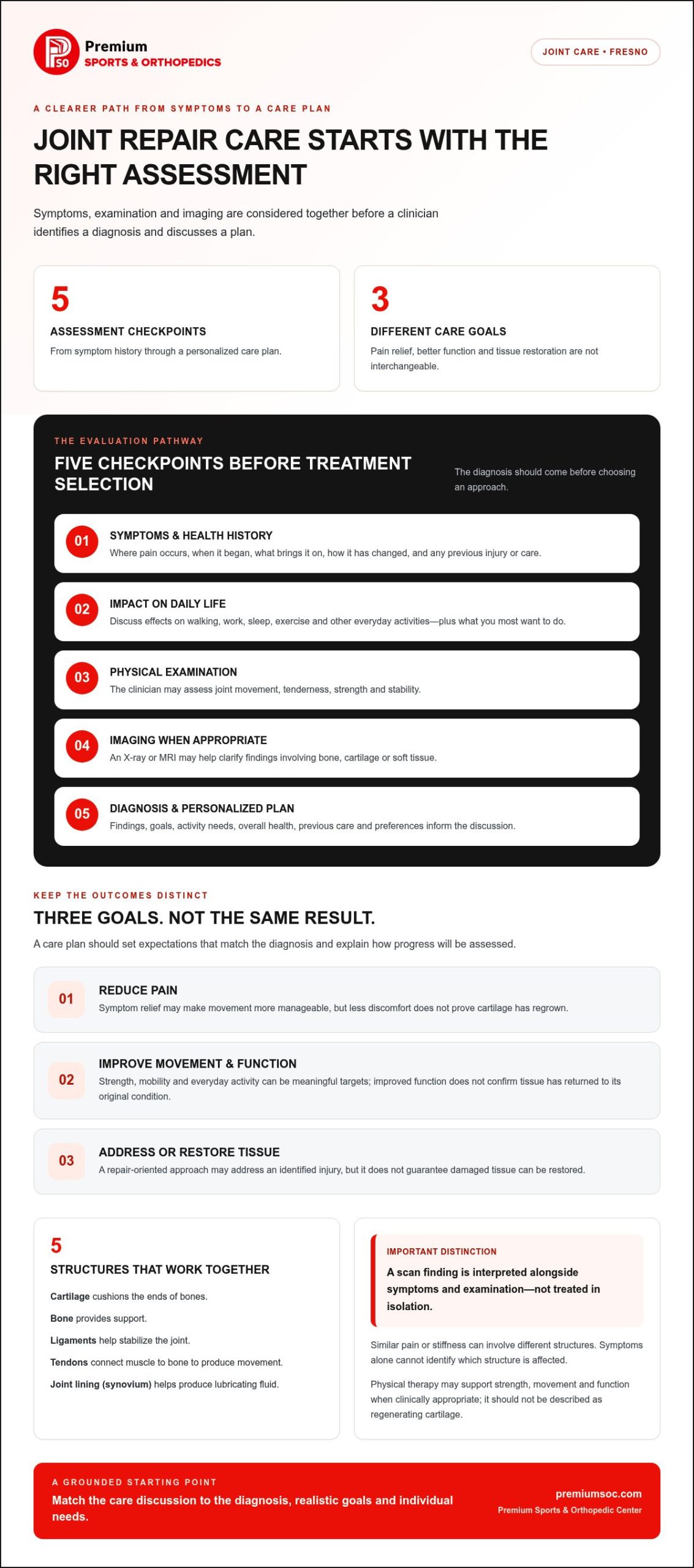
Separate three possible goals: reducing pain, improving how the joint moves and works, and restoring tissue. These outcomes are related, but they aren’t interchangeable. Less discomfort doesn’t necessarily mean cartilage has regrown, and improved function doesn’t prove that underlying tissue has returned to its original condition. A careful plan sets goals that match the diagnosis and explains how progress will be assessed.
Which joint structures can contribute to pain and restricted movement?
A joint relies on several structures working together. Cartilage cushions the ends of bones; bone provides support; ligaments help stabilize the joint; and tendons connect muscles to bone to produce movement. The joint lining, or synovium, surrounds the joint and helps produce lubricating fluid. Injury, gradual wear, inflammation, or repeated overuse can affect one or several of these structures.
Similar symptoms can therefore have different causes. Stiffness and pain might relate to cartilage changes, a ligament injury, irritated tendons, or inflammation in the joint lining. Symptoms alone can’t identify the damaged structure. Articular cartilage repair techniques describes approaches specifically focused on cartilage, but those procedures are not a universal answer to every source of joint pain.
How is joint repair therapy different from symptom management?
Symptom management focuses on easing discomfort or making daily movement more manageable. Repair-oriented care considers the problem behind the symptoms and may aim to improve function or address an identified tissue injury. These goals can overlap: a plan may address pain while also supporting mobility and recovery.
When clinically appropriate, care may combine orthopedic treatment and physical therapy. Physical therapy can support strength, movement, and function through mobility restoration therapy, but it shouldn’t be described as regenerating cartilage. Likewise, not every repair-oriented treatment restores damaged tissue or reverses arthritis. Ask what a proposed approach is intended to change, how progress will be assessed, and what limitations remain. Clear expectations keep the focus on a meaningful goal, such as moving more comfortably or returning to an activity, rather than assuming a cure.
How Clinicians Assess Joint Damage Before Repair-Oriented Care
A thoughtful assessment connects what you feel with what may be happening inside the joint. Clinicians typically review your symptoms and health history, examine the joint, consider imaging when appropriate, establish a diagnosis, and then build a plan with you. Imaging is only one part of the picture. A scan finding needs to be interpreted alongside your symptoms and examination, since a visible change may not explain every movement problem or source of pain.
What happens during an orthopedic joint evaluation?
Expect questions about where the pain occurs, when it began, what brings it on, and whether it has changed over time. The clinician may ask about previous injuries or care and how symptoms affect walking, work, sleep, exercise, or other daily activities. These details help distinguish a recent change from a persistent pattern.
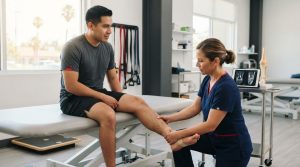
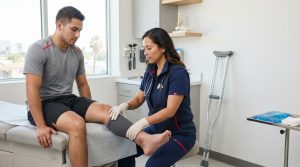
During the physical examination, the clinician may assess movement, tenderness, strength, and joint stability. Depending on the concern, imaging such as an X-ray or MRI may help clarify findings involving bone, cartilage, or soft tissue. The goal is to identify the likely source of symptoms, not to treat a scan in isolation. Diagnosis should come before treatment selection because the right plan depends on what is causing the symptoms.
How do diagnosis and personal goals shape the care plan?
Once the findings are considered together, the clinician can discuss which goals fit the diagnosed problem. Those goals might focus on easing symptoms, improving function, supporting recovery, or addressing a specific injury. Your activity needs, overall health, previous care, and preferences also matter. When clinically appropriate, a plan may combine orthopedic care and physical therapy, with progress reviewed against goals that matter in everyday life.
Returning to a particular activity may call for a different functional target than making stairs or household tasks more manageable. Share what you most want to do, what limits you now, and what approaches you’ve already tried. This makes shared decision-making more practical. The Fresno joint pain clinic care comparison offers additional context for thinking through care choices. Reviews of emerging strategies in regenerative medicine can help distinguish developing research from decisions based on an individual clinical evaluation.
For Fresno-area patients, an orthopedic assessment provides a grounded starting point for discussing advanced joint repair therapy and recovery goals. Explore orthopedic care in Fresno to learn about a personalized next step.
How Current Joint Repair Approaches Compare With Emerging Research
“Joint repair” can refer to very different approaches, from care that supports movement to procedures aimed at a specific cartilage defect. Their evidence and goals aren’t interchangeable. This comparison distinguishes established care categories from treatments still being studied, so promising research isn’t mistaken for a proven personal outcome.
| Approach | Evidence context | Key caveat |
|---|---|---|
| Orthopedic care and physical therapy | Clinical assessment and rehabilitation guide diagnosis, movement, strength, and function. | These approaches can support mobility and recovery, but aren’t evidence of cartilage regeneration. |
| Cartilage-repair procedures | Some surgical techniques are used for selected cartilage problems; clinical evidence relates to specific procedures and patient groups. | A procedure for a defined cartilage defect isn’t a universal treatment for joint pain or widespread arthritis. |
| PRP | Platelet-rich plasma has been studied in people with joint conditions. | Evidence and outcomes vary; research does not establish guaranteed cartilage restoration or predictable benefit for an individual. |
| Stem-cell and other regenerative approaches | Studies include human research as well as earlier laboratory and animal work. | As of 2026, the FDA has not approved stem-cell therapies for orthopedic conditions. |
| Experimental tissue-regeneration strategies | Some approaches remain in preclinical research, including animal studies. | Animal findings do not establish safety or effectiveness in people. |
What can PRP, stem-cell, and cartilage-repair research tell patients?
PRP uses a preparation made from a person’s blood, while “stem-cell therapy” covers distinct cell-based approaches. Cartilage-repair procedures are a separate category, with techniques and suitability depending on the injury and joint. These labels aren’t synonyms or proof that a treatment rebuilds cartilage. Human studies can offer useful evidence, but findings for one method or group of patients don’t automatically apply to another. Research results also can’t predict an individual patient’s outcome.
Why promising animal studies don’t equal proven patient treatment
Animal research is an early step. A result in an animal model can help scientists investigate a treatment, but it doesn’t establish that the approach will be safe or effective for people. A Colorado report described experimental work with animal-study findings. Separately, in April 2026, ARPA-H’s NITRO program announced cartilage and bone regeneration in animal models, with teams moving toward first-in-human trials. That progress is meaningful research, not proof of a routine patient treatment or a forecast of any person’s recovery.
When discussing advanced joint repair therapy, focus on the diagnosis, the intended goal, and the evidence behind the specific approach being considered. Orthopedic care and physical therapy can support an individualized recovery plan when clinically appropriate, without promising tissue regeneration.
How to Prepare for Advanced Joint Repair Therapy in Fresno
A little preparation can make a joint-care consultation more focused. Bring a clear picture of what has changed, what you’ve tried, and what you hope to do more comfortably. These details connect the evaluation to your everyday needs rather than symptoms alone.
What information should you bring to a joint-care consultation?
Before your visit, jot down when symptoms began, where you feel them, what makes them worse or better, and how they affect daily activities. Include mobility concerns such as difficulty walking, climbing stairs, reaching, or returning to sport. If knee symptoms are your main concern, this knee pain treatment guide for Fresno offers additional context.
- Symptom pattern: Note when pain or stiffness occurs and whether it changes with activity or rest.
- Previous care: List treatments you’ve tried and how they affected your symptoms or function.
- Relevant records: Bring available imaging reports and a current medication list.
- Personal goals: Identify what you want to improve, such as walking comfortably, returning to sport, or sleeping with less disruption.
A few notes can help you describe patterns you might otherwise forget during an appointment. Be candid about what’s difficult and what progress would mean to you.
Which questions help set realistic treatment expectations?
Use the discussion to understand the reasoning behind a proposed plan. Ask what diagnosis the evaluation supports, how the plan addresses that problem, and what benefits are realistic. You can also ask about limitations, potential risks, recovery needs, and follow-up.
- How will we measure whether the plan is helping?
- What activities may need to change during recovery, and for how long?
- When will progress be reviewed, and what could lead to adjusting the plan?
Recovery timelines and activity guidance depend on the condition, the approach selected, and individual factors. A plan involving physical therapy may have different milestones from another type of care. Rather than relying on a general promise or someone else’s experience, ask how progress will be assessed for your situation. For Fresno-area patients, an orthopedic consultation can help organize those questions into a personalized next step. Explore joint tissue repair therapy and orthopedic care to discuss your joint symptoms and goals.
How Personalized Joint Repair Care Supports Mobility in Fresno
Joint symptoms affect more than a single movement. They can change how comfortably you walk, work, exercise, or manage everyday tasks. At Premium Sports & Orthopedic Center, care planning considers your joint symptoms, how they affect function, and what you hope to do more comfortably. That context helps shape a plan around your needs rather than a one-size-fits-all promise.
How do orthopedic care and physical therapy work together?
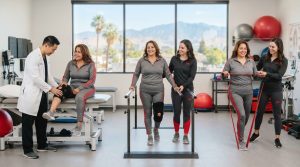
An orthopedic consultation can connect your symptoms and functional concerns with an appropriate care plan. The discussion can establish practical goals, such as improving range of motion or building strength for daily activities. If clinically appropriate, physical therapy may support movement and strength as part of broader recovery planning. Dedicated physiotherapy practices like Minsu’s Healing Oasis demonstrate how specialized manual therapy and rehabilitative exercise can help individuals regain functional joint mobility.
Advanced joint repair therapy should fit the diagnosed problem and the person receiving care. The term doesn’t point to one specific procedure, and no single approach suits every joint concern. Premium Sports & Orthopedic Center provides joint tissue repair therapy as part of orthopedic pain management and rehabilitation. This care can be considered within an individualized plan without assuming that treatment will regenerate cartilage, eliminate pain, or prevent surgery. Your clinician can explain the purpose of each recommended care component and how it relates to your goals.
What should patients expect from a personalized recovery plan?
A recovery plan is guided by your diagnosis, overall health, activity needs, and response to care. Progress may be reviewed over time, with goals or recommendations adjusted as your function changes. If a particular activity remains difficult, share that information. It helps keep the plan grounded in what matters to you and provides an opportunity to discuss whether the next step should change.
There isn’t one timeline that applies to everyone. The pace and activity guidance depend on the care plan and individual response, so clear communication matters throughout recovery. Ask what changes to watch for, how progress will be assessed, and when to revisit your goals. The aim is a thoughtful path toward better mobility, with realistic expectations at every stage.
For Fresno-area joint symptoms, an orthopedic consultation can turn questions into a practical, individualized care plan. Explore the Fresno orthopedic and joint care team as a next step toward understanding your options.
Take a Confident Next Step Toward Better Mobility
Choosing advanced joint repair therapy starts with understanding the cause of your symptoms, not chasing a promise of cartilage regrowth or guaranteed surgery avoidance. A careful orthopedic assessment connects your symptoms, examination findings, and relevant imaging to a plan shaped around your health and daily goals. Distinguish potential pain relief and improved function from actual tissue restoration, especially when evaluating emerging research.
At Premium Sports & Orthopedic Center, licensed medical practitioners provide orthopedic care, joint tissue repair therapy, and physical therapy to support individualized recovery planning when appropriate. The center serves patients in Fresno and nearby Clovis. Your next step can be a conversation focused on what’s limiting your movement, which outcomes matter to you, and how progress may be assessed.
Explore personalized orthopedic and joint care in Fresno, and take an informed step toward moving with greater confidence.
Frequently Asked Questions
What is advanced joint repair therapy?
Advanced joint repair therapy is a broad term for care intended to address joint problems and support improved function. It doesn’t describe one standard procedure or guarantee that damaged cartilage will regrow. A clinician considers your symptoms, examination findings, and relevant imaging before discussing suitable options, realistic goals, potential limitations, and follow-up. The right plan depends on the cause of your joint symptoms and what you hope to do more comfortably.
Is advanced joint repair therapy the same as regenerative medicine?
No. The terms can overlap, but they aren’t identical. Regenerative medicine describes a broad area of approaches intended to support tissue repair or the body’s healing response. Joint repair therapy can also include orthopedic assessment, rehabilitation, and other care focused on function. The label alone doesn’t identify a specific treatment or establish how strong the evidence is for a particular joint problem. Ask what approach is being discussed and what it’s intended to achieve.
Can joint repair therapy rebuild damaged cartilage?
Whether cartilage repair is possible depends on the diagnosis and the specific treatment being considered. Some approaches are under study, but promising research doesn’t prove that a treatment rebuilds cartilage for every patient. Findings from animal studies also don’t establish benefit in people. Ask your clinician what outcome current evidence supports for your condition, how progress will be assessed, and what other care options may be appropriate.
Who may be a candidate for advanced joint repair therapy?
Suitability depends on the source and extent of symptoms, examination findings, overall health, activity goals, and prior care. An individualized assessment helps determine whether repair-oriented care, physical therapy, another orthopedic approach, or a combination may fit your needs. A general therapy description can’t establish candidacy or predict recovery. In Fresno, an orthopedic consultation can connect your joint concerns with a plan shaped around your health and everyday activities.
How long does recovery from joint repair therapy take?
Recovery varies with the joint problem, the care plan, overall health, and the activities you hope to resume. A plan may include gradual mobility and strength work, while other approaches can involve different recovery needs. Your clinician can explain relevant milestones and follow-up after assessing your situation. Don’t treat a general timeline as a promise. Ask how your progress will be monitored and when activity guidance may change.
Is advanced joint repair therapy a proven alternative to surgery?
Advanced joint repair therapy shouldn’t be viewed as a guaranteed substitute for surgery. The appropriate approach depends on the diagnosis, symptoms, functional limits, and evidence for the available options. Some people may be considered for non-surgical care, while others may need a different plan—an evaluation often seen in specialized practices like Ohio Foot & Ankle Surgeon that weigh both non-invasive therapies and surgical options for complex joint conditions. Discuss expected benefits, risks, limitations, and alternatives with an orthopedic clinician so you can make an informed decision based on your individual needs.