
 04 Oct 2026
What if chronic joint pain management isn’t about choosing between medication and simply putting up with discomfort? When pain disrupts your sleep, work, or favorite activities, conflicting advice can make every next step feel uncertain. You may wonder whether movement could make symptoms worse, whether medication is the only answer, or whether pain is just part of getting older. A single assumption or approach doesn’t fit everyone.
Managing persistent joint pain starts with understanding what may be contributing to it and how it affects your daily function. This guide separates common myths from practical facts, outlines steps you can take day to day, and explains how movement, physical therapy, activity adjustments, and orthopedic care can play different roles. You’ll also learn what information to bring to an assessment and when persistent symptoms may warrant professional attention. The goal is to help you make informed choices without trying to diagnose the cause on your own.
Key Takeaways
- Chronic pain describes how long symptoms have lasted, not their cause or what your future mobility will look like.
- Joint pain can have different contributors, so a one-size-fits-all solution is unlikely to suit everyone.
- Movement, physical therapy, activity adjustments, and clinician-directed care can play different roles in chronic joint pain management.
- Track symptom patterns and their effects on daily activities to bring useful details to an assessment.
- Persistent pain, recurring symptoms, or reduced mobility may be a reason to seek an individualized orthopedic assessment in Fresno.
Chronic Joint Pain Management: Which Common Beliefs Get in the Way?
Persistent joint pain can make ordinary routines, from climbing stairs to getting a good night’s sleep, feel harder than they should. That disruption deserves attention, but it doesn’t define your future. The word “chronic” describes how long pain has lasted; it doesn’t explain its cause or predict how it will change.
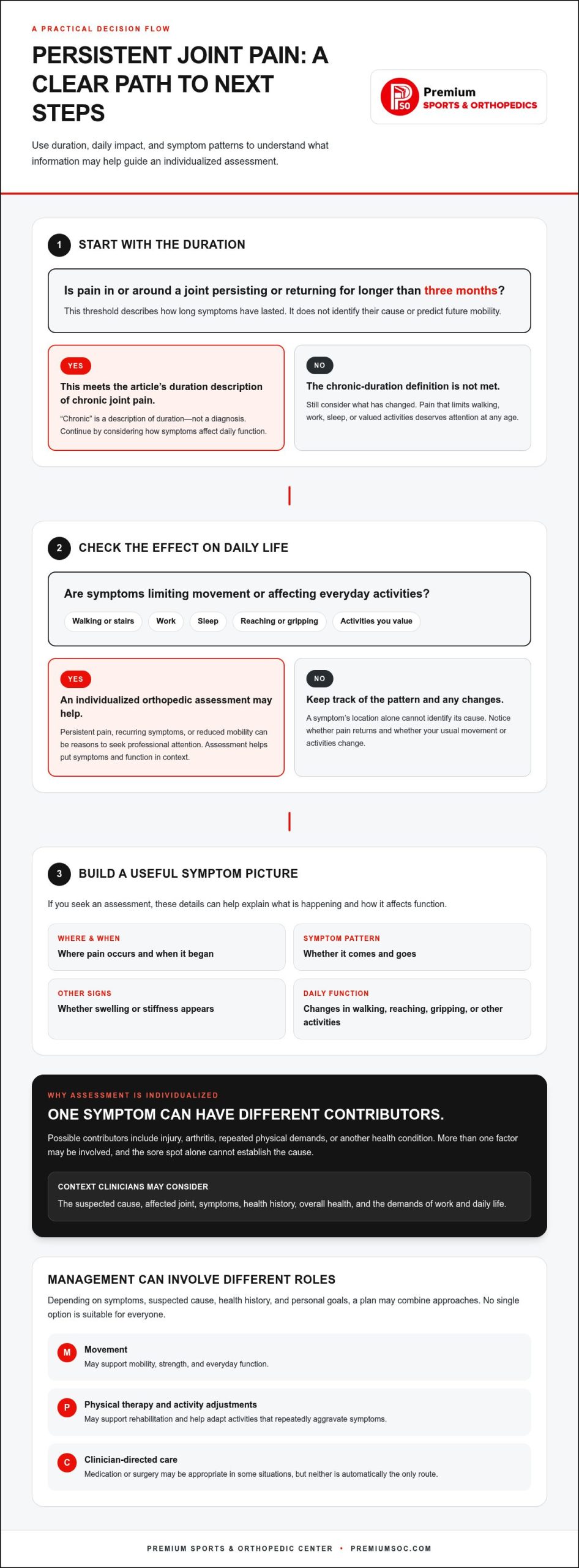
Chronic joint pain is pain in or around a joint that persists or returns for longer than three months. This describes duration, not a diagnosis. The broader concept of chronic pain includes pain that can continue or recur over time, and joint symptoms can have different contributors. An assessment can help put symptoms in context.
Myth: Chronic joint pain is just a normal part of getting older
Age can influence the likelihood of some joint changes, but it doesn’t mean you have to accept persistent or limiting pain without question. Age-related changes may be present without causing major symptoms, while pain that affects walking, work, sleep, or valued activities deserves attention at any age.
A scan doesn’t tell the whole story, either. Imaging findings and pain don’t always correspond neatly: a visible change doesn’t by itself show how much discomfort someone will feel. Symptoms need to be considered alongside function and health history. Instead of focusing only on age, consider what has changed and how it affects your daily life.
Myth: The only choices are daily medication or surgery
Chronic joint pain management isn’t limited to those two options. Depending on the joint, possible cause, symptoms, and personal goals, a plan may include movement, physical therapy, activity adjustments, or clinician-directed treatments. These approaches serve different purposes and may be considered together. They aren’t a universal formula, and no single option is suitable for everyone.
For example, a plan may look at how to maintain comfortable movement while adapting activities that repeatedly aggravate symptoms. Rehabilitation can support mobility and function, while an orthopedic assessment can help clarify next steps. Additionally, practices like Precision Spinal Care focus on how structural alignment and spinal mechanics influence joint discomfort throughout the body. Medication or surgery may be appropriate in some situations, but neither is automatically the only route. Treatment decisions depend on each person’s circumstances.
Pain isn’t inevitable, and one treatment won’t work for everyone. Start by noting how symptoms affect daily life, then seek guidance that takes the whole picture into account. This article offers general information, not a diagnosis or a substitute for individualized medical advice.
What Can Cause Chronic Joint Pain, and Why Does It Persist?
Joint pain is a symptom, not a diagnosis. An injury, arthritis, repeated physical demands, or another health condition may contribute, and more than one factor can be involved. The location of discomfort can offer clues, but it can’t identify the cause on its own. As the Centers for Disease Control and Prevention explains in its overview of What Can Cause Chronic Joint Pain, arthritis includes different conditions, so the context behind symptoms matters.
How joint structures and surrounding tissues relate to pain
A joint brings bones together, with cartilage helping cushion their ends. Ligaments connect bones and help stabilize the joint; tendons connect muscles to bones, while nearby muscles support movement. Symptoms can involve a joint or the tissues around it. Pain after an injury, for instance, may relate to different structures than discomfort that builds with repeated activity. These examples don’t identify what’s happening in an individual joint, and similar symptoms can have different explanations.
That’s why assessment considers more than the sore spot. A clinician may ask where pain occurs, when it began, whether it comes and goes, and whether swelling or stiffness appears. Changes in walking, reaching, gripping, or other daily activities also help show how symptoms affect function. These details guide evaluation, but no single symptom can confirm a cause.
Why the same pain-management plan does not fit everyone
Persistent joint pain needs context because the same symptom can have different contributors, and the right management approach depends on the person, not pain intensity alone. A painful joint doesn’t automatically reveal the source or seriousness of a problem. Clinicians consider the suspected cause alongside overall health, the affected joint, and the demands of work and daily life. This helps shape a plan around individual needs rather than a one-size-fits-all remedy.
For chronic joint pain management, one person may need guidance focused on mobility and rehabilitation, while another may need a different clinical approach based on their symptoms and assessment. To learn about one area of care, read this joint tissue repair therapy guide. The guide provides additional information, while an individualized orthopedic assessment can help connect symptoms and function to appropriate next steps. Learn about mobility restoration therapy and how a movement-focused plan may support everyday function.
If pain keeps returning or limits everyday movement, orthopedic care in Fresno can help you explore a personalized management plan.
Chronic Joint Pain Management: How Do Common Approaches Differ?
There isn’t one approach that suits every joint or every person. A plan may combine practical daily adjustments with rehabilitation or clinician-directed care, depending on symptoms, suspected cause, health history, and goals. The options below serve different roles; none guarantees relief, and some may not be appropriate for a particular situation.
| Approach | General role | Considerations |
|---|---|---|
| Movement | May help support mobility, strength, and everyday function. | Choose activity based on symptoms and physical ability. Don’t push through worsening pain without guidance. |
| Physical therapy | Can provide structured rehabilitation suited to movement needs and functional goals. | Activities may need to change as symptoms and abilities change. A physical therapist or clinician can guide an appropriate approach. |
| Activity changes | Adapting how or when a task is done may help manage demands on a painful joint. | Changes should support daily needs without unnecessarily ruling out comfortable movement. |
| Clinician-directed treatments | A clinician may consider additional options based on assessment and individual circumstances. | Suitability, potential benefits, and risks vary. Medication decisions belong with a qualified clinician who can consider personal health risks. |
Where movement and physical therapy may fit
Guided movement can be one part of supporting strength, mobility, and daily function. Appropriate activities depend on the joint, symptoms, physical ability, and clinical guidance. There’s no single exercise routine for everyone. If a movement worsens pain, pause rather than forcing it and seek advice.
How clinicians consider other treatment options
If symptoms persist or limit daily activities, a clinician can consider whether additional options fit the person’s assessment and goals. Joint tissue repair therapy is one area of care, but its relevance depends on the individual situation. It shouldn’t be assumed to suit every person or every cause of joint pain.
For a separate overview of local care approaches, explore this Fresno joint pain care comparison. An individualized orthopedic assessment and rehabilitation plan can help connect your symptoms and goals with appropriate next steps. Learn more about orthopedic care and physical therapy as part of your care journey.
What Practical Steps Can Support Joint Pain Management Day to Day?
Small observations can help you make daily choices and explain your symptoms clearly during an assessment. A simple routine keeps the focus on what changes, what affects your comfort, and how pain influences activities that matter to you. These steps support chronic joint pain management, but they don’t replace individualized medical guidance.
Track symptoms and adapt activities thoughtfully
Try this practical sequence:
- Notice patterns. Record when discomfort appears, what you were doing, and how long any increase or easing lasts.
- Note other changes. Include stiffness, swelling, and effects on daily function, such as difficulty walking, reaching, or handling objects.
- Pace activities. Break demanding tasks into manageable parts or adjust how you do them. This can help you stay engaged without treating every flare as a reason to stop moving altogether.
- Maintain comfortable movement. Adapt activity to how you feel and your clinician’s guidance. Don’t force a movement that makes symptoms worse. If this keeps happening, ask a healthcare professional for advice.
- Review and share the pattern. If symptoms persist, worsen, or repeatedly interfere with daily life, discuss your notes with a healthcare professional.
A symptom log helps you describe patterns; it doesn’t diagnose the cause. Use it as a communication tool, not a reason to label the condition yourself. A concise record of timing, triggers, stiffness, swelling, and function can give a clinician useful context.
Know when joint pain needs prompt medical attention
Some changes call for prompt assessment rather than routine tracking. Seek medical attention for sudden severe joint pain, significant swelling, fever alongside joint symptoms, or inability to use the joint. These signs need timely professional evaluation; don’t wait for a symptom log to show a pattern.
If symptoms feel urgent or severe, use appropriate urgent or emergency services rather than waiting for a routine clinic appointment. This guidance can’t determine the cause or urgency for an individual, so follow professional advice when you’re concerned.
For persistent pain or reduced mobility that affects everyday activities, an individualized orthopedic assessment can help connect your symptom history and functional needs with possible next steps. Explore orthopedic assessment and physical therapy to learn about support tailored to your needs.
When to Seek Chronic Joint Pain Management in Fresno
Consider an individualized orthopedic assessment if joint pain persists, keeps returning, or makes everyday movement harder. You don’t need to wait until you’ve stopped an activity entirely. Difficulty with routine tasks, such as walking comfortably, reaching, or keeping up with work, can be a useful reason to discuss your symptoms with a clinician.
An assessment can bring several pieces of the picture together: your symptom history, how pain affects function, and findings from an examination. Based on that information, a clinician can discuss whether further evaluation may be appropriate and what next steps could fit your needs. The goal is to develop an informed plan, not to promise a particular result.
What to prepare for an orthopedic or rehabilitation assessment
A little preparation can make it easier to explain what’s been happening. Consider bringing or noting:
- A timeline of when symptoms began and how they’ve changed.
- Relevant medical history and a list of current medications.
- Activities or movements that worsen symptoms, along with anything that seems to ease them.
- How symptoms affect daily function and which activities you’d like to work toward.
These details help guide the conversation, but you don’t need to identify the cause yourself. The clinician will consider your history and examination findings to determine whether further evaluation or treatment is appropriate.
How individualized care can support a return to daily activities
Chronic joint pain management may involve coordinated orthopedic care and physical therapy tailored to your symptoms, goals, and day-to-day demands. A useful plan can set realistic functional goals, review progress, and adjust as needs change. Progress can vary, so care should be guided by your individual assessment rather than a guaranteed timeline or outcome.
Premium Sports & Orthopedic Center provides orthopedic and rehabilitation care for patients in Fresno and Clovis. If persistent symptoms or reduced mobility are making daily life more difficult, an individualized clinical assessment can help clarify possible next steps. Explore orthopedic care in Fresno to learn more.
Take the Next Step Toward More Confident Movement
Chronic joint pain can have different causes, so its duration alone doesn’t define what’s happening or which care may be appropriate. A symptom log, thoughtful activity adjustments, and comfortable movement can help you notice patterns. Persistent pain or reduced mobility may call for an individualized assessment.
Chronic joint pain management doesn’t have to mean relying on one approach. At Premium Sports & Orthopedic Center, orthopedic pain management and sports medicine consultations help inform next steps. Depending on individual needs and clinical assessment, care may also include physical therapy, muscle recovery treatments, or joint tissue repair therapy. These options aren’t guarantees of a particular result, but they can be considered as part of a personalized plan.
If joint symptoms are limiting your daily activities, explore orthopedic and rehabilitation care in Fresno at Premium Sports & Orthopedic Center.
Frequently Asked Questions
Is chronic joint pain always a sign of arthritis?
No. Arthritis is one possible cause, but joint pain can also follow an injury, repeated physical demands, or other health conditions. Pain is a symptom, not a diagnosis, and its location alone can’t identify the source. A clinician can consider your symptom history, affected joint, function, and examination findings to determine what may be contributing and whether further evaluation is appropriate.
Can chronic joint pain improve without surgery?
Yes, some people manage joint pain without surgery, but the right approach depends on the cause, affected joint, health history, and personal goals. Care may include physical therapy, activity adjustments, clinician-directed treatment, or a combination of approaches. For example, wellness practices like Livelovelife Chiropractic illustrate how gentle, hands-on care can complement everyday adjustments to improve overall mobility. No option suits everyone or guarantees a particular result. An individualized assessment can help clarify which non-surgical steps may be reasonable for your situation.
How long does joint pain need to last to be considered chronic?
Joint pain is generally considered chronic when it persists or recurs for more than three months. This time frame describes duration, not the cause, severity, or likely outcome. Pain lasting that long may have different explanations, so note when it began, whether it comes and goes, and how it affects daily activities. A clinician can help put those details in context.
What happens if chronic joint pain is left untreated?
The effects vary. Pain may continue, recur, or make daily activities harder, but the outcome depends on its underlying cause. Don’t assume that symptoms will inevitably worsen, or that they should simply be ignored. If pain limits movement, sleep, work, or valued activities, an assessment can help clarify possible contributors and appropriate next steps. This article can’t predict an individual outcome or replace medical advice.
Can physical therapy help manage chronic joint pain?
Physical therapy may help support mobility, strength, and daily function as part of a broader care plan. The approach should reflect the affected joint, symptoms, physical ability, and goals, rather than rely on a standard routine. A physical therapist or clinician can guide appropriate activity and adjust it as needed. Physical therapy doesn’t diagnose the cause by itself or guarantee pain relief, but it may contribute to individualized care.
When should I see a doctor for persistent joint pain?
Consider seeing a clinician when pain persists, keeps returning, or reduces your ability to move or manage everyday tasks. Bring notes about when symptoms occur, what seems to affect them, and any stiffness or swelling. Seek prompt medical attention for sudden severe pain, significant swelling, fever with joint symptoms, or inability to use the joint. Use appropriate urgent or emergency services for urgent symptoms rather than waiting for a routine visit.
Is it safe to exercise when a joint hurts?
It depends on the symptoms and the activity. Comfortable movement may be appropriate for some people, but don’t force an exercise that worsens pain or significantly limits how you use the joint. Adjust activity to your abilities and any guidance from a clinician or physical therapist. If pain repeatedly increases with movement, or you’re unsure what’s suitable, seek individualized advice before continuing that activity.