 05 Oct 2026
Mobility restoration therapy focuses on making everyday movement more manageable, not just easing pain. Stiffness or discomfort can affect how you walk, climb stairs, reach, or return to an activity you enjoy. A useful plan starts with the movements that matter in your daily life and considers what may be limiting them.
Care depends on your symptoms, health history, and goals. An orthopedic consultation can help assess a musculoskeletal concern, while physical therapy can support movement and function. In this article, you’ll learn what mobility-focused care may involve, how an individualized plan takes shape, and what information can help you prepare for an assessment. You’ll also find guidance on when pain, stiffness, or reduced mobility may be a reason to seek orthopedic or rehabilitation care.
Key Takeaways
- Mobility restoration therapy is a goal-led approach to improving everyday movement, not one standardized treatment.
- An individualized plan connects symptoms, movement concerns, health history, and personal goals with appropriate care.
- Orthopedic consultation, physical therapy, joint tissue repair therapy, and muscle recovery treatments can serve different roles.
- Before an appointment, note what hurts, which activities are difficult, and what movements you hope to regain.
- Premium Sports & Orthopedic Center provides orthopedic and rehabilitation care for people in Fresno and Clovis.
What Is Mobility Restoration Therapy and Its Benefits?
Mobility restoration describes a functional goal: improving movement in ways that matter in everyday life. That may mean walking more comfortably, reaching overhead, bending to pick something up, standing comfortably, or returning to a valued activity. Rather than focusing only on a body part or symptom, mobility-focused care considers how movement affects the tasks and routines you want or need to manage.
A mobility goal describes what you hope to do; a therapy plan describes the care selected to help you work toward it. The phrase mobility restoration therapy does not name one standardized procedure or guarantee a particular outcome. It can describe care intended to support functional movement. Physical therapy, for example, is a clinical discipline with a broad scope, as outlined in this overview of Physical therapy. The appropriate approach depends on an individual assessment, and progress varies.
Pain, stiffness, weakness, balance challenges, or an injury can affect movement in different ways. Discomfort may make a familiar task harder, while changes in strength or steadiness can affect how someone moves. These experiences alone do not identify a diagnosis. An orthopedic or rehabilitation assessment can help clarify what may be affecting function and which care options fit your needs.
Which parts of everyday movement can mobility-focused care address?
Care may focus on practical activities such as walking across a room, climbing steps, reaching for a shelf, bending to dress, or standing long enough to prepare a meal. For an active person, a meaningful goal could be returning to a recreational activity or training routine. The target depends on the affected area, health history, and personal priorities. Two people with similar symptoms may have different movement goals.
Is mobility restoration therapy one specific procedure?
No. It is a broad description of a goal-led process, not the name of a single technique. A clinician considers symptoms, movement, relevant health history, and daily activities when discussing appropriate care. Physical therapy and orthopedic care may contribute in different ways, depending on the assessment.
Some people may be candidates for outpatient, non-surgical care, while others may need a different clinical approach. Assessment helps guide that decision. Rather than assuming one method fits every injury or condition, a care plan should reflect the person’s circumstances and be reviewed as needs change.
How Does Mobility Restoration Care Connect Assessment With Movement?
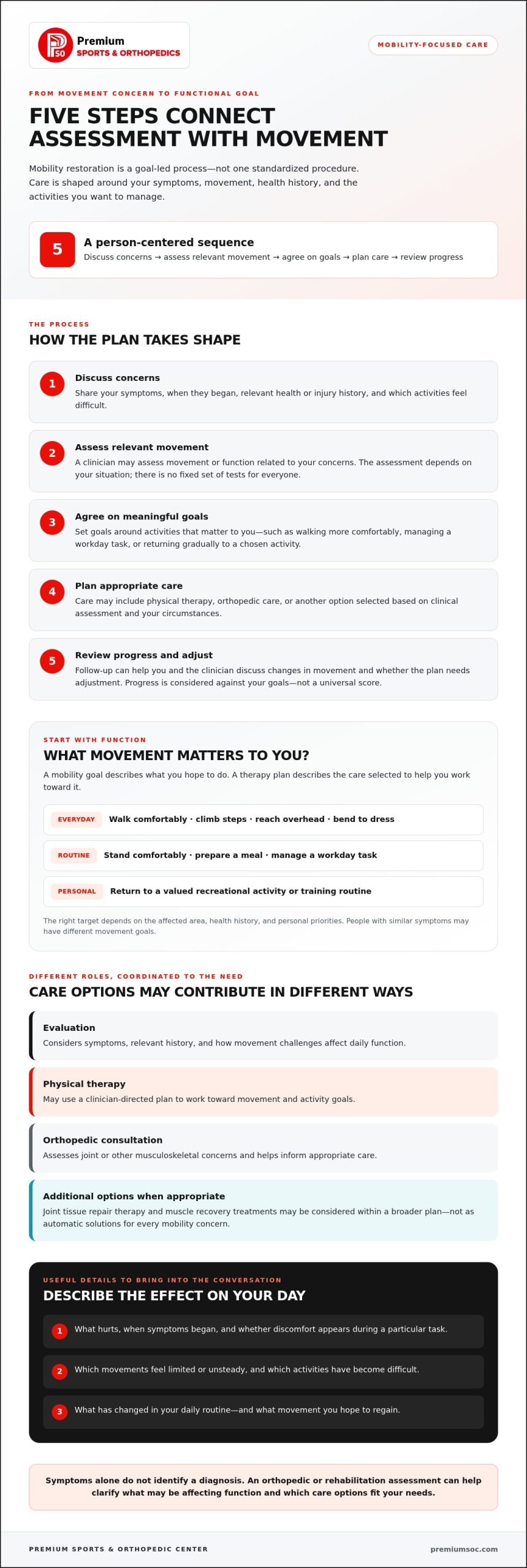
A mobility-focused plan starts by identifying what is getting in the way of movement and what you want to do more comfortably. The process generally connects five steps: discuss concerns, assess relevant movement, agree on goals, plan care, and review progress. This helps keep mobility restoration therapy focused on the individual rather than on a generic routine.
What may happen during an initial mobility assessment?
The conversation may cover your symptoms, when they began, relevant health or injury history, and which activities feel difficult. A clinician may then assess movement or function related to those concerns. The specific assessment depends on your situation; there is no fixed set of tests that applies to everyone.
Practical details can make the discussion more useful. Explain whether discomfort arises during a particular task, whether movement feels limited or unsteady, and what you have changed in your daily routine as a result. This context helps the clinician consider your symptoms alongside movement and function. An assessment is not simply a checklist of painful areas; it connects a concern with its effect on everyday activity.
How do goals and follow-up shape the care plan?
After reviewing the findings, the clinician and patient can identify goals that fit the person’s life. That might mean walking more comfortably, managing a workday task, or gradually returning to a chosen activity. Clear goals help guide care and make follow-up more useful because progress can be considered in terms of function, rather than a universal score.
The care plan may include physical therapy, orthopedic care, or another appropriate option based on clinical assessment. Joint tissue repair therapy is one service that can be considered within a broader plan, rather than an automatic solution for every mobility concern. Follow-up gives the clinician and patient a chance to discuss how movement is changing and whether the plan needs adjustment.
Progress might show up as a daily task becoming easier, less disruption to a routine, or greater confidence with a relevant movement. The signs that matter depend on your starting point and agreed goals. Treatment choices and timing vary, so no single pace or outcome applies to everyone. If pain or limited movement affects your routine, an orthopedic or rehabilitation assessment can help clarify next steps.
How Do Physical Therapy, Orthopedic Care, and Tissue Repair Relate?
These services can play different, complementary roles in a mobility-focused plan. An evaluation considers the concern and its effect on function. Physical therapy can focus on movement goals, while orthopedic care assesses musculoskeletal concerns. Joint tissue repair therapy and muscle recovery treatments are additional options that may be considered when appropriate. None is a universal answer or a guaranteed solution.
| Care role | How it may relate to mobility |
|---|---|
| Evaluation | Considers symptoms, relevant history, and how movement challenges affect daily function. |
| Physical therapy | May use a clinician-directed plan to work toward movement and activity goals. |
| Orthopedic consultation | Assesses joint or other musculoskeletal concerns and helps inform appropriate next steps. |
| Joint tissue repair or muscle recovery care | Represents care options that may be discussed in light of individual needs and clinical findings. |
What role can physical therapy play in mobility goals?
Physical therapy can connect clinical findings with practical movement aims, such as managing a daily task or returning to an activity. A clinician may guide exercises or activity adjustments as part of an individualized plan. Appropriate choices depend on the person’s evaluation, symptoms, and circumstances, so a routine that suits one person may not suit another. Avoid starting or increasing exercises based only on a general description of mobility care.
When might orthopedic or tissue repair care be part of the discussion?
An orthopedic evaluation can help assess a joint or musculoskeletal concern and its connection to limited movement. Based on the findings, a clinician may discuss physical therapy, joint tissue repair therapy, or muscle recovery treatments as possible parts of care. These are not competing universal answers; their relevance depends on the individual assessment and goals.
For ongoing joint discomfort, explore these chronic joint pain management approaches to understand why persistent symptoms deserve thoughtful attention. At Premium Sports & Orthopedic Center, orthopedic care and physical therapy can contribute to a mobility restoration therapy plan shaped around clinical findings and everyday function. Learn more about orthopedic and rehabilitation care.
How to Safely Support Mobility Progress
Your observations can make conversations about mobility restoration therapy more useful. Notes about symptoms and daily activities can help you explain what has changed, while clinician guidance keeps next steps grounded in your circumstances. Avoid prescribing exercises for yourself or sharply increasing activity without guidance, particularly if pain or movement difficulty is changing.
How can you prepare for a mobility-focused appointment?
You do not need special equipment or testing to describe what you are experiencing. Before an appointment, note details that may help the clinician understand your concern:
- Timing: When the movement difficulty began and whether it has changed.
- Affected activities: Which movements or daily tasks feel limited or uncomfortable.
- Patterns: What seems to bring on or ease the symptoms, if you have noticed a pattern.
- Relevant history: Previous injuries, treatment, or other health details related to the concern.
- Personal priorities: Activities you hope to manage more comfortably or return to.
Bring questions, too. You might ask how the concern relates to a particular daily activity or what guidance to follow between visits. Specific, honest details are more helpful than trying to diagnose the problem yourself.
How can you recognize progress without expecting a fixed timeline?
Progress can be gradual and may look different from person to person. Instead of comparing your recovery with someone else’s schedule, notice changes that matter to your own routine. Is a relevant task becoming easier? Has your ability to take part in an activity changed? Are symptoms appearing in a different pattern? These observations can support a focused follow-up conversation, but do not replace your clinician’s assessment.
Share improvements and setbacks. A change in comfort or activity tolerance may help the treating clinician decide whether the plan still fits or needs adjustment. Follow specific instructions about exercises and activity, and discuss any uncertainty before pushing further. There is no universal pace for every concern.
Seek urgent medical evaluation for severe or sudden symptoms, such as a major injury or a sudden inability to move normally. If symptoms feel like an emergency, contact emergency services or go to an emergency department. For non-emergency pain or movement concerns, an orthopedic or rehabilitation assessment can help guide appropriate next steps. Arrange an orthopedic or rehabilitation assessment to discuss how your symptoms affect everyday movement.
How Can a Fresno Mobility Care Team Help You Take the Next Step?
Mobility goals are personal. One person may want to move through a workday with less difficulty; another may hope to return to a favorite activity. At Premium Sports & Orthopedic Center, orthopedic consultation, physical therapy, and recovery services can be considered in light of the patient’s concern, assessment, and functional priorities. The center provides orthopedic and rehabilitation care for people in Fresno and Clovis, with a conversation that starts with the movements that matter to them.
What does individualized mobility care mean at the center?
It means shaping the care discussion around the person’s needs rather than assuming everyone follows the same pathway. An orthopedic consultation can help evaluate a musculoskeletal concern, while physical therapy can support goals related to movement and function. The center also provides joint tissue repair therapy and muscle recovery treatments. Which options are appropriate depends on clinical assessment, and no particular treatment, timeline, or result is guaranteed.
These services are considered in context, not as interchangeable answers. For example, the appropriate next step for someone with persistent joint discomfort may differ from what suits someone whose main concern is returning to an activity after an injury. The aim is to connect evaluation and care options with the person’s priorities and clinical picture.
When is it reasonable to seek an orthopedic or rehabilitation assessment?
Consider an assessment if pain or movement difficulty persists, interferes with daily activities, or keeps you from valued routines. You do not need to arrive with a diagnosis. Describing what feels difficult and what you hope to do can help a clinician evaluate the concern and discuss relevant care options.
If joint symptoms are part of the picture, this Fresno joint pain care comparison offers related reading. It can help you understand care considerations, but it cannot replace an individualized assessment of your needs.
Taking the next step can begin with a conversation about the movements you want to make easier, whether that means managing everyday tasks or returning to an active lifestyle. If you are in Fresno or Clovis, explore an orthopedic consultation and discuss your movement goals with the care team. A thoughtful mobility restoration therapy plan starts with understanding what matters to you.
Take the Next Step Toward Everyday Movement
Mobility restoration therapy is a goal-led process, not one standard treatment. The right plan starts with how pain, stiffness, or other movement challenges affect daily life, then connects clinical assessment with relevant care and follow-up. Progress is personal, so changes in everyday function matter more than comparing your recovery with someone else’s.
At Premium Sports & Orthopedic Center, Dr. Green and a team of licensed medical practitioners provide orthopedic consultations, physical therapy, joint tissue repair therapy, and muscle recovery treatments. Appropriate options depend on your needs and clinical assessment. For people in Fresno and Clovis, a conversation about what you hope to do more comfortably can help clarify a path forward.
Explore mobility-focused orthopedic care in Fresno and Clovis and discuss your movement goals with the care team. Start with the activities you want to make easier.
Frequently Asked Questions
What is mobility restoration therapy?
Mobility restoration therapy is a broad term for care focused on improving movement and everyday function. It is not one standardized procedure. Depending on symptoms, health history, and clinical assessment, care may involve an orthopedic evaluation, physical therapy, or other appropriate recovery services. Goals might relate to walking, reaching, or managing daily activities more comfortably. The plan, results, and timing vary from person to person.
Is mobility restoration therapy the same as physical therapy?
No. Physical therapy may be one part of a mobility-focused plan, while mobility restoration describes the broader goal of improving movement and function. An orthopedic consultation can also help assess a musculoskeletal concern and guide next steps. These terms are not interchangeable treatment names. Appropriate care depends on the person’s symptoms, relevant history, assessment findings, and activity goals.
Who may benefit from mobility restoration therapy?
People whose pain, stiffness, weakness, or injury affects everyday movement may benefit from discussing mobility-focused care with a clinician. For example, difficulty walking, reaching, or completing a valued activity may be worth assessing if it persists or limits routine. This does not mean everyone needs the same treatment. An orthopedic or rehabilitation assessment can help clarify the concern and relevant options, including care available in Fresno.
How long does mobility restoration therapy take?
There is no single timeline for mobility-focused care. Progress may depend on what is contributing to the movement difficulty, how long symptoms have been present, a person’s health and goals, and the care plan. A clinician can explain what changes to monitor and when to review progress. Avoid comparing your recovery with another person’s or expecting a particular result by a fixed date. Plans and timing are individual.
Can mobility restoration therapy help with chronic joint pain?
Mobility-focused care may be relevant if ongoing joint symptoms interfere with movement or daily activities, but the appropriate approach depends on an individual evaluation. An orthopedic clinician can assess the concern and discuss options such as orthopedic care or physical therapy, as appropriate. Persistent or changing symptoms deserve an individualized conversation. Avoid assuming that one exercise routine or treatment fits every type of joint pain.
What happens during a mobility restoration assessment?
A clinician may ask about your symptoms, relevant health or injury history, affected activities, and movement goals. Depending on your concern, the assessment may also consider movement or function. The findings help guide a conversation about possible next steps. Each assessment is tailored to the individual, so there is no required appointment sequence or particular test that every person should expect.
Can I support mobility progress between appointments?
Follow the guidance provided for your situation and discuss questions before changing your activity or exercises. You can note which daily movements feel easier, remain difficult, or seem to affect symptoms, then share those observations at follow-up. Do not copy another person’s routine or push through worsening symptoms. Severe or sudden symptoms call for urgent medical evaluation; contact emergency services or go to an emergency department if you believe it is an emergency.