 19 Oct 2026
What if pain that seems like a simple strain is actually a sign you need an orthopedic evaluation? It’s understandable to feel unsure when pain, swelling, or weakness makes it difficult to judge what’s going on. In the strain vs serious orthopedic injury question, “strain” describes an injury to a muscle or tendon, but the word alone doesn’t tell you how severe the injury is.
This guide explains symptoms commonly associated with a strain, warning signs that call for prompt medical attention, and safer next steps. You’ll learn how strains differ from sprains and fractures, why symptoms alone can’t confirm an injury, and when to pause normal activity and seek an assessment. Severe pain, trouble bearing weight, visible deformity, or numbness and tingling deserve particular attention. An orthopedic consultation can assess your symptoms and help guide an individualized recovery plan, with physical therapy or sports medicine care considered when appropriate.
Key Takeaways
- In the strain vs serious orthopedic injury question, the tissue involved is only part of the picture. Symptoms alone can’t confirm how serious an injury is.
- Notice changes in strength, movement, swelling, bruising, and your ability to use the affected area as you decide what to do next.
- Severe pain, inability to bear weight, visible deformity, joint instability, or numbness and tingling are reasons to seek prompt medical evaluation.
- After an injury, stop the aggravating activity, protect the area, and monitor symptoms. Use comfort measures cautiously and follow clinician guidance.
- An orthopedic consultation in Fresno can assess your symptoms and recovery goals, then help guide an individualized plan that may include sports medicine or physical therapy.
Strain vs. Serious Orthopedic Injury: What Is the Difference?
A quick turn, a heavier-than-usual workout, or a sudden push during a game can leave you wondering what you’ve hurt. The pain might seem like a strain, but that label alone can’t tell you whether the injury is mild or another structure needs attention. Understanding the difference between strain vs serious orthopedic injury starts with separating the tissue involved from the injury’s severity.
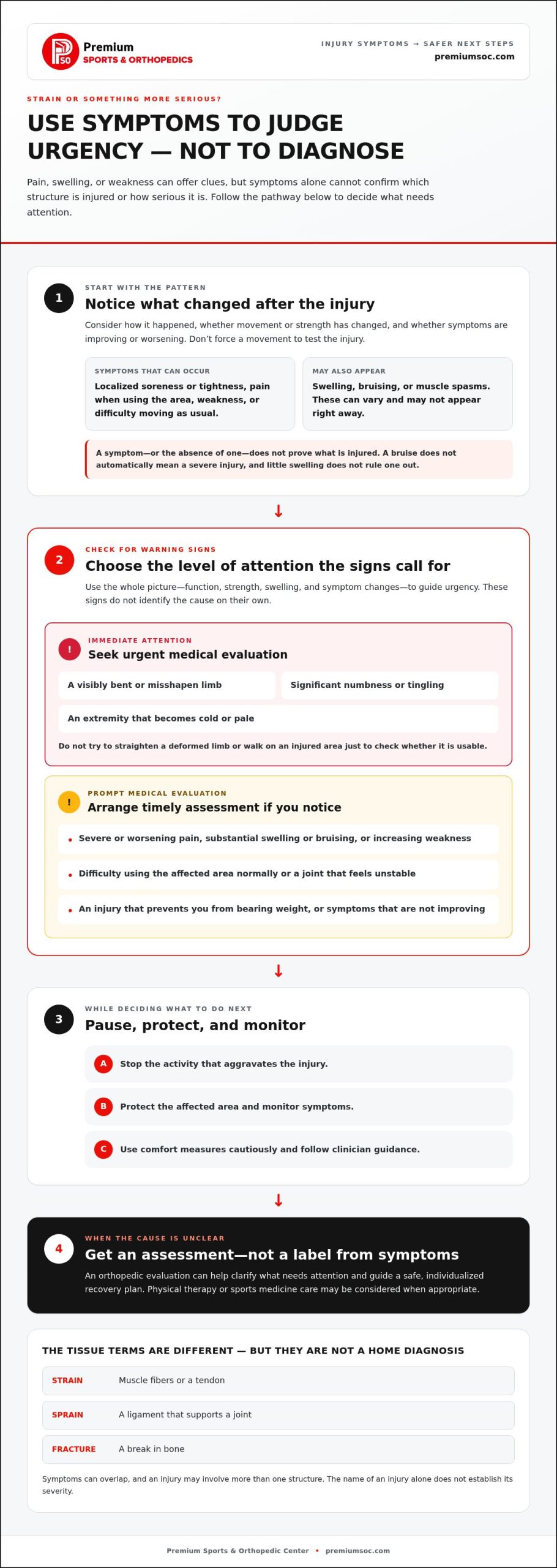
A strain affects a muscle or the tendon that connects muscle to bone. A sprain affects a ligament, the strong band of tissue that connects bones at a joint. A fracture is a break in a bone. These terms describe different structures, but symptoms can overlap, so they can’t confirm an injury on their own.
What tissue does a strain affect?
Muscles contract to create movement, while tendons transfer that force to bones. Either can be stretched or damaged when pulled beyond its capacity, used repeatedly without enough recovery, or exposed to a sudden force. A strained calf might follow a fast push-off, while a lower-back muscle may become painful after lifting or repeated bending. The location and activity offer context, not proof of exactly what’s injured.
Strains can involve muscle fibers, a tendon, or both. The Strain (injury) overview discusses causes and degrees of muscle strain, but an individual injury still needs to be considered in context. Even familiar soreness can have more than one possible cause.
Why the word strain does not settle how serious it is
Strains vary in how much tissue is affected and how much they limit everyday function. One person may feel tightness but move comfortably; another may have marked weakness or difficulty using the affected area. Pain intensity matters, but it doesn’t reliably identify the injured structure or establish how extensive the damage is. A painful injury isn’t automatically a severe strain, and tolerable pain doesn’t rule out a more significant problem.
“Strain names the tissue involved; it doesn’t provide a definitive diagnosis or measure the injury’s seriousness.” That distinction is central to the strain vs serious orthopedic injury question. How the injury happened, changes in movement and strength, and a clinician’s assessment all help put symptoms in perspective.
Keep the terms clear, but don’t rely on the label alone:
- Strain: affects muscle fibers or a tendon.
- Sprain: affects a ligament that supports a joint.
- Fracture: involves a break in bone.
These categories aren’t a home diagnosis checklist. A sudden twist, for example, can injure more than one structure, and swelling or discomfort can occur with different injuries. If symptoms are concerning or normal movement is affected, an orthopedic evaluation can help clarify what needs attention and inform a safe recovery plan.
Symptoms of a Strain vs. Signs of a More Serious Injury
After an injury, the pattern of symptoms can help you decide how quickly to seek care, but it can’t identify the injured tissue with certainty. A strain may cause localized tenderness, pain when using the affected muscle, weakness, or difficulty moving through your usual range. Similar symptoms can occur with other orthopedic injuries, so consider how your strength and function have changed, not just where it hurts.
Symptoms that can occur with a strain
A strained muscle or tendon may feel sore or tight, especially when you contract or stretch the area. Swelling, bruising, or muscle spasms can occur, but they vary and may not appear right away. The Mayo Clinic’s guide to muscle strain symptoms and causes describes symptoms across different levels of strain. No single symptom, or lack of one, proves what you’ve injured.
Pay attention to what you can comfortably do. Can you lift your arm, bend your knee, grip an object, or walk as you normally would? A change in movement or strength matters, even if the pain seems manageable. Avoid forcing a movement to test the injury. That can aggravate symptoms and still won’t provide a reliable diagnosis.
When pain or loss of function deserves prompt attention
Seek prompt medical evaluation for severe or worsening pain, substantial swelling or bruising, increasing weakness, or difficulty using the affected area normally. A joint that feels unstable or an injury that prevents you from bearing weight also warrants timely assessment. If symptoms aren’t improving, an orthopedic consultation can evaluate how the injury affects movement and function.
Some warning signs call for immediate attention rather than waiting to see how the injury develops. A visibly bent or misshapen limb, significant numbness or tingling, or an extremity that becomes cold or pale needs urgent medical evaluation. These changes can signal a serious problem, but they don’t identify its cause on their own. Don’t try to straighten a deformed limb or walk on an injured area just to check whether it’s usable.
Use symptoms as a guide to urgency, not as a home diagnosis. A bruise doesn’t automatically mean a severe injury, and the absence of dramatic swelling doesn’t rule one out. Consider the whole picture: the force or movement that caused the injury, whether function has changed, and whether symptoms are getting better or worse. If you’re unsure about the level of concern, an orthopedic injury assessment can help you discuss a safe next step.
How Clinicians Assess a Strain and Rule Out Other Injuries
Sorting out strain vs serious orthopedic injury takes more than matching a symptom to a checklist. A clinician considers how the injury occurred, what has changed since, and which movements or activities are now difficult. That context guides a focused assessment and helps determine whether more evaluation is needed. Symptoms provide clues, but they don’t confirm a specific injury on their own.
What an orthopedic assessment may involve
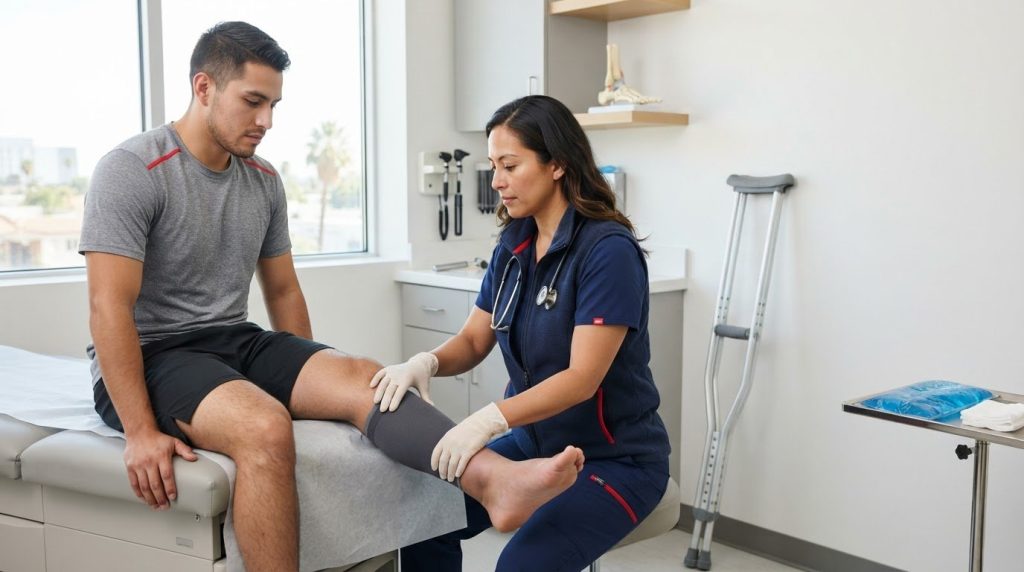
The conversation may cover the movement or impact that caused the problem, when symptoms began, and whether they’ve changed. Share what you were doing, where you feel discomfort, and which tasks have become harder, such as reaching overhead, gripping, or walking. Your usual work, sports, and activity goals can also make the recovery discussion more relevant.
The clinician may assess the affected area by checking movement, tenderness, strength, and function as appropriate. The examination is tailored to your symptoms and the body part involved; an assessment of a shoulder won’t be identical to one of an ankle or back. Don’t try to reproduce painful movements or perform home tests as a substitute for professional evaluation.
When imaging may be considered
Imaging isn’t automatically needed for every strain, and it isn’t ruled out simply because an injury seems like a muscle problem. The decision depends on the history and examination, including whether the findings raise concern for a fracture or another structural injury. An X-ray is commonly used to assess bone. It doesn’t show soft tissues such as muscles and tendons in the same way that other imaging methods can.
If the assessment suggests that further detail about soft tissue or another structure is needed, a clinician may consider additional imaging, such as MRI or ultrasound. The right approach depends on what question the evaluation needs to answer, not on a one-size-fits-all testing rule.
Imaging should follow the clinical question: assessment findings guide whether a scan is useful and which type may help. A scan is one part of the picture. Its findings need to be considered alongside the injury mechanism, symptoms, and physical assessment to guide next steps.
You can make the evaluation more useful by describing what you can and can’t do, whether symptoms are changing, and any prior injury in the same area. An orthopedic consultation can assess your symptoms and discuss an individualized recovery plan. For broader clinical support and initial guidance, private medical services such as Ready Health offer accessible healthcare options to address concerning symptoms. This gives you a clearer path forward without relying on guesswork or assuming every injury needs the same test.
What to Do After an Injury and When to Seek Care
In the first moments after an injury, focus on protecting the area rather than proving how much it can tolerate. Continuing to run, lift, or push through pain can aggravate symptoms, while pausing gives you a chance to notice how the injury affects movement. A simple plan can help you respond safely as you decide whether the strain vs serious orthopedic injury question needs professional assessment.
Immediate steps that avoid worsening the injury
Stop the activity that triggered or increases the pain. Support the injured area in a comfortable position, and avoid unnecessary movement or pressure. Don’t repeatedly stretch, massage, or test it to see whether it has improved. If a measure increases pain or brings on numbness, tingling, or unusual color or temperature changes, stop and seek medical advice.
For comfort, you might try a wrapped cold pack for a short period, keeping it off bare skin. Stop if the area becomes numb or the cold causes more pain. Gentle compression or elevation may feel supportive for some injuries, but avoid tight wrapping or any position that causes discomfort. These measures are not a substitute for evaluation, and clinician guidance should take priority.
As you monitor symptoms, note whether swelling or bruising changes and whether ordinary tasks become easier or harder. Avoid returning to strenuous activity just because pain briefly settles. A gradual return should depend on how the injury is doing and, when needed, guidance from a clinician.
When to arrange an orthopedic evaluation
Arrange a timely orthopedic assessment if symptoms persist, worsen, return repeatedly, or limit normal movement and everyday activities. An evaluation can help clarify what may be contributing to the problem and support a recovery plan that fits your needs. For an injury connected to exercise or sport, this Fresno sports medicine care guide explains how sports medicine support relates to active recovery.
Some signs call for urgent medical care rather than a routine appointment. Seek immediate evaluation for severe pain, an inability to walk more than a few steps after a lower-body injury, significant numbness or tingling, a limb that looks bent or misshapen, or an extremity that becomes cold or pale. Don’t try to straighten a deformed area or force movement. If you’re uncertain how urgent the symptoms are, choose prompt medical guidance rather than testing the injury at home.
If symptoms are not urgent but are interfering with your work, exercise, or daily routine, an orthopedic consultation can assess your movement and discuss an individualized next step. Explore orthopedic care for injury assessment as you plan a safe return to activity.
Orthopedic Injury Evaluation and Recovery Support in Fresno
After an injury, it’s natural to wonder whether to wait, change your routine, or seek an assessment. An orthopedic consultation in Fresno can help evaluate pain, movement, and how symptoms affect daily activities. It’s also a chance to discuss what you want to return to, whether that means walking comfortably, getting back to work, or resuming a sport. Seeking an evaluation doesn’t mean the injury is necessarily severe; it’s a practical way to make an informed next-step plan.
Matching evaluation and recovery support to the injury
A clinician considers your symptoms and examination findings alongside your priorities. Sports medicine consultations and orthopedic care can help shape a recovery discussion around the affected area and your activity goals. If back discomfort is limiting bending, lifting, or other daily movement, the Fresno back pain relief guide offers information relevant to that concern.
Recovery support should fit the individual, not a generic timeline. If restoring movement and function is part of the care plan, physical therapy may support rehabilitation. The focus can be on practical goals, such as moving more comfortably or rebuilding confidence with everyday activities, while adjusting the plan to the person’s needs. Symptoms alone can’t determine a particular treatment or timeframe.
Take a confident next step toward recovery
Make an assessment more useful by describing the movement or event that started the symptoms, how they’ve changed, and which activities are now difficult. Mention whether discomfort improves or worsens with certain movements, and share relevant goals, such as returning to a job task or recreational activity. These details give the clinician context for discussing your options.
If you’re still weighing strain vs serious orthopedic injury, remember that an evaluation is a step toward clarity, not a prediction that something serious is wrong. It can help you understand what needs attention and discuss an individualized recovery plan. For people in Fresno and nearby Clovis, orthopedic care, sports medicine consultations, and physical therapy provide relevant support as recovery needs are considered.
Take an informed step toward recovery by exploring orthopedic care at Premium Sports & Orthopedic Center.
Take the Next Step Toward Confident Movement
Uncertainty about strain vs serious orthopedic injury doesn’t have to leave you stuck between ignoring discomfort and assuming the worst. Treat your next step as a chance to get informed: consider what you need to do comfortably again, and bring that goal into a conversation about your care.
For people in the Fresno area, orthopedic and sports medicine consultations can help guide that discussion. When appropriate for an individual care plan, physical therapy and muscle recovery treatments may support rehabilitation. The right approach depends on your needs, so focus on a path that respects your symptoms and the activities you hope to return to.
You don’t need to have all the answers before seeking guidance. A thoughtful evaluation can help you move forward with greater clarity and confidence. Explore orthopedic care at Premium Sports & Orthopedic Center and take a positive step toward feeling and moving better.
Frequently Asked Questions
Can a strain be a serious orthopedic injury?
Yes, a strain can be serious if muscle or tendon damage substantially affects strength and function. The word “strain” identifies the type of tissue involved, not how extensive the injury is. For example, difficulty using a limb after a sudden force deserves attention even if you suspect a pulled muscle. In the strain vs serious orthopedic injury question, a clinician’s assessment helps distinguish a less extensive strain from an injury needing more care.
Can you have a serious injury without severe pain?
Yes. Pain intensity alone can’t reliably show how serious an injury is or identify what’s damaged. Notice function too: new weakness, instability, or difficulty moving or using the area can be concerning even if pain feels manageable. Also watch for numbness, tingling, or unusual color or temperature changes. If these symptoms appear after an injury, seek medical guidance rather than relying on pain as your only measure.
Does a strain always cause bruising or swelling?
No. Bruising and swelling can occur with a strain, but they don’t happen in every case and may vary in appearance or timing. Their presence doesn’t prove that a strain is the cause, either. Soreness after exercise without visible bruising, for instance, still doesn’t confirm what tissue is affected. Pay attention to changes in comfort and function, and seek an assessment if symptoms worsen or interfere with everyday tasks.
How long should strain pain last before you seek care?
Consider seeking medical advice if symptoms aren’t improving after a few days, or sooner if pain is severe or function is limited. If an injury hasn’t improved after five days, consult a clinician. Don’t wait for that point if symptoms are worsening or concerning. For ongoing pain affecting work, sleep, or daily movement, an orthopedic consultation in Fresno can assess the issue and discuss appropriate next steps.
Can you walk on a strained leg?
It depends on your symptoms, and walking shouldn’t be used to prove the injury is minor. Avoid forcing steps if walking increases pain or feels unstable. If you can’t walk more than a few steps after a leg injury, seek prompt medical evaluation. If walking is possible but remains uncomfortable or your function is reduced, arrange an assessment before returning to exercise or other demanding activity.
Do you always need an X-ray for a suspected strain?
No. A suspected strain doesn’t automatically call for an X-ray, which is generally used to assess bones rather than provide a complete view of muscles and tendons. A clinician decides whether imaging is useful after considering how the injury happened and the examination findings. Depending on the concern, another imaging method may be considered. The goal is to answer a clinical question, not to order a scan by default.
When should I seek emergency care for an orthopedic injury?
Seek emergency medical care for severe pain, a visibly misshapen limb, significant numbness or tingling, or an injured extremity that becomes cold or pale. Inability to walk more than a few steps after a leg injury also warrants immediate evaluation. Don’t try to straighten a deformed limb or force movement. For symptoms that are concerning but not an emergency, arrange timely medical assessment instead of continuing activities that aggravate them.