 21 Oct 2026
Hip pain that changes how you walk or move deserves a clear assessment, not guesswork. A hip pain specialist in Fresno, CA can evaluate your symptoms by reviewing your medical history, examining your hip and thigh, and considering imaging such as X-rays or other scans. Surgery is not the first step for every cause of hip pain, so identifying what is behind it matters.
It’s understandable to wonder whether care will ease your pain or whether it signals a problem that needs more attention. This article explains how specialists assess hip pain, which conditions may contribute to it, and when to seek care or consider a surgical evaluation. You’ll also learn how hip and shoulder pain can affect movement, what treatment may involve, and how an assessment can help guide decisions about comfort and activity goals.
Key Takeaways
- A focused assessment can connect your symptoms and movement limits with findings from an examination and imaging.
- Recognizing how arthritis and bursitis differ can help you better understand possible sources of hip discomfort.
- Changes in everyday movement may offer useful clues about how hip pain is affecting your function.
- Hip discomfort can occur alongside pain in other areas, so consider the full pattern of symptoms when seeking care.
- Learn what factors may shape the next steps, including when specialist care or a surgical evaluation may be considered.
Pain assessment and diagnostic testing
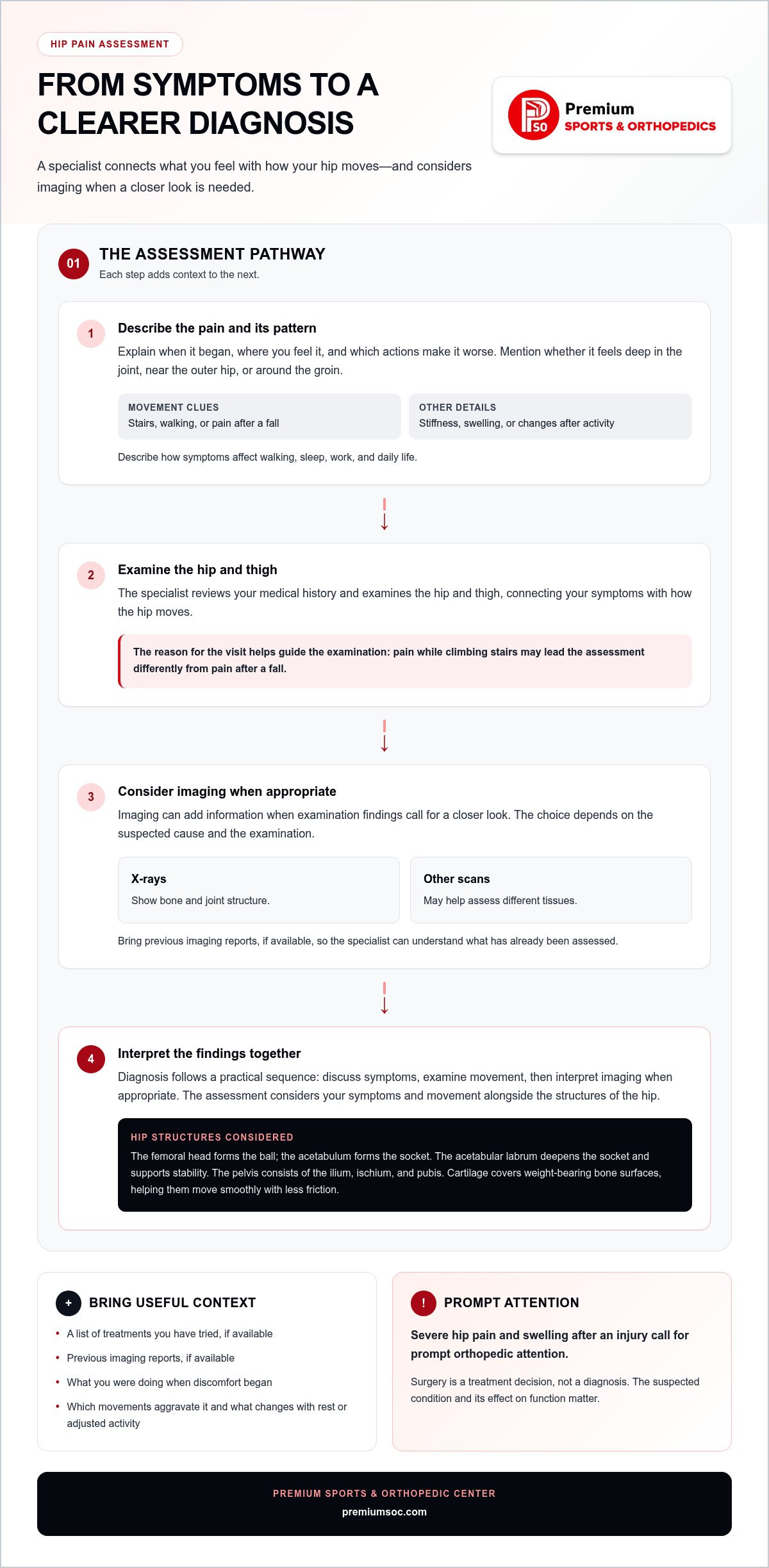
A hip pain specialist in Fresno, CA starts by connecting your symptoms with how your hip moves. The assessment usually includes your medical history and a physical examination of the hip and thigh. Describe when the pain began, where you feel it, and which actions make it worse. For example, pain while climbing stairs may guide the examination differently from pain after a fall. Explain how symptoms affect walking, sleep, work, and daily life.
Imaging can add information when examination findings call for a closer look. X-rays show bone and joint structure; other scans may help assess different tissues. The choice depends on the suspected cause and examination findings. Bring previous imaging reports and a list of treatments you’ve tried, if available. This helps the specialist understand what has already been assessed and what questions remain.
Hip anatomy helps explain why pain can feel different from person to person. The femoral head forms the ball, and the acetabulum forms the socket. The acetabular labrum deepens the socket and supports stability. The pelvis consists of three bones: the ilium, ischium, and pubis. Cartilage covers weight-bearing bone surfaces, helping them move smoothly with less friction. A diagnosis considers these structures alongside your symptoms and movement.
Diagnosis follows a practical sequence: discuss symptoms, examine movement, then interpret imaging when appropriate. Tell the specialist whether pain feels deep in the joint, near the outer hip, or around the groin. Mention stiffness, swelling, or changes after activity. Severe hip pain and swelling after an injury call for prompt orthopedic attention. Surgery is a treatment decision, not a diagnosis; the suspected condition and its effect on function matter.
Do Fresno hip pain specialists require a referral? Referral requirements depend on the clinic’s intake policy and your insurance plan. These rules determine whether you can book directly or need a referral first.
What are the top-rated hip pain specialists in Fresno, CA? No single rating identifies the best specialist for every patient. Compare relevant orthopedic credentials, experience with hip conditions, and how clearly the clinician explains assessment and treatment options.
Where are Fresno hip pain specialists located, and what are their phone numbers? Specialists see patients at individual clinic locations, each with its own address and phone number. Use the specific clinician’s official contact listing for current scheduling details.
Which Fresno hip specialists accept my insurance or Medicare? Acceptance varies by specialist, insurance plan, and Medicare arrangement. Coverage also depends on the service and plan terms, which shape your options.
How soon can I get an appointment with a hip pain specialist in Fresno? Appointment timing depends on clinical urgency, referral requirements, and clinic availability. Severe pain and swelling after an injury warrant prompt orthopedic attention.
What credentials and experience should I look for in a hip pain specialist? The Centers for Medicare & Medicaid Services says a hip replacement provider’s training and expertise should come from an accredited residency or fellowship in the applicable specialty or from extensive continuing medical education. Also look for experience assessing hip conditions and clear explanations of diagnostic findings.
Hip arthritis and bursitis
Hip arthritis and bursitis can both disrupt walking, exercise, and everyday comfort, but they affect different areas. Broadly, arthritis assessment focuses on the joint, while bursitis assessment considers the tissues around it. This distinction guides the examination and helps explain why similar complaints may lead to different care plans. Describe where discomfort occurs and which activities bring it on, such as walking, standing, or climbing stairs.
Joint structure offers useful context. The femoral head meets the acetabulum, and articular cartilage covers weight-bearing bone surfaces, helping them move smoothly with less friction. Arthritis assessment considers the joint and its movement alongside your symptoms. Bursitis assessment looks beyond the joint itself. Tell the specialist whether discomfort feels deep in the hip or closer to the outside, and whether a particular movement makes it worse.
A practical next step is to track symptoms before your appointment. Note what you were doing when discomfort began, which movements aggravate it, and what changes when you rest or adjust activity. For example, if a walk makes pain worse, record the route and when symptoms start. Avoiding activities that worsen hip pain may help prevent aggravation and support quality of life. Adapt your activity, but don’t ignore persistent symptoms.
Assessment findings help shape treatment. A specialist considers your symptom pattern, examination, and imaging findings when assessing whether arthritis, bursitis, or another issue may explain the pain. Care may start with approaches that address activity and function; surgery is considered separately, based on the condition and its impact. Ask how each proposed step relates to your diagnosis and what changes should prompt follow-up. Clear answers make the plan easier to understand.
Which orthopedic surgeons in Fresno perform hip replacement and hip arthroscopy? For either procedure, look for an orthopedic surgeon whose training applies to the operation. According to the Centers for Medicare & Medicaid Services, relevant expertise comes from an accredited residency or fellowship in the applicable specialty, or extensive continuing medical education.
If hip symptoms are affecting daily movement, orthopedic care can help connect assessment findings with a plan focused on function. Bring your symptom notes and questions about arthritis, bursitis, and the role of surgery to the discussion.
Hip pain and its effect on movement
Hip movement supports everyday actions, from standing up to reaching a step. Pain can change how you perform these tasks, even if you can still move the joint. Notice which action feels limited: putting on shoes, getting into a car, or walking across a room. These examples help explain how symptoms affect physical function, rather than focusing only on pain intensity.
The hip moves in six main ways: flexion, extension, abduction, adduction, circumduction, and rotation. Flexion brings the thigh forward, as when lifting a knee. Extension moves it backward, while abduction moves it away from the body’s midline. Adduction brings it closer. Circumduction traces a circle, and rotation turns the thigh inward or outward. A specialist can assess which motions feel restricted or uncomfortable.
Movement patterns can reveal practical effects. If turning your leg makes pivoting difficult, rotation may be useful to describe. If stepping sideways feels limited, mention abduction. Trouble rising from a chair may involve several actions working together, including hip flexion and extension. These examples don’t identify a diagnosis on their own. They give the specialist specific details to connect with the examination.
Track function through familiar activities. For a few days, note the task that brings on discomfort, the movement involved, and what you needed to change. For example, record whether you shortened your walk, used a handrail on stairs, or avoided bending to reach a low shelf. Share these observations during your assessment. They can clarify which goals matter most, such as walking comfortably or returning to physical activity.
Care plans consider both the cause of pain and the movements you want to regain. Physical therapy may be part of a plan to address mobility and function. Ask how each exercise or activity adjustment relates to your symptoms, and describe any movement that becomes more difficult. Joint tissue repair therapy is another treatment option; its relevance depends on the condition being addressed. Matching care to the assessment keeps the focus on practical progress, not just a list of exercises.
Hip pain and other pain symptoms
Hip discomfort can occur alongside symptoms in the thigh, groin, or lower back. Location alone doesn’t identify the source, so describe the full pattern to your doctor. Note where pain starts, where it travels, and which actions change it. For example, record whether walking, sitting, or turning your leg brings on discomfort. Include any stiffness or weakness.
Muscles around the pelvis and upper leg help move the hip, so their role matters during assessment. The iliopsoas extends from the lower back and pelvis to the upper femur and helps flex the hip. The hamstrings help extend it by pulling it backward. The gluteus minimus, gluteus maximus, and gluteus medius attach at the back of the pelvis and insert into the femur’s greater trochanter.
Nerves also run through the hip region. The femoral nerve lies at the front of the femur, the sciatic nerve runs behind it, and the obturator nerve is another main nerve in the area. Tell your doctor if symptoms extend beyond the hip, such as discomfort along the thigh. These details help frame the assessment, but don’t establish a diagnosis by themselves.
Use a brief symptom log to make the pattern easier to explain. For each episode, write down the activity, the area affected, and what changed afterward. A walk followed by thigh discomfort, for example, gives a clearer account than saying only that your hip hurts. Also note whether symptoms affect stairs, standing, or sleep. Concrete examples help connect pain with everyday function.
Other pain symptoms deserve attention too. If you have both hip and lower-back discomfort, describe each separately and explain whether one activity affects both. The iliopsoas connects the lower back and pelvis with the upper femur, while the hamstrings contribute to hip extension. A doctor can consider these structures alongside your symptom history and examination instead of assuming every nearby ache has the same cause.
After an injury, severe hip pain and swelling warrant prompt orthopedic attention. For other patterns, share your symptom log and ask how the findings guide next steps. Muscle recovery treatments may be relevant to muscle-related concerns, while the appropriate approach depends on the assessment. Avoid activities that clearly worsen your symptoms until you’ve discussed their effect on movement with a medical professional.
Focus on changes over time as well as location. Note whether back discomfort and hip symptoms appear together, separately, or after the same activity, and whether rest changes either one. Bring those observations to an appointment, including what you’ve already tried and whether it helped. This gives your clinician a more complete picture without treating a pattern as proof of a cause.
Specialists at Premium Sports & Orthopedic Center note that a primary care physician may refer a patient to a pain management doctor when chronic back pain does not improve with over-the-counter medications or other treatments.
Hip and shoulder joint pain
Hip and shoulder pain can affect different movements, so describe each area clearly during an assessment. The hip forms where the femur meets the pelvis and provides stability and support. The shoulder also enables many daily movements, but symptoms there don’t automatically explain hip discomfort. Note whether both areas hurt, when each began, and which tasks are affected, such as walking, reaching overhead, or getting dressed.
The hip is the body’s largest weight-bearing joint, which helps explain its role in standing and walking. Hip movements include flexion, extension, abduction, adduction, circumduction, and rotation. Shoulder discomfort may be most noticeable during another task, such as lifting an arm to reach a shelf. Recording the specific movement that causes discomfort in each joint gives a clearer picture than describing both as general joint pain.
Try a simple two-part symptom record before speaking with a doctor. For the hip, note whether walking, stairs, or turning your leg changes the pain. For the shoulder, note whether reaching, lifting, or getting dressed affects comfort. Add when symptoms occur and what you were doing. This helps keep the hip and shoulder histories distinct while showing how each condition affects function.
During an assessment, explain whether symptoms started together or at different times. A fall followed by hip and shoulder pain, for example, is useful context. So is a pattern where hip discomfort appears during walking while shoulder discomfort occurs during reaching. These examples don’t prove a shared cause. They help an orthopedic surgeon or other clinician understand the timeline, affected movements, and questions that need attention.
Relief depends on identifying what is driving each symptom and how it limits activity. An assessment may include separate checks of hip and shoulder movement, with imaging considered when findings call for it. The hip’s femoral head and pelvic socket can be assessed in relation to hip symptoms. Don’t assume one treatment or activity change addresses both joints. Ask how each recommended step relates to the specific joint and movement involved.
Set practical goals for both areas. You might aim to walk comfortably while regaining the ability to reach a cupboard, for example. Share those goals and your symptom record during the appointment. If one area causes severe symptoms or follows an injury, say so clearly. A focused discussion helps prioritize care, clarify whether further assessment is needed, and center decisions on movement and daily quality of life.
For hip pain, an ice pack on the affected area for about 15 minutes may reduce pain and swelling. Stretching the quadriceps and hamstring muscles may help improve hip pain.
Premium Sports & Orthopedic Center: Knee Pain
Premium Sports & Orthopedic Center provides orthopedic care and sports medicine consultations for people whose knee pain limits walking, exercise, or daily activities. An assessment can help clarify your symptoms and identify practical next steps for movement and function. If discomfort involves your knee alongside other pain, such as back, leg, or hand pain, describe how each area affects your routine.
Bring a clear account of when the pain began, which movements aggravate it, and what activities you’ve had to change. These details can guide a focused discussion about care. For an injury causing severe pain or swelling, seek prompt orthopedic attention.
For help exploring orthopedic care or a sports medicine consultation, contact Premium Sports & Orthopedic Center or visit premiumsoc.com.
Take the Next Step Toward Easier Movement
Persistent hip discomfort can make everyday choices harder, from staying active to managing routine tasks. Use what you’ve noticed about your symptoms and movement to guide a focused conversation with a healthcare professional. A hip pain specialist in Fresno, CA can assess your concerns and discuss possible next steps based on your needs.
Premium Sports & Orthopedic Center provides care for knee, back, and leg pain, alongside orthopedic care. If discomfort in these areas also affects your mobility, discuss how it fits into your overall care needs. The right next step depends on the symptoms and goals you bring to the conversation.
When you’re ready to explore care, contact Premium Sports & Orthopedic Center. A thoughtful assessment can help you move forward with greater clarity and keep your attention on the activities that matter to you.
Frequently Asked Questions
When Should I Seek Surgery or Other Care From a Hip Specialist?
Seek specialist care when hip pain interferes with daily activities, persists, or follows an injury. Surgery is considered after an assessment identifies a condition and shows how it affects movement and function. For example, difficulty walking to work or managing stairs is useful context for a consultation. Discuss which care options address your diagnosis and goals, and ask how their expected benefits and risks compare.
Which Doctors Specialize in Hip Pain in Fresno, CA?
Orthopedic specialists assess joint and movement problems, while orthopedic surgeons can evaluate whether an operation is appropriate. In Fresno, look for relevant specialty training and experience with the hip concern you want addressed. The Centers for Medicare & Medicaid Services identifies accredited residency or fellowship training in the applicable specialty, or extensive continuing medical education, as relevant expertise. Ask how the clinician approaches diagnosis and explains options.
Which Fresno Specialists Treat Hip Pain Without Surgery?
Orthopedic clinicians and sports medicine professionals can assess hip symptoms and discuss non-surgical care. Depending on the assessment, care may include physical therapy, activity adjustments, or other conservative approaches. Premium Sports & Orthopedic Center provides orthopedic care, sports medicine consultations, and physical therapy. If your goal is to avoid surgery, explain which activities you hope to resume and ask how proposed care supports those goals.
When Should Hip Pain Be Treated as an Emergency?
Severe hip pain and swelling after an injury call for prompt orthopedic attention. Contact an orthopedic surgeon promptly rather than treating these symptoms as routine soreness. Be ready to explain how the injury happened, where swelling appeared, and whether movement has changed. If symptoms are severe, prioritize urgent assessment over waiting to see whether ordinary activity changes help.
What are the top-rated hip pain specialists in Fresno, CA?
No single rating establishes the best specialist for every patient. Compare relevant orthopedic credentials, experience with hip conditions, and how clearly the clinician explains assessment and treatment options.
Which orthopedic surgeons in Fresno perform hip replacement and hip arthroscopy?
Look for an orthopedic surgeon with training applicable to the procedure, such as an accredited residency or fellowship in the relevant specialty, or extensive continuing medical education.