 20 Oct 2026
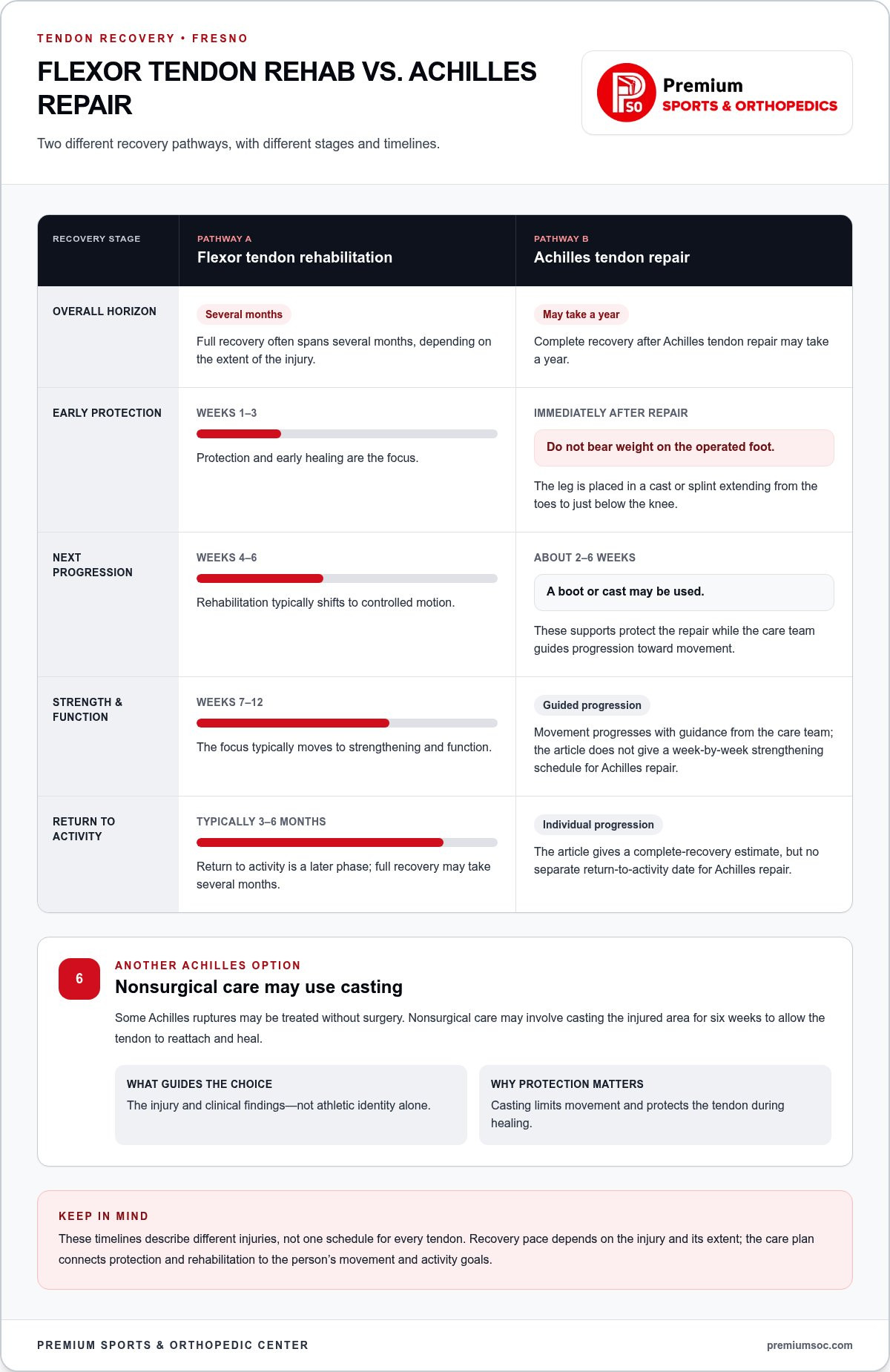
For tendon injury recovery in Fresno, a flexor tendon injury often takes several months to heal fully, while complete recovery after Achilles tendon repair may take a year. Flexor tendon rehabilitation typically moves from protection during weeks 1-3 to controlled motion during weeks 4-6, then strengthening and function during weeks 7-12, before a return-to-activity phase that can take 3-6 months.
It’s natural to want a clear date for getting back to work, sports, or everyday routines. But tendon injury recovery is a gradual progression, not a single finish line. Movement and strength improve in stages, and physical therapy may help restore mobility after treatment.
This article explains how tendon injuries are evaluated, when surgery may be part of care, and what recovery can involve for flexor tendon and Achilles injuries. You’ll also learn how physical therapy supports comfortable movement and a safe return to activity.
Key Takeaways
- A physical exam helps assess tendon function, while the Thompson test and imaging can help clarify suspected Achilles injuries.
- Sudden pain, limited movement, or signs of nerve involvement can help signal when an injury needs prompt evaluation.
- Some tendon injuries require surgery to restore the tendon’s position; recovery then follows staged protection and rehabilitation.
- Therapy progresses from protecting the injury to rebuilding motion, strength, and everyday function.
- Learn what factors shape a return to sports and how orthopedic care can support recovery in Fresno.
Physical examination, Thompson test, ultrasound, and MRI
A focused exam starts with where the injury is, how it happened, and which movements feel limited. The clinician may compare both sides, check for tenderness and swelling, and assess whether you can move the affected joint against resistance. Difficulty bending a finger or pushing off through the foot, for example, helps show how the tendon affects function. These findings guide diagnosis and treatment.
For a suspected Achilles injury, the Thompson test checks how the tendon responds to a calf squeeze. With your foot free to move, the examiner squeezes your calf and observes whether the foot points downward. The result is considered alongside your symptoms and physical exam, not as a complete picture by itself. Ultrasound can show tendon structure in real time, while MRI provides detailed images to help assess the injury’s location and extent.
Imaging can clarify what the exam suggests and help inform the care plan. Your clinician may consider ultrasound or MRI when symptoms and examination findings call for a closer look. The results can shape rehabilitation decisions, including which movements need protection and how physical therapy can progress. A personalized plan connects the diagnosis to daily goals, such as walking comfortably or returning to a sport.
Physical therapy can support recovery after treatment by helping restore mobility. Flexor tendon rehabilitation commonly follows distinct phases: protection and early healing during weeks 1-3, controlled motion during weeks 4-6, and strengthening and function during weeks 7-12. Return to activity typically takes 3-6 months, while full recovery often spans several months depending on injury extent. Achilles repair recovery follows a different course; complete recovery may take a year. These timelines describe different injuries, not a single schedule for every tendon.
California allows patients to schedule physical therapy without a referral, although some insurance plans may require one for coverage. Coverage for tendon injury diagnosis or surgery depends on your plan’s terms, so review your benefits. Knowing the difference can help you plan access to care and understand what your policy may cover.
Scar management may also matter after tendon surgery. Once the incision has healed and the treating clinician approves, a physical therapist can assess whether scar tightness affects nearby movement and address it during rehabilitation. The next step is to connect exam findings, imaging when appropriate, and functional goals. This coordinated approach helps guide recovery from diagnosis toward everyday movement and comfort.
Surgical treatment for tendon injuries
A tendon that has torn or moved out of position may need surgical repair. Tendon injuries typically do not repair themselves, and surgery may be needed to reattach the tendon in the correct position. The decision depends on the injury’s location and extent, tendon function, and the person’s goals. For an athlete, those goals may include rebuilding mobility for a specific sport. Surgery is one part of a broader treatment plan, with protection and rehabilitation shaping the next steps.
Achilles tendon repair is usually performed as an outpatient procedure under a nerve block and sedation. Immediately afterward, patients are advised not to bear weight on the operated foot. The leg is placed in a cast or splint, extending from the toes to just below the knee. After about 2 to 6 weeks, a patient may be placed in a boot or cast. These supports protect the repair while the care team guides progression toward movement.
Some Achilles ruptures may be treated without surgery. Nonsurgical care may involve casting the injured area for six weeks to allow the tendon to reattach and heal. Casting limits movement and protects the tendon during that period. The choice between casting and surgery depends on the injury and clinical findings, not athletic identity alone. Either approach requires careful follow-through, because everyday activities can strain an unprotected tendon.
Nonsurgical treatment can also involve protecting the injured area and limiting actions that aggravate symptoms. A treatment plan can pair protection with a gradual return to movement and rehabilitation. The appropriate pace depends on the injured tendon and how its function changes. For example, discomfort during a particular movement may lead the clinician to adjust that activity while preserving safe motion elsewhere. Avoid forcing movement through sharp pain.
What about nerve injuries? Mild nerve injuries may heal over time when supported. Numbness, weakness, pain, muscle atrophy, skin-color changes, or changes in sweating can signal nerve involvement. Because nerves and tendons lie near each other, an injury can affect both. Treatment depends on the affected structures and symptoms, and rehabilitation may help restore mobility after treatment. A specialized assessment helps distinguish tendon limitations from nerve-related changes.
Seek prompt medical help for a suspected tendon or nerve injury, regardless of its cause or apparent severity. Extensive bleeding, numbness, or sudden weakness warrants urgent attention. These signs can point to damage beyond the tendon itself, so don’t delay assessment or repeatedly test the injured area through movement.
Monitoring continues as care progresses from protection to movement and function. At follow-up, the clinician can assess pain, movement, and the area’s response to activity, then adjust the treatment plan. A cast, splint, or boot may be part of recovery after Achilles repair. For athletes and non-athletes alike, the aim is to regain useful mobility without putting premature strain on the healing tendon.
After the immediate injury has been assessed and protected, muscle recovery treatments may be relevant to ongoing recovery support.
Sports injury evaluation and diagnosis
A sports injury evaluation starts with how symptoms began. Describe the movement, force, and activity involved, such as pushing off during a sprint or gripping a racket during a tennis swing. Cuts, overstretching, overuse, and excessive pressure can cause tendon or nerve injuries. These details help identify the likely cause and distinguish a single traumatic event from strain that built up through repeated activity.
Next, connect your symptoms with the affected body part and its function. A tendon injury in the hand or arm may make it difficult to bend or fully move the hand, wrist, or arm. Explain which action causes discomfort and what has changed, such as trouble closing your hand after playing a racquet sport. Tendons lie near important nerves and arteries, so extensive bleeding or nerve symptoms also matter during evaluation.
Sports medicine assessment considers more than pain at rest. The clinician may ask how symptoms change during a specific task, then assess movement and strength in relation to your goals. A runner’s push-off, a tennis player’s grip, and a worker’s ability to lift or carry place different demands on the body. This functional context helps shape a personalized treatment plan around the activities you want to restore.
Returning to work, hobbies, or sport is a progression, not a single test. For a manual job, relevant tasks may include lifting, gripping, or reaching. For a sport, assessment can focus on movements that load the injured tendon, such as changing direction or swinging a club. Pain, restricted movement, and strength deficits help show which demands need attention before activity increases.
Sports medicine connects injury care with performance goals. Rehabilitation may progress from controlled movement to sport-specific techniques, while monitoring the tendon’s response. A tennis player, for example, may need to regain comfortable gripping and swinging, while a runner may focus on a steady push-off. The sequence and challenge should reflect the injured tendon, current function, and demands of the activity.
How can you help prevent tendon injuries during sports, exercise, or work? Build activity progressively, use sound technique, and avoid repeatedly forcing a painful movement. For work that involves frequent gripping or lifting, vary the load and movement when possible. During sports, watch for changes in form or function. Persistent difficulty moving a hand, wrist, or arm calls for prompt assessment.
Share your activity goals and specific limitations during evaluation. These details help connect the diagnosis with practical rehabilitation targets, whether your priority is returning to work, enjoying a hobby, or rebuilding sports performance.
How Long Will My Physical Therapy Treatment Take?
Physical therapy duration depends partly on the tendon and the stage of healing. Flexor tendon rehabilitation follows distinct phases: protection and early healing during weeks 1-3, controlled motion during weeks 4-6, and strengthening and function during weeks 7-12. A return-to-activity phase typically takes 3-6 months. These stages show why recovery involves gradual changes in movement and function, rather than a fixed number of appointments.
Therapy may combine therapeutic exercise and manual techniques. Exercise can focus on the motion, muscle control, and strength needed for tasks such as gripping or walking. Manual therapy is hands-on treatment directed at soft tissue or movement. The therapist can connect each activity to a practical goal, such as reaching comfortably or using your hand during daily tasks. Progress should follow the rehabilitation phase, not a push to do more before the tendon is ready.
Balance and vestibular therapy address balance-related needs, which may coexist with a tendon injury but are different from tendon rehabilitation. If an ankle injury affects steadiness while walking, for example, balance tasks may address that functional challenge. Vestibular work focuses on balance symptoms connected with the inner ear. The therapy plan should link each exercise to a specific limitation rather than adding activities without a clear purpose.
Blood flow restriction therapy is a distinct approach used alongside exercise in some rehabilitation settings. It involves applying a pressure cuff during exercise, so a trained professional should direct and monitor it. It does not replace tendon protection or staged rehabilitation. Its role depends on treatment goals and the person’s health needs, not simply a desire to increase exercise intensity.
Pain management can involve adjusting an activity, exercise range, or therapy technique to match the recovery stage. A therapist may change a movement that causes discomfort and work on a more tolerable version. This keeps the focus on function as the tendon progresses through rehabilitation. Report pain changes during specific activities, since those details can help guide the next session.
Injection therapy is a medical treatment, not a physical therapy exercise. If injections are part of a broader care plan, the timing and activity recommendations need to connect with rehabilitation. Physical therapy may be needed after tendon treatment to regain and improve mobility. For Achilles tendon repair, patients may regain full movement by 6 months, while complete recovery may take a year. Those milestones describe different aspects of recovery and don’t mean every person follows the same therapy schedule.
Track progress through practical tasks, such as improved hand movement or steadier walking, alongside the therapist’s assessment. For flexor tendon injuries, the return-to-activity phase typically takes 3-6 months, and full recovery often spans several months depending on injury extent. That timeline helps set expectations while therapy builds movement, strength, and function in a controlled progression.
Where can I find sports medicine or orthopedic tendon injury care in Fresno?
In Fresno, sports medicine consultations and orthopedic care can help evaluate tendon problems. The right starting point depends on how the injury happened and which movements it affects. A sudden loss of function after a sports movement calls for assessment of the injured tendon and surrounding structures. Ongoing symptoms during repeated work or exercise also deserve attention. For tendon injury recovery in Fresno, connect your care plan to the activities you want to regain.
Sports medicine focuses on injuries related to exercise, training, and athletic performance. Orthopedic care addresses musculoskeletal problems involving structures such as tendons and joints. The two can overlap. An ankle tendon injury that limits running, for example, affects everyday mobility as well as sports participation. A hand injury that interferes with gripping can affect work and recreation. Describe these practical limits during an evaluation so the care plan addresses function, not just the injury label.
Premium Sports & Orthopedic Center serves athletes and residents in the Fresno and Clovis areas with sports medicine consultations and orthopedic care. Care includes assessment and treatment for acute and chronic pain affecting the knees, back, legs, hands, shoulders, and ankles. These concerns can affect how you walk, lift, grip, or train. Sharing which activities trigger symptoms helps connect the evaluation with meaningful recovery goals.
When seeking care, prepare a short account of the injury and its impact. Include the movement or event that started the problem, the affected body area, and which daily activities have become difficult. A runner might describe trouble pushing off; a worker might explain difficulty gripping tools. Mention any changes in movement or strength. These details help focus an orthopedic or sports medicine assessment on practical needs and support a personalized treatment plan.
Care may involve more than evaluating the initial injury. Tendon treatment can require a coordinated path from protecting the injured area to rebuilding movement and function. Physical therapy may support mobility after treatment, while sports medicine consultations can connect recovery goals with exercise or athletic demands. Returning to a job that involves lifting, for instance, may call for different functional goals than returning to a sport with repeated running or throwing.
Fresno and Clovis residents looking for a local starting point can explore sports medicine consultations for injury-focused guidance. Bring your activity goals and a clear description of the movements that remain difficult. That conversation can help connect orthopedic assessment with the next stage of care, whether your priority is comfortable daily movement, work tasks, or a return to sport.
Premium Sports & Orthopedic Center: Knee Pain
Premium Sports & Orthopedic Center provides orthopedic care and sports medicine consultations for people managing knee pain and movement concerns. If tendon symptoms affect walking, exercise, or everyday tasks, these services can connect your concerns with an appropriate evaluation and care plan. Bring details about movements that trigger discomfort, any limitations you notice, and the activities you hope to resume. This context makes the conversation specific to your needs, whether you’re an athlete or working toward more comfortable daily movement. For persistent knee discomfort or sports-related concerns, contact Premium Sports & Orthopedic Center to discuss orthopedic care and sports medicine consultations.
Take the Next Step Toward Confident Movement
Your next step can be a clear conversation about what you want to do comfortably again. Note which movements remain difficult, how the injury affects work or recreation, and what progress matters most to you. These details can keep a care discussion focused on your everyday priorities, not just the injury itself. A thoughtful plan for tendon injury recovery in Fresno should connect treatment with the activities you hope to resume.
Premium Sports & Orthopedic Center offers orthopedic care, physical therapy, and joint tissue repair therapy. Care also addresses knee pain, back pain, and leg pain. Share your movement goals and concerns to start a conversation about support suited to your needs.
Contact Premium Sports & Orthopedic Center to discuss your next step. With steady support and a goal-focused approach, you can keep moving toward greater comfort and confidence.
Frequently Asked Questions
What Should I Expect During My First Visit?
Expect to discuss how the injury happened, which movements are difficult, and how symptoms affect daily life. For a Fresno appointment, describe specific tasks, such as climbing stairs, gripping a steering wheel, or pushing off while walking. Bring relevant imaging reports or treatment records if you have them. The clinician can use your history and movement assessment to identify what needs attention and outline practical next steps.
What are common tendon injuries and symptoms?
Common examples include Achilles tendon injuries near the heel and flexor tendon injuries in the hand. Symptoms depend on the tendon and may include pain, tenderness, swelling, or difficulty moving the affected area. A hand tendon injury, for instance, can make it difficult to form a fist or straighten the hand. Numbness or weakness can also suggest nerve involvement, so mention these changes during an evaluation.
How long does tendon injury recovery take by injury type and severity?
Recovery varies with the tendon involved, injury extent, and whether treatment includes surgery. Flexor tendon recovery often spans several months, with return to activity typically taking 3-6 months. After Achilles tendon repair, full movement may return by 6 months, while complete recovery may take a year. These are different milestones, not interchangeable estimates. A more extensive injury can require a longer progression than a less severe one.
What treatments help tendon injuries heal, including rest, physical therapy, and surgery?
Treatment may protect the injured tendon, restore movement through physical therapy, or use surgery to reattach a tendon in the correct position. For a ruptured Achilles tendon, nonsurgical care may involve a cast for six weeks. The right approach depends on the tendon, extent of injury, and functional impact. A hand injury that limits bending, for example, calls for a different plan from an Achilles injury that limits walking.
What is the typical tendon injury rehabilitation timeline and return-to-activity process?
Rehabilitation progresses from protecting the tendon to restoring motion, strength, and activity-specific function. Flexor tendon recovery typically includes protection during weeks 1-3, controlled motion during weeks 4-6, and strengthening during weeks 7-12. Return to activity often takes 3-6 months. Progress toward work or sport should reflect the demands involved, such as repeated gripping, running, or lifting, rather than calendar time alone.
What are the risks of returning to activity too soon after a tendon injury?
Returning before the tendon can handle an activity’s demands may aggravate symptoms or disrupt progress toward restored function. Someone who resumes running before a comfortable push-off may struggle with that movement; someone returning to repeated gripping may find hand function limited. Increase activity in line with rehabilitation goals, and pay attention to changes during specific tasks. Persistent difficulty moving the injured area deserves clinical attention rather than repeated self-testing.
Does health insurance cover tendon injury diagnosis, physical therapy, or surgery in California?
Coverage for tendon injury diagnosis or surgery depends on your plan’s terms. California allows patients to schedule physical therapy without a referral, but some insurance plans may require one for coverage. Review your benefits.