
 08 Oct 2026
What if lasting ankle stability depends on restoring control, not just easing soreness? If your ankle feels weak or unpredictable on a walk, during a workout, or on uneven ground, it’s understandable to worry about another sprain disrupting your routine. Ankle instability physical therapy Fresno care can help address those concerns with a plan focused on movement and function, not simply how the ankle feels at rest.
An ankle may feel unsteady after a sprain or when strength, balance, or coordination hasn’t fully returned. Physical therapy can help identify contributing factors and guide a progressive recovery based on your needs and goals. In this guide, you’ll learn common reasons an ankle can feel wobbly, what an assessment and therapy plan may involve, and when recurring symptoms are worth discussing with a professional. Whether you hope to return to sport or feel more secure in everyday activities, understanding the next steps can help you move forward with greater confidence.
Key Takeaways
- Repeated giving-way or uncertainty on uneven ground deserves attention, though symptoms alone don’t confirm a diagnosis.
- Ankle steadiness can involve strength, balance, coordination, and your body’s awareness of joint movement.
- An assessment may explore your injury history, symptom patterns, daily activities, and goals, along with movement relevant to your needs.
- Physical therapy may progress from foundational mobility and control toward more demanding tasks as appropriate.
- Learn what to prepare for ankle instability physical therapy Fresno and how local care may support your return to valued activities.
What ankle instability feels like, and when it deserves attention
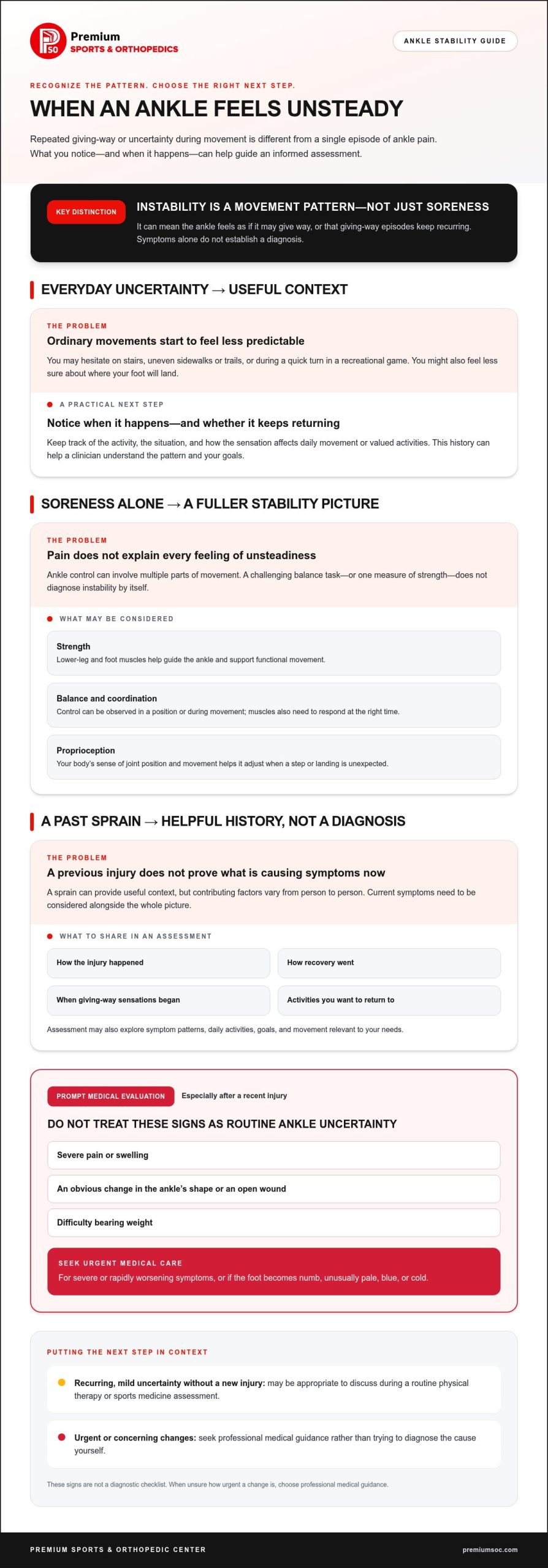
Ankle instability describes a feeling that the ankle may give way, or repeated episodes when it does. You might hesitate on uneven ground, feel less sure placing your foot, or notice the ankle buckle during an activity. These experiences can follow an ankle sprain, but the history and contributing factors differ from person to person. Symptoms alone don’t establish a diagnosis, so recurring or concerning changes deserve an informed assessment.
Ankle instability is a pattern of perceived or repeated giving-way, not simply one episode of ankle pain. Pain can occur with many ankle problems, while instability describes uncertainty or loss of support during movement. A previous sprain is useful context to share, not proof of the cause. The Sprained ankle overview provides background on this common injury and why recovery history may matter.
How recurring ankle instability can affect everyday movement
Small moments can make the concern noticeable. You may take stairs more cautiously, feel unsure walking across an uneven sidewalk or trail, or hesitate when turning quickly during a recreational game. Even routine errands around Fresno can feel different when you’re thinking about where each step will land.
That caution is understandable. Avoiding every movement that feels uncertain, however, may narrow your activity choices and make it harder to feel confident using the ankle. Pay attention to when the sensation occurs, what you were doing, and whether it keeps returning. This practical history can help a clinician understand how symptoms affect your daily life and goals.
When ankle symptoms call for prompt medical attention
Recurring, mild uncertainty without a new injury may be appropriate to discuss during a routine physical therapy or sports medicine assessment. A recent injury with severe pain or swelling, an obvious change in the ankle’s shape, an open wound, or difficulty bearing weight warrants prompt medical evaluation. Seek urgent medical care for severe or rapidly worsening symptoms, or if the foot becomes numb, unusually pale, blue, or cold.
These examples aren’t a diagnostic checklist, and they can’t determine what’s causing your symptoms. If you’re unsure how urgent a change is, choose professional medical guidance rather than trying to diagnose it yourself. Once urgent concerns have been addressed, a physical therapy discussion can help explore recurring instability and its impact on movement. For people searching “ankle instability physical therapy Fresno,” distinguishing a single painful episode from a recurring giving-way pattern is a useful first step.
Why ankle stability involves strength, balance, and movement control
A steady ankle relies on more than the ability to tolerate weight. Your body continually senses where a joint is and how it’s moving, then adjusts muscle activity to help control each step. This sense is called proprioception. It helps you respond when the ground shifts or your foot lands at an unexpected angle, working alongside strength, balance, and coordination.
Ankle stability involves coordinated control through movement, not pain reduction alone. Discomfort matters, but it doesn’t describe every factor that may affect how secure the ankle feels. A clinician may consider how the ankle moves, how you respond to balance challenges, and what demands your daily activities place on it. The areas to focus on depend on your symptoms, injury history, examination, and goals.
The role of prior sprains and confidence in movement
A previous lateral ankle sprain, which affects the outer side of the ankle, can help guide a clinician’s questions. They may ask how it happened, how recovery went, and whether giving-way sensations began afterward. That history offers useful context, but it doesn’t prove the sprain is causing current symptoms. Other factors may be relevant, so assessment should consider the whole picture.
Confidence matters, too. If you worry that the ankle could give way, you may avoid quick turns, uneven paths, or certain recreational activities. That response is understandable, but it can make it harder to judge which movements feel manageable. Discussing the specific situations that cause hesitation helps connect physical assessment with the activities you want to resume.
How balance and strength relate to ankle function
Balance tasks can show a clinician how you control your body in a particular position or during movement. They aren’t a diagnosis by themselves. Performance may vary with fatigue, discomfort, attention, and the task being tested, so a clinician interprets observations alongside your history and other findings.
Muscles in the lower leg and foot help guide the ankle and support functional movement. Their strength is one part of the picture, not a stand-alone measure of stability. Coordination also matters: muscles need to respond at the right time as you step, shift your weight, or change direction. How these elements are assessed depends on the person and activity.
For example, the needs of someone who wants to walk comfortably on neighborhood paths may differ from those of a person returning to court sports. Exercise selection and progression call for individual clinical judgment. A challenging balance drill isn’t automatically the right starting point. With ankle instability physical therapy Fresno, discussing your movement goals can help shape a relevant recovery approach. Premium Sports & Orthopedic Center offers physical therapy for Fresno-area patients, including those addressing ankle symptoms and comfortable movement. Learn about physical therapy care.
What ankle instability physical therapy may assess in Fresno
An assessment begins with your experience, not a one-size-fits-all test. In ankle instability physical therapy Fresno care, a clinician may ask when the ankle feels unreliable, whether symptoms are changing, and what you need to do comfortably. Your account helps put movement observations in context. A balance task, for example, may be interpreted differently depending on whether your main concern is walking, work, or returning to a sport.
Describe what you notice in your own words. “It gives way when I turn” or “I hesitate on sloped ground” can be more useful than trying to name a condition. There isn’t one required set of tests for everyone. The clinician selects assessment activities based on your history, symptoms, and their judgment during the visit.
Questions that help clarify the ankle instability pattern
You may be asked when giving-way happens, which activities bring it on, and whether it began after a sprain or another injury. Share how the ankle recovered, whether you’ve had previous episodes, and any recent changes in activity. Footwear may also be relevant context. Just as important, explain your goals. You don’t need to be an athlete to benefit from an assessment shaped around what matters to you.
How assessment findings shape rehabilitation priorities
A clinician may observe mobility, strength, balance, or movements related to your daily tasks and activities. These observations are considered alongside what you report, rather than treated as proof of a diagnosis on their own. The findings help identify which areas may deserve attention and what starting point makes sense for your needs.
Goals should connect to real life. One person may want to walk comfortably through everyday routines; another may hope to change direction with more confidence during sport. Discussing the exact task makes progress easier to relate to your priorities. The plan’s details depend on examination findings and individual needs, and may be adjusted as your response and goals become clearer.
Before an appointment, consider jotting down a brief timeline: when symptoms began, what tends to trigger them, previous injuries, and activities you’ve changed or avoided. Include questions you want answered, such as which movements the clinician plans to assess and how the findings relate to your goal. These notes can help you use the visit well, especially if it’s hard to recall details in the moment.
If you’re active, ankle assessment is one part of a broader return-to-activity picture. The sports physical therapy guide offers additional context on athletic recovery, while your individual discussion can stay focused on your ankle, movement needs, and next steps.
How physical therapy can progress toward steadier ankle movement
Physical therapy for ankle instability isn’t a fixed sequence of exercises or a promise of a particular result. It’s an individualized process that may start with movements you can manage comfortably and build toward tasks that reflect your daily routine or activity goals. The pace and focus depend on your symptoms, examination findings, and how your ankle responds as activity changes.
Progress isn’t always a straight line. If a new movement brings on discomfort or a sense of giving-way, a clinician can use that response to reconsider the task, its difficulty, or the next step. Adjusting an activity that aggravates symptoms doesn’t necessarily mean stopping all movement. The aim is to find an appropriate activity level with professional guidance.
Early priorities: comfortable movement and foundational control
Depending on your presentation, early priorities may include tolerable ankle motion and greater comfort with basic movements. A clinician may consider what you can do now, what feels uncertain, and which activities need modification while recovery progresses. This isn’t a home-program prescription: specific exercises, frequency, and intensity should reflect your assessment and individual needs.
Foundational control can provide a starting point for more demanding movement. The practical focus might be everyday actions that matter to you, rather than a standard checklist for every patient. If walking or standing tasks feel challenging, share exactly what happens and how your symptoms respond. That information can help guide decisions about what to address next.
Building toward daily activities, exercise, and sport
As appropriate, therapy may advance toward more challenging balance demands, direction changes, or movements related to recreation and sport. A clinician can consider movement quality and symptom response when deciding whether to progress, adapt, or revisit a task. Returning to sport or another demanding activity should be individualized and guided by clinical judgment, not based on a universal timeline.
Think about the goal in practical terms. Is it walking with more comfort, managing work activities, or feeling prepared for the movements your sport requires? Specific goals connect therapy decisions to the life you want to return to. If activity leaves your ankle feeling less secure, report that instead of pushing through or assuming discomfort is expected.
This approach keeps the plan responsive: a task that suits one person may not suit another, and progress depends on your needs and findings. Fresno-area readers looking for ankle instability physical therapy Fresno can consider how individualized physical therapy may support a return to comfortable movement. For broader local recovery information, explore the physical therapy guide for Clovis.
To learn more about physical therapy, visit Premium Sports & Orthopedic Center.
Finding ankle instability physical therapy in Fresno and taking the next step
Recurring ankle symptoms can leave you unsure what to do next. A physical therapy visit offers an opportunity to describe what you’re experiencing, discuss your priorities, and learn what the assessment suggests. You don’t need to arrive with a diagnosis or a complete record. A few clear notes can help you explain the pattern and make the conversation more useful.
What to bring up during a physical therapy visit
Before your visit, jot down when the ankle feels unreliable and what you’re doing at the time. Include previous sprains or other injuries, how the ankle recovered, and any relevant medical history. Note changes you’ve made to work, exercise, or everyday routines, too. Even a short timeline can help organize details that are easy to forget during a conversation.
- Symptoms: Describe when they occur, how they feel, and whether anything seems to bring them on or ease them.
- Injury history: Share what you remember about earlier ankle injuries and recovery.
- Current activity: Mention movements or activities you’ve modified, along with the reason.
- Goals and questions: Identify what you’d like to do more comfortably and ask how progress and symptoms may be monitored.
These notes are a starting point, not a test you need to pass. Be candid if a task makes you hesitant or if your symptoms vary from day to day. Your perspective helps keep the discussion grounded in the activities that matter to you.
Choosing a practical recovery goal in Fresno
A useful goal reflects your life, not someone else’s return-to-sport deadline. You might want to manage daily walking, feel more comfortable with work demands, enjoy recreation, or work toward athletic activity. Naming a specific task gives you and the clinician a shared reference point for discussing options. Goals can also be revisited as your needs or findings become clearer.
Premium Sports & Orthopedic Center provides physical therapy for Fresno-area patients, including people seeking support for ankle symptoms. An evaluation can help inform appropriate options, but it doesn’t guarantee a particular result or schedule. Progress varies with the individual, clinical findings, and response to activity. A thoughtful discussion can clarify what may be relevant for you and what questions remain.
If you’re considering ankle instability physical therapy Fresno, bring your notes and goals to an individualized conversation about movement and recovery. Start with a practical aim, whether that’s feeling more at ease during daily routines or working toward recreation. Learn about physical therapy care in Fresno.
Take a confident next step for your ankle
You don’t have to wait until ankle symptoms disrupt every part of your routine to seek clarity. A conversation about what you want to do next can help turn a general concern into a practical goal, whether that means feeling more comfortable with daily movement or exploring a return to recreation. Keep your focus on steady, sustainable progress rather than comparing your recovery with someone else’s.
For people considering ankle instability physical therapy Fresno, Premium Sports & Orthopedic Center offers physical therapy and sports medicine consultations for the Fresno and Clovis communities. An individualized discussion can help you understand possible next steps based on your needs, while recognizing that progress and recommendations vary from person to person.
When you’re ready to explore local support, explore physical therapy care in Fresno. Each thoughtful step toward understanding your ankle can help you move forward with greater confidence.
Frequently Asked Questions
Can physical therapy help ankle instability?
Yes, physical therapy may help address movement and functional factors related to an ankle that feels unreliable. A clinician can use your symptoms, examination, and goals to guide an individualized plan, then adjust it based on how you respond. Someone who feels uncertain during routine walking may need different priorities from someone preparing for court sports. The purpose is to work toward meaningful activity without assuming the same approach suits everyone.
What causes an ankle to keep giving way?
Repeated giving-way can have more than one contributor, so symptoms alone can’t explain it. A previous sprain may be part of the history, while strength, balance, movement control, or another ankle concern may also merit consideration. Note whether episodes happen during a particular task or without an obvious trigger. A clinician can use that pattern and an examination to help distinguish possible explanations rather than treating one suspected cause as certain.
How long does physical therapy for ankle instability take?
There isn’t one standard timeline for physical therapy for ankle instability. The length of care can depend on your examination findings, symptom pattern, goals, and how your ankle responds as activities progress. Someone working toward comfortable daily movement may have different milestones from someone aiming to resume demanding sport. Ask how progress will be reviewed and which functional changes matter for your goal. A clinician can discuss expectations based on your individual situation.
Is ankle instability the same as a sprained ankle?
No. A sprain is an injury to ankle ligaments, while instability describes a feeling or recurring pattern of the ankle giving way. Instability may be reported after a sprain, but the terms don’t mean the same thing: one describes an injury, the other a movement concern. A sprain doesn’t automatically mean someone will experience ongoing instability, and a feeling of instability doesn’t identify its cause. Assessment can help clarify what may be happening.
When should I see a physical therapist for ankle instability in Fresno?
Consider a physical therapy discussion if ankle uncertainty keeps returning, affects activities you value, or makes you change how you move. You don’t need to wait until sport is affected; difficulty with work or everyday tasks is also a useful reason to seek guidance. For ankle instability physical therapy Fresno, bring a short note about when symptoms occur and what you’d like to do more comfortably. New severe symptoms call for prompt medical evaluation.
Can I exercise if my ankle feels unstable?
Whether to exercise depends on your symptoms, the activity, and your clinical situation. Don’t assume you need to stop all movement, but avoid pushing through an activity that causes the ankle to give way or sharply worsens symptoms. You might temporarily choose a less demanding option while arranging an assessment. A physical therapist can help you discuss suitable activity and how to adapt it, rather than relying on a generic exercise plan.
What happens during an ankle instability physical therapy evaluation?
An evaluation typically begins with a conversation about your symptoms, injury history, health context, and activity goals. Depending on your needs, the clinician may observe ankle movement and tasks related to balance, strength, or daily function. Not everyone completes the same tests. Wear clothing that allows comfortable movement, and bring questions about activities that feel difficult. The findings help inform appropriate next steps, though they don’t guarantee a particular outcome.