 21 Sep 2026
Healing an athletic injury isn’t just about waiting for an isolated joint to quiet down; true recovery demands rebuilding the full-body movement patterns that absorb force and generate power. If you’re struggling with lingering joint or muscle pain, cycling through cookie-cutter exercises at a generic clinic can leave your progress stalled and feed the worry that surgery is your only path forward. Choosing specialized sports physical therapy Fresno athletes trust bridges that divide, transforming passive rehabilitation into proactive, high-level orthopedic care.
You shouldn’t have to settle for basic daily mobility when your goal is returning to sport at your peak. In this 2026 guide, you’ll discover how sports physical therapy in Fresno accelerates injury recovery, restores joint mobility, and enhances athletic performance through personalized, non-surgical solutions. We explore proven recovery pathways, objective return-to-play milestones, and California direct access guidelines so you can confidently take control of your athletic comeback today.
Key Takeaways
- Understand how sports physical therapy Fresno athletes depend on bridges the gap between basic daily function and peak athletic performance.
- Discover how targeted non-surgical orthopedic care resolves persistent knee, shoulder, and ankle injuries by fixing underlying biomechanical faults.
- Learn the structured, five-phase rehabilitation framework that relies on objective strength and movement milestones rather than arbitrary calendar dates to prevent re-injury.
- Explore how pairing manual physical therapy with muscle recovery treatments and joint tissue repair therapy optimizes cellular healing.
- Find out how to choose the right outpatient clinic in the Central Valley and how California direct access laws allow you to start treatment immediately.
What Is Sports Physical Therapy and How Does It Differ from General Rehab?
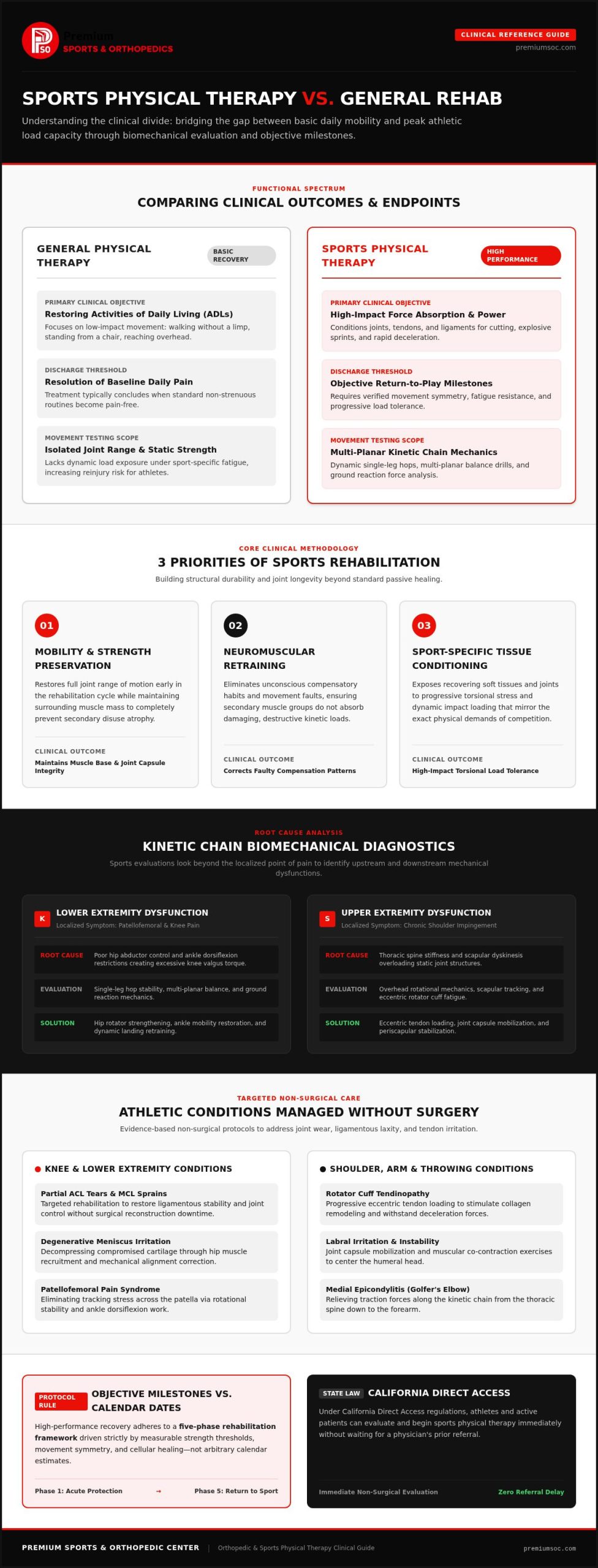
Many patients assume all physical therapy follows the same blueprint. In reality, clinical treatment splits into distinct disciplines designed for entirely different functional outcomes. General rehabilitation centers on restoring basic activities of daily living. It helps people walk without a limp, stand up from a chair comfortably, or reach overhead to open a cabinet. When an athlete or active individual experiences an injury, achieving basic daily mobility is only the first step. Navigating cutting forces, explosive sprints, and sudden decelerations demands a fundamentally higher threshold of physical resilience.
That is where dedicated sports physical therapy Fresno clinics set themselves apart. While traditional care stops once you can move through a normal routine without pain, sports therapy actively conditions your joints, ligaments, and tendons to absorb high-impact athletic loads. Central Valley athletes often struggle when discharged from standard clinics prematurely. Without testing sport-specific movement mechanics under fatigue, the risk of reinjury remains high. High-performance rehabilitation bridges this clinical gap through progressive load management, dynamic balance work, and targeted tissue adaptation within established physical therapy specialties.
Core Objectives of Sports Rehabilitation
Specialized sports physical therapy focuses on building structural durability alongside full joint restoration through three clinical priorities:
- Mobility and Strength Preservation: Restoring full joint range of motion early while maintaining surrounding muscle mass to prevent atrophy.
- Neuromuscular Retraining: Eliminating unconscious compensatory habits, ensuring secondary muscle groups don’t take on destructive loads.
- Sport-Specific Tissue Conditioning: Exposing recovering joints and soft tissues to progressive torsional stress and dynamic impact, matching the true demands of your sport.
The Biomechanical Evaluation Process
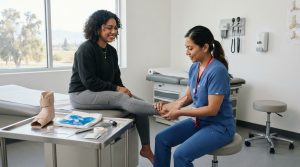
Effective treatment requires stepping back from the localized point of discomfort to analyze how your entire body moves. An athlete with knee pain may actually suffer from poor hip abductor control, while chronic shoulder impingement often stems from thoracic spine stiffness or scapular dyskinesis. During a sports-focused evaluation, clinicians track functional kinetic chains through dynamic single-leg hops, multi-planar balance drills, and ground reaction mechanics. Establishing these objective baseline measurements guarantees your clearance to play relies on verified performance data, keeping you off the sidelines and out of the operating room.
Common Sports Injuries Treated by Fresno Physical Therapists
Central Valley athletes across competitive leagues, high school tournaments, and adult recreation face intense mechanical demands year-round. From rapid deceleration on soccer fields to repetitive torque on the baseball diamond, heavy training loads take a toll. Fortunately, invasive procedures aren’t the only answer for managing common sports injuries. Evidence-based non-surgical protocols allow patients to address joint wear, ligamentous laxity, and tendon irritation directly, avoiding prolonged surgical downtime.
Knee and Lower Extremity Athletic Injuries
Ligament strains and cartilage issues dominate court and turf sports. Targeted physical therapy can effectively rehabilitate partial ACL tears, MCL sprains, and degenerative meniscus irritation without immediate surgical intervention. Clinicians focus on restoring joint stability by strengthening the hip rotators and correcting ankle dorsiflexion restrictions. If persistent aching keeps you off the court, exploring options for knee pain treatment Fresno specialists offer can pinpoint subtle biomechanical faults and relieve patellofemoral stress before damage worsens.
Shoulder, Arm, and Overhead Throwing Conditions
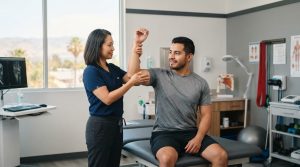
Repetitive overhead mechanics place extreme traction on the upper extremities. Rotator cuff tendinopathy, labral irritation, and medial epicondylitis develop when rotator cuff muscles fatigue and transfer excess force into static joint structures. Through targeted sports physical therapy Fresno practitioners utilize eccentric tendon loading, joint capsule mobilization, and periscapular strengthening. Mobilizing the scapulothoracic joint restores proper gliding mechanics, relieving subacromial impingement during throws, swings, or overhead lifts.
Spine and Core Biomechanics for Runners and Field Athletes
Distance running and rotational sports channel repetitive ground reaction forces straight into the axial skeleton. Without adequate core endurance, this impact leads to lumbar facet irritation, sacroiliac joint dysfunction, and recurring muscular spasms. Clinical rehabilitation rebuilds deep transverse abdominal and gluteal engagement to actively decompress spinal joints. Restoring thoracic spine extension also allows runners to maintain efficient breathing mechanics and posture throughout long-distance training. If stubborn back or joint discomfort is slowing down your active lifestyle, scheduling a comprehensive sports medicine consultation provides a clear, non-invasive roadmap back to full performance.
Sports Physical Therapy vs. General Physical Therapy: Which Do You Need?
Deciding where to take your rehabilitation depends entirely on what your routine demands. If your primary goal is getting back to desk work, walking through Woodward Park, or taking the stairs comfortably, traditional rehabilitation offers a solid foundation. If your life involves cutting across a soccer field, lifting in the gym, or swinging for extra bases, typical exercises won’t provide enough protection. Enlisting specialized sports physical therapy Fresno providers offer bridges the gap between everyday function and dynamic athletic loads. Teaming up with experienced clinicians through targeted sports medicine in Fresno ensures your care matches the physical intensity of your active pursuits.
Evaluating Treatment Goals and Intensity Levels
Standard physical therapy focuses on symptom reduction and baseline independence. Care usually wraps up once you can complete everyday tasks without pain. In contrast, sports rehabilitation follows clinical principles outlined by the American Academy of Sports Physical Therapy, conditioning tissues well beyond baseline comfort thresholds. Sessions feature progressive overload, high-velocity deceleration, and reactive agility drills. Pushing your structural system under controlled fatigue builds the physical reserve needed to withstand game-day stress without re-injury.
Diagnostic and Performance Testing Differences
The tools used to measure your recovery also highlight the clear differences between these disciplines:
- Traditional Clinical Metrics: Relies primarily on table-based muscle grading, passive joint mobility checks, and basic resting pain scales.
- Dynamic Force Analysis: Evaluates ground reaction forces, rate of force development, and bilateral limb symmetry during explosive single-leg hops.
- High-Speed Motion Capture: Pinpoints compensatory movement patterns during sprints, directional changes, and high-impact landings that static tests miss.
Relying on dynamic performance metrics instead of static joint measurements gives you objective proof that your body is ready to return to competition safely.
Phases of a High-Performance Sports Rehabilitation Program
Returning from an athletic injury shouldn’t rely on guesswork or a generic calendar countdown. High-level recovery follows a structured, criterion-based roadmap. Under this model, an athlete advances only after meeting objective functional milestones rather than waiting out arbitrary timeframes. Structured sports physical therapy Fresno programs systematically guide athletes from initial tissue trauma back to dynamic competition, drastically minimizing the risk of secondary setbacks along the way.
Phase 1 and 2: Pain Reduction, Tissue Healing, and Early Mobility
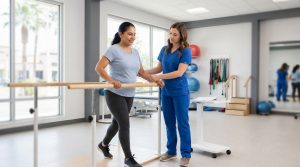
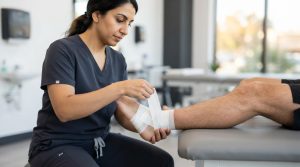
The opening stages prioritize settling joint effusion and calming acute muscle spasms while safeguarding healing tissues. Clinicians utilize hands-on manual techniques alongside targeted muscle recovery treatments to restore passive joint range of motion. Early isometric exercises and light resistance bands maintain baseline neural activation in supporting musculature without stressing compromised ligaments or tendons.
Phase 3: Progressive Strength, Hypertrophy, and Movement Retraining
Once joint swelling subsides and full resting mobility returns, the focus shifts toward tissue capacity. Athletes transition to closed-kinetic-chain strength work, eccentric tendon loading, and compound movements that restore symmetry across the hips, spine, and lower extremities. During this intermediate rebuilding stage, pairing active exercise with innovative joint tissue repair therapy can accelerate cellular healing and stimulate healthy collagen remodeling, giving soft tissues the structural integrity needed to tolerate heavy athletic loads.
Phase 4: Sport-Specific Conditioning and Return-to-Play Clearance
The final phase transforms clinical strength into game-ready speed, agility, and dynamic power. Here, athletes face high-demand multi-planar drills that replicate real-world competitive conditions:
- Rapid Deceleration and Cutting: Training the kinetic chain to absorb and redirect ground reaction forces with proper knee and hip alignment.
- Reactive Plyometrics: Executing unpredictable jumping and bounding drills under cardiovascular fatigue to confirm reflex stability.
- Objective Discharge Testing: Passing standardized return-to-sport testing batteries to verify that limb symmetry and psychological confidence meet discharge standards.
If you’re ready to leave lingering aches behind and follow an evidence-based roadmap tailored to your sport, connect with our clinical team to explore specialized orthopedic care and physical therapy that puts your athletic goals first. To discuss your timeline directly with experienced practitioners, you can also schedule detailed sports medicine consultations in Clovis to kick off your recovery today.
Selecting the Best Sports Physical Therapy Clinic in Fresno
Choosing where to undergo rehabilitation directly shapes how rapidly, safely, and completely you get back to your sport. In many large corporate clinics, athletes find their care handed off between rotating aides or split across several patients at once. High-level recovery demands undivided clinical focus. When looking for elite sports physical therapy Fresno facilities provide, prioritize practices that deliver dedicated, one-on-one sessions with licensed clinicians who understand the biomechanics of your specific discipline.
Local insight matters just as much as clinical credentials. A sports rehabilitation team embedded in the Central Valley understands the seasonal demands facing local competitors, whether you are preparing for Clovis cross-country invitationals, playing in regional adult soccer circuits, or training for trail runs in the Sierra foothills. That community connection creates a collaborative partnership focused on keeping you active in the sports you love.
Essential Clinical Capabilities to Look For
Finding the right clinical environment means looking beyond convenient location pins to evaluate actual sports-focused capabilities:
- Direct Sports Experience: Therapists who actively treat high school, collegiate, and master-level athletes, tailoring loading parameters to match high-demand movements.
- Collaborative Orthopedic Oversight: On-site access to sports medicine practitioners who can coordinate non-surgical interventions alongside physical therapy.
- Integrated Recovery Technologies: Availability of non-invasive options such as muscle recovery treatments and joint tissue repair therapy to stimulate sluggish soft tissues.
The Premium Sports & Orthopedic Center Advantage
At Premium Sports & Orthopedic Center (formerly Green Sports Medicine), our practice redefines athletic care across Fresno and Clovis. Led by Dr. Green alongside skilled, licensed physical therapists, our team specializes entirely in comprehensive non-surgical orthopedic care. We don’t route active patients toward premature surgical interventions. Instead, we combine manual physical therapy with innovative joint tissue repair therapy and personalized muscle recovery treatments to resolve the underlying source of your shoulder, knee, ankle, or back pain.
Every athlete receives an individualized recovery program designed around their physical targets. By uniting advanced clinical diagnostic knowledge with hands-on rehabilitation, we help Central Valley competitors eliminate lingering discomfort, rebuild durable movement patterns, and return to the playing field stronger than before.
Take Charge of Your Athletic Comeback Today
Overcoming persistent joint or muscle pain doesn’t require invasive surgery or settling for generic routines that ignore the physical demands of your sport. Lasting recovery bridges the gap between basic mobility and explosive performance through progressive loading, objective return-to-play benchmarks, and advanced tissue healing. Committing to specialized sports physical therapy Fresno athletes trust ensures your entire kinetic chain is fully conditioned to handle competition without the threat of re-injury.
Led by Dr. Green and our experienced practitioners, Premium Sports & Orthopedic Center delivers personalized, non-surgical care across Fresno and Clovis. We integrate targeted physical therapy with joint tissue repair therapy and muscle recovery treatments to resolve the root cause of your symptoms. Your athletic goals remain within reach, and you don’t have to navigate the comeback journey alone. Restore your mobility with expert sports physical therapy and take your first step toward peak performance today.
Frequently Asked Questions
How does sports physical therapy differ from regular physical therapy?
Sports physical therapy is specifically designed to restore high-velocity loading, agility, and sport-specific biomechanics, whereas traditional therapy focuses on basic daily activities. Regular care concludes once you can walk or climb stairs without pain. Sports rehabilitation trains your body to absorb cutting forces, sprint, and jump safely under fatigue. It builds the physical resilience needed for competitive athletics rather than just baseline daily comfort.
Do I need a doctor referral to see a sports physical therapist in Fresno?
Under California direct access laws, you can begin treatment with a sports physical therapist without a doctor’s referral for up to 45 calendar days or 12 visits. After this threshold, continuing care requires an approved plan signed by a licensed physician. Keep in mind that specific health plans or HMO networks may still mandate internal physician referrals for coverage, so checking your plan details in advance is always wise.
How long does a typical sports physical therapy rehabilitation plan take?
Most rehabilitation programs span between six and sixteen weeks, depending on the injury’s severity, affected tissues, and your sport’s demands. Minor soft tissue sprains often resolve in six to eight weeks, while complex ligament tears require structured, criterion-based progression over several months. Rather than adhering to an inflexible calendar, experienced clinicians advance your plan as your joint stability, muscular strength, and movement control hit objective milestones.
Can sports physical therapy help me avoid orthopedic surgery?
Yes, structured non-surgical rehabilitation often allows athletes to recover fully and avoid invasive orthopedic surgery altogether. By combining focused sports physical therapy Fresno providers specialize in with joint tissue repair therapy, you can rebuild joint stability, calm chronic inflammation, and correct faulty movement patterns. Many partial ligament tears, chronic tendinopathies, and meniscus issues respond exceptionally well to conservative orthopedic care, keeping you off the operating table.
What sports injuries are most frequently treated in Fresno clinics?
Fresno clinics routinely treat lower extremity ligament strains, overuse tendon conditions, and overhead throwing injuries across all athletic levels. Common issues include patellofemoral knee pain, ACL and meniscus tears from court or turf sports, and ankle sprains. Clinicians also frequently address rotator cuff impingement, shoulder labral strains, and chronic lumbar disc irritation sustained during high-impact running, recreational leagues, or competitive school sports throughout the Central Valley.
What should I wear and bring to my initial sports physical therapy evaluation?
Wear athletic clothing that allows complete freedom of movement and gives the therapist easy visual access to your injured joint. Comfortable shorts, an athletic shirt, and the specific footwear or cleats you use during competition are ideal. You should also bring your photo ID, insurance details, and any previous diagnostic imaging reports, such as X-rays or MRIs, to assist your clinical team during your assessment.
How do therapists determine when an athlete is safe to return to play?
Clinicians evaluate return-to-sport readiness through objective, criterion-based functional testing batteries rather than arbitrary healing timelines. Safe clearance requires achieving at least 90% limb strength symmetry, passing multi-directional single-leg hop tests, and displaying stable landing mechanics under fatigue. Advanced sports physical therapy Fresno teams also assess psychological confidence and movement efficiency during simulated sport drills to ensure you step back onto the field fully protected.