 17 Oct 2026
Persistent joint pain can affect how you work, sleep, and stay active. When discomfort keeps returning or makes everyday movement harder, it’s reasonable to want answers rather than assumptions. A chronic joint pain specialist Fresno patients visit can assess what may be contributing to symptoms and discuss practical next steps based on their needs and goals.
Seeing a specialist doesn’t automatically mean surgery or a prescription. Care can begin with an orthopedic evaluation and a conversation about how pain affects your daily life. Depending on what’s clinically appropriate, options may include non-surgical care, physical therapy, or joint tissue repair therapy. No single approach is right for everyone, and results can’t be guaranteed.
This article explains when persistent or recurring joint pain may warrant specialist attention, what an evaluation can clarify, and how to prepare for an appointment. You’ll also learn how orthopedic care can connect assessment with movement and recovery goals. At Premium Sports & Orthopedic Center, Fresno and Clovis patients can discuss a path forward with Dr. Green and the care team.
Key Takeaways
- Notice when recurring joint pain starts limiting movement or disrupting everyday routines, and consider whether an evaluation could clarify next steps.
- A chronic joint pain specialist Fresno patients see can connect symptom patterns, movement goals, and clinical findings to a more informed care discussion.
- Seeing a specialist doesn’t automatically mean surgery. Possible approaches depend on individual findings, goals, and medical history.
- Prepare for an appointment by noting when pain occurs, which activities it affects, what care you’ve tried, and what you hope to do more comfortably.
- Learn how orthopedic consultations, physical therapy, joint tissue repair therapy, and muscle recovery treatments may fit into care when clinically appropriate.
When Should You See a Chronic Joint Pain Specialist in Fresno?
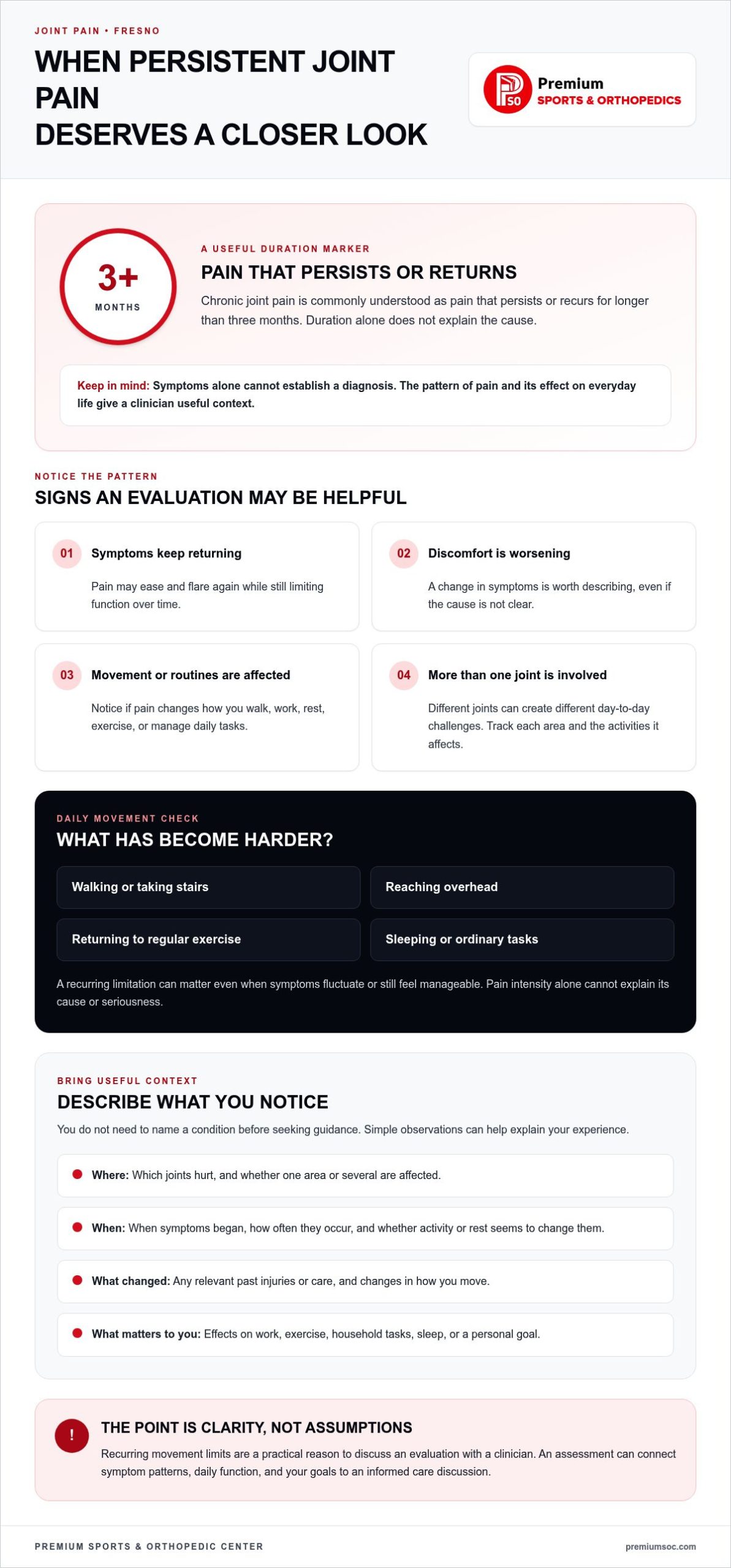
Occasional soreness after an unfamiliar workout or a long day may settle with rest. Pain deserves closer attention when it persists, keeps returning, or repeatedly gets in the way of movement and daily routines. Chronic joint pain is commonly understood as pain that persists or recurs for longer than three months, though duration alone doesn’t explain its cause. The broader concept of chronic pain includes different causes and experiences, so symptoms alone can’t establish a diagnosis.
Joint discomfort may affect one area or several, and its pattern can change. For Fresno-area residents, pain in multiple joints may create different challenges from day to day: walking may be difficult at times, while reaching overhead or climbing stairs becomes a separate concern. Keep track of which joints are affected and which activities feel harder so you can describe the full picture during an evaluation.
How persistent joint pain can affect everyday movement
Notice what pain changes in your day. Do you take stairs one at a time, shorten a walk, avoid reaching for items on a shelf, or postpone returning to regular exercise? Symptoms can ease and flare again while still limiting function over weeks or months. Disrupted sleep or difficulty with ordinary tasks also matters. Pain intensity alone can’t reveal its cause or determine how serious a condition is. Its pattern and effect on your life offer useful context for a clinician.
You don’t need to wait until every activity feels impossible. A recurring limitation is worth noting if it changes how you move, work, rest, or take part in activities you value, even if it seems manageable.
When a Fresno-area specialist evaluation may be helpful
Consider discussing an evaluation when joint symptoms keep returning, are worsening, or interfere with activities you want or need to do. The same applies when discomfort affects multiple joints or makes it harder to sleep, walk comfortably, or manage daily tasks. These patterns don’t point to a specific diagnosis on their own, but they are a reason to discuss your experience with a clinician.
You don’t need to name the condition before seeking guidance. Describe where discomfort occurs, when it tends to appear, which movements affect it, and how it changes your routine. A chronic joint pain specialist Fresno patients consult can consider this information as part of a clinical assessment, connecting symptoms with function and discussing appropriate next steps.
Persistent movement limits are a practical reason to seek clinical assessment, even when symptoms fluctuate or affect more than one joint. The goal is to understand your situation more clearly, not to assume a cause from a symptom checklist. An evaluation can help you move from uncertainty toward an informed plan for your comfort and activity goals.
How a Fresno Joint Pain Specialist Connects Symptoms to a Care Plan
A useful evaluation goes beyond identifying where it hurts. It connects your health history and symptom pattern with the movements you want to manage, then uses a clinical assessment to guide discussion of next steps. This keeps the conversation focused on your circumstances rather than a one-size-fits-all checklist. A chronic joint pain specialist Fresno patients consult can also consider whether discomfort in several joints is creating broader limits in daily life.
Joint symptoms can have different causes, and similar complaints don’t necessarily point to the same condition. MedlinePlus provides an overview of possible causes of joint pain; an individual assessment helps put your history and function into context.
What information helps explain a joint pain pattern?
Before a visit, jot down what you’ve noticed, even if symptoms vary from day to day. A clear timeline and real-life examples can make the discussion more useful. You don’t need to arrive with a suspected diagnosis. Describe what happens and what you’d like to do more comfortably.
- Which joints hurt, and whether discomfort affects one area or several.
- When symptoms began, how often they occur, and whether particular activities or rest seem to change them.
- Any relevant past injuries or care, along with changes in how you move.
- How symptoms affect work, exercise, household tasks, sleep, or another personal goal.
If knee pain is your main concern, the Fresno knee pain treatment guide provides more topic-specific context. Bring relevant prior records or test results if you have them. A clinician may consider these as part of the assessment, depending on your situation.
How assessment can shape the next step
The discussion can move from your history to your priorities, then to a clinical assessment and possible next steps. The clinician may ask how a movement feels or which tasks have become harder. The aim is to understand how symptoms relate to function, not to assume that one symptom automatically calls for one treatment.
Recommendations depend on clinical findings, your needs, and your goals. When appropriate, the discussion may include rehabilitation such as physical therapy or other orthopedic care. If you work on your feet, for example, that demand may matter differently from a goal of returning to recreational activity. The plan should reflect the person, not just the painful joint.
A useful care plan connects what you’re feeling with what you want to be able to do. Sharing both helps you discuss practical options and understand why a particular next step may fit. For a local conversation focused on orthopedic evaluation and movement goals, explore orthopedic care in Fresno and Clovis.
Does Seeing a Chronic Joint Pain Specialist in Fresno Mean Surgery?
No. Seeing a specialist doesn’t, by itself, mean surgery is the next step. An evaluation helps clarify your joint concerns and discuss care options, which may include non-surgical approaches. The conversation starts with your clinical findings, health history, goals, and care you’ve already tried, not an assumption that every patient needs an operation.
At Premium Sports & Orthopedic Center, care focuses on non-surgical and outpatient orthopedic solutions. Physical therapy, joint tissue repair therapy, and muscle recovery treatments are among the services that may be considered when clinically appropriate. Each can be discussed as part of an individualized plan, but no treatment suits every person or condition, and no approach can guarantee a particular result.
What non-surgical and outpatient care can involve
Physical therapy may be part of a conversation about movement and rehabilitation goals. The clinic also provides joint tissue repair therapy and muscle recovery treatments. Whether any of these options fits depends on the clinician’s assessment and your individual needs. A specialist can explain the options being considered and how they relate to your goals, rather than treating any service as an automatic recommendation.
Outpatient care means care provided without an inpatient hospital stay. The term alone doesn’t tell you which treatment is right or what your experience will involve. Ask how a proposed approach relates to the issue being assessed and the activities you hope to manage.
How to weigh possible benefits and limitations
Useful decisions leave room for questions. Talk with your clinician about what a recommended option is intended to address, what limitations or uncertainties may apply, and what alternatives are reasonable for your situation. You can also discuss how your health history and response to previous care might inform the next step.
Set practical goals for the discussion. You might want to manage work tasks more comfortably, return to a regular activity, or make everyday movement easier. Treatment response varies, so ask how progress will be considered without expecting a promised outcome or timeline. If back symptoms are your main concern, the Fresno back pain relief guide offers focused information on that topic.
A visit with a chronic joint pain specialist Fresno patients consult is an opportunity to understand options, not a commitment to surgery. If surgery becomes part of the discussion, ask why it’s being considered, what other approaches may be appropriate, and how the decision relates to your goals. A clear explanation can help you weigh the next step at your own pace.
For patients seeking a local setting to discuss orthopedic care and movement goals, Premium Sports & Orthopedic Center’s care connects orthopedic evaluation with non-surgical and outpatient options when clinically appropriate.
How to Prepare for a Chronic Joint Pain Appointment in Fresno
A little preparation can help you make the most of an appointment, especially if symptoms come and go or affect more than one joint. You don’t need to arrive with a diagnosis or a perfect record. A few notes about what you’ve noticed, what has become harder, and what you hope to do can give the clinician a useful starting point.
A simple symptom and activity record
Focus on patterns that matter to your daily life, not every sensation. Note which joints are involved, when discomfort tends to appear, and whether certain movements or routines seem to affect it. If several areas bother you, list each one so the overall picture doesn’t get lost in the most painful symptom.
- Symptoms: Record when discomfort began, where you feel it, and whether it comes and goes or has changed over time.
- Activities: Note which tasks are affected, such as walking, reaching, household routines, work duties, or exercise.
- Relevant history: Include past injuries, care you’ve tried, and any records or test results you already have.
- Mobility and goals: Describe changes in how you move and what you’d like to return to or manage more comfortably.
Use everyday language. For example, “my hand feels stiff after working” or “walking feels harder after a while” describes your experience without guessing at its cause. You don’t need to track symptoms for a set period or postpone an appointment to collect more details. Bring notes if you have them; otherwise, share what you remember.
Questions that support a clear care discussion
It can help to write down a few questions before you meet with a chronic joint pain specialist Fresno patients visit. Choose the ones that address your main concerns:
- What does the assessment suggest about my symptoms, and what remains uncertain?
- How might the recommended care relate to my mobility or the activities I want to manage?
- What goals are realistic for me, and how will we discuss whether the plan is helping?
- What should I expect for follow-up, and when should I share a change in symptoms?
These questions can keep the conversation practical. If a recommendation isn’t clear, ask for an explanation in everyday terms. Discuss how your work, home responsibilities, activity level, and symptoms in other joints may shape the approach. That context helps make the plan relevant to your life, rather than focused only on one movement or body area.
Don’t wait for a routine appointment if symptoms suddenly become severe or you notice a concerning change. Seek prompt medical attention for urgent symptoms. For an orthopedic evaluation focused on your movement concerns, schedule an appointment with Premium Sports & Orthopedic Center.
How Premium Sports & Orthopedic Center Supports Joint Pain Care in Fresno
Persistent joint symptoms can raise practical questions: What might be contributing to the discomfort, and what could help you work toward your daily goals? Premium Sports & Orthopedic Center serves patients in Fresno and Clovis with orthopedic consultations, physical therapy, joint tissue repair therapy, and muscle recovery treatments. Its focus on non-surgical and outpatient orthopedic care gives patients a local place to discuss options without assuming one treatment fits everyone.
Whether symptoms affect one joint or several, an important starting point is understanding how they relate to movement, work, and activities. A chronic joint pain specialist Fresno patients consult can consider those concerns as part of an orthopedic evaluation and guide a discussion of possible next steps. Recommendations depend on the clinician’s assessment and each patient’s situation.
Care focused on mobility and recovery goals
Orthopedic care connects joint concerns with a broader view of function. You might want to manage daily tasks more comfortably, return to a valued activity, or work toward improved mobility. Sharing those priorities gives the care discussion a practical focus. Physical therapy may be considered in relation to movement and rehabilitation goals when appropriate.
Joint tissue repair therapy and muscle recovery treatments are also available at the center. Their availability doesn’t mean either is a universal recommendation. A clinician determines appropriate next steps based on individual findings, needs, and goals. This keeps the conversation centered on your circumstances rather than a preset treatment path.
The center’s non-surgical and outpatient focus may suit patients exploring orthopedic care without presuming surgery is necessary. Discuss what an option is intended to address, what uncertainties may apply, and how it relates to the movements you want to work toward. No specific approach can promise a particular result.
Take the next step with a local orthopedic team
If recurring joint symptoms continue to interfere with movement or routines, an orthopedic discussion can help put your concerns in context. This may be especially useful when more than one joint is affected or limitations make it harder to stay active. You don’t need to have a diagnosis in hand; clear descriptions of what has changed and what you hope to do can help frame the conversation.
Premium Sports & Orthopedic Center brings orthopedic consultations together with physical therapy and other recovery services for Fresno and Clovis patients. Explore care at Premium Sports & Orthopedic Center to learn about the clinic’s orthopedic and movement-focused services.
Make Your Next Step About the Life You Want to Get Back To
Persistent joint discomfort can make it easy to focus only on what hurts. As you consider care, keep sight of what you want to do more comfortably and confidently, whether that’s staying active, managing everyday responsibilities, or returning to a meaningful routine. Those priorities can shape a useful conversation with a chronic joint pain specialist Fresno patients consult about their concerns and possible next steps.
You don’t need to have every answer before beginning. A clear account of what has changed and what matters most to you is a practical place to start. From there, an orthopedic evaluation can help you explore options suited to your circumstances, without assuming a particular treatment or outcome.
Premium Sports & Orthopedic Center offers orthopedic care and sports medicine consultations, along with physical therapy and joint tissue repair therapy for patients in Fresno and Clovis. Explore orthopedic care and recovery services in Fresno to take a considered next step toward a clearer plan.
Frequently Asked Questions
Is chronic joint pain always caused by arthritis?
No. Arthritis is one possible cause, but persistent joint pain can have other explanations, including effects related to an injury or repeated strain. Similar symptoms can arise for different reasons, so pain alone can’t identify the cause. A clinician considers your health history, how symptoms began, which joints are affected, and how the problem has changed over time before discussing possible causes.
Can chronic joint pain affect sleep, mood, or daily energy?
It can. Ongoing discomfort may make it harder to settle into a comfortable sleeping position or keep up with usual activities, and the experience differs from person to person. If pain leaves you feeling less rested or changes your energy for work and home routines, mention that during an evaluation. A chronic joint pain specialist Fresno patients consult can use those details to understand how symptoms affect daily life.
Should I keep exercising when a joint hurts chronically?
The appropriate activity depends on your symptoms, health, and what may be causing the joint pain. Don’t push through severe or worsening pain; pause and discuss the change with a qualified clinician. That doesn’t mean everyone should stop all movement. Describe which activities feel manageable and which aggravate symptoms so the clinician can help you consider suitable movement and any needed adjustments.
Can more than one painful joint be related to the same underlying issue?
Possibly, but pain in several joints can also have different explanations, and the pattern alone can’t establish a cause. Note every affected area, when symptoms started in each one, and whether the discomfort or movement limitations change together. Sharing those details during an assessment helps the clinician consider the full picture without assuming one diagnosis or treatment applies to every joint.
What does a joint pain specialist need to know about a previous injury?
Share when and where the injury happened, how the joint recovered, and what has changed since. For example, note whether a movement that felt manageable after the injury has become difficult again. Bring relevant records you already have, if available. An old injury can offer useful context, but it’s only one part of an assessment and doesn’t determine the diagnosis by itself.
When should sudden joint symptoms receive prompt medical attention?
Seek prompt medical assessment for sudden, severe, or rapidly worsening symptoms, especially with concerning changes such as fever or inability to use the joint. These symptoms need timely attention rather than waiting for a routine appointment. If you believe there’s immediate danger, contact local emergency services. This guidance is general and doesn’t diagnose the cause; a clinician can assess your specific situation.
Can chronic joint pain return after a period of improvement?
Yes, symptoms can ease and later return, but recurrence alone doesn’t reveal why. Note what has changed since the improvement, including which activities are harder, whether symptoms occur more often, and whether other joints are affected. Discuss the pattern with a clinician, particularly if it’s worsening or interfering with usual routines. A return of pain doesn’t predict how symptoms will progress or respond to care.
For orthopedic care and movement-focused services in Fresno and Clovis, contact Premium Sports & Orthopedic Center to take the next step.