
 0Comments
 22 Sep 2026
Collapsing onto the couch and waiting for soreness to fade isn’t an effective training strategy; true muscle recovery for runners is an active physiological discipline, not passive waiting. If you have ever rolled out of bed with legs that feel like concrete, you know the frustration of wanting to hit the road while your body demands a halt. It’s completely natural to worry whether that stubborn ache in your calves or knees is normal fatigue or the start of a chronic overuse injury.
You don’t have to choose between cutting your weekly mileage and running through constant pain. By grounding your post-run routine in clinical sports medicine, you can accelerate cellular tissue repair, protect against tears and tendinitis, and step into every workout with fresh, resilient legs. In this guide, we examine the biological mechanisms of muscle adaptation, clear up confusion around recovery modalities like cold versus heat therapy, and provide practical protocols to help you train at your absolute best.
Key Takeaways
- Debunk the myth of lactic acid buildup and learn how modern muscle recovery for runners focuses on cellular repair rather than passive resting.
- Master a structured 60-minute post-run sequence to optimize fluid balance, clear metabolic waste, and jumpstart soft tissue healing.
- Evaluate the true clinical evidence behind trending recovery modalities, separating sensory pain relief from genuine structural muscle repair.
- Harness systemic recovery pillars, including slow-wave sleep and strategic protein distribution, to optimize growth hormone release and muscle adaptation.
- Identify clinical red flags that differentiate normal delayed-onset soreness from overuse injuries, clarifying when to treat symptoms at home versus seeking orthopedic evaluation.
Understanding the Physiology of Muscle Fatigue and Soreness in Runners
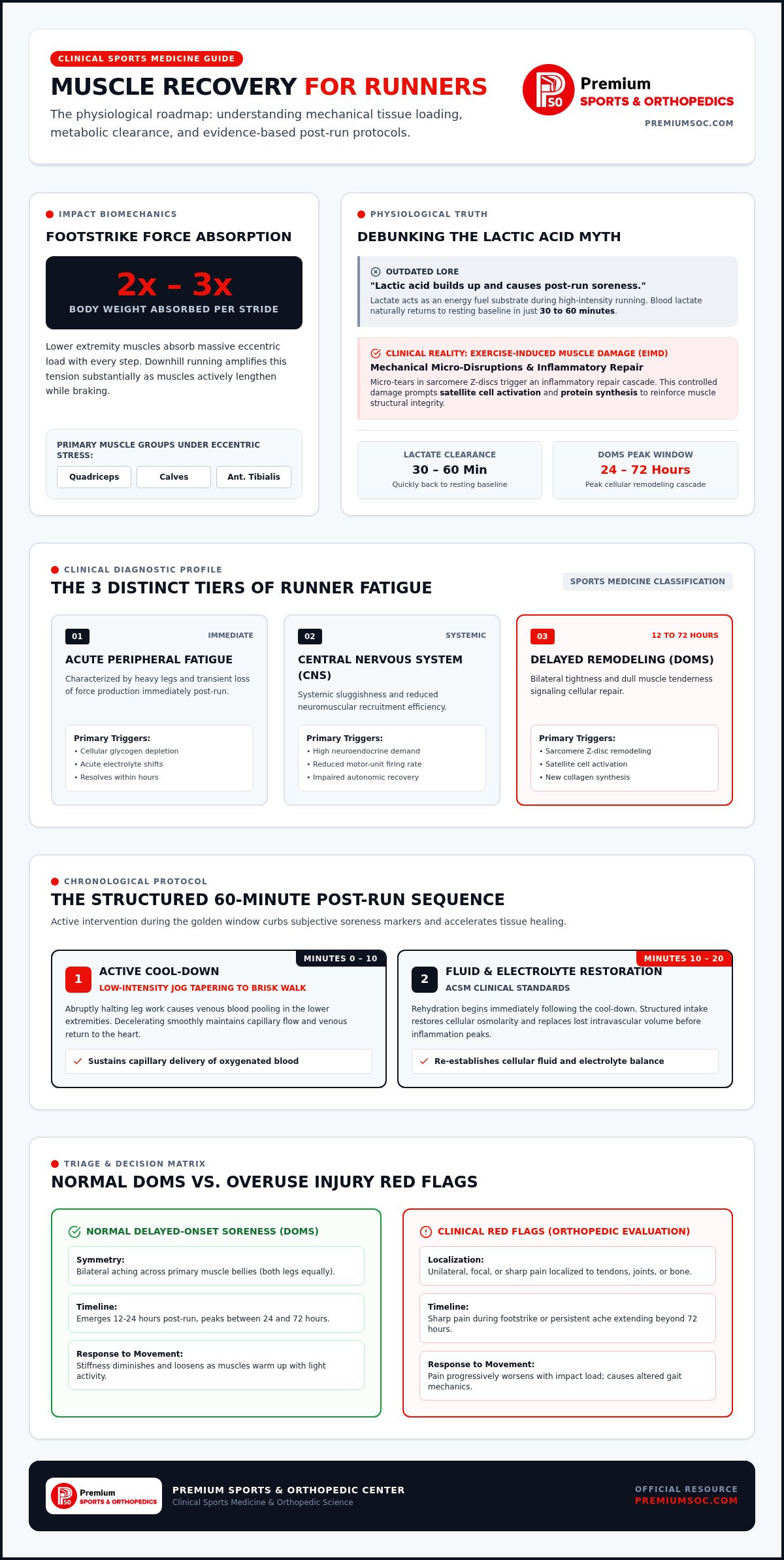
Every stride you take sends impact forces rippling through your lower extremities, creating exercise-induced muscle damage (EIMD). Rather than indicating structural failure, these microscopic tears across your myofibrils represent the natural catalyst for athletic progression. Successful muscle recovery for runners begins with understanding this cellular reality rather than blaming outdated scapegoats.
For decades, popular running lore blamed post-workout stiffness on lactic acid accumulation. Sports science has thoroughly dismantled this myth. Lactate serves as an essential fuel substrate during high-intensity efforts, and circulating blood lactate returns to resting baseline levels within 30 to 60 minutes after you stop running. The real culprit behind that familiar, delayed stiffness is mechanical microtrauma followed by an inflammatory repair cascade.
Downhill segments accelerate this process dramatically. Running downhill forces your quadriceps, calves, and anterior tibialis into severe eccentric contractions, where muscle fibers attempt to brake and stabilize the body while being actively lengthened. This eccentric stress triggers localized micro-disruptions across the z-discs of individual sarcomeres. Far from being detrimental, this controlled mechanical damage stimulates satellite cell activation and protein synthesis, building resilient, fatigue-resistant muscle fibers for your next training cycle.
The Mechanics of Eccentric Muscle Contraction in Distance Running
During the footstrike phase of running, your lower-body muscles absorb forces equal to two to three times your body weight. Your quadriceps and calves act as shock absorbers through eccentric lengthening, causing physical strain across individual sarcomeres. Hilly routes amplify this load substantially; descending a steep grade generates far greater mechanical tension than running on flat pavement. While this intense loading drives soreness, it’s also the exact stimulus that prompts soft tissue to reinforce its structural integrity over time.
DOMS vs. Acute Muscle Fatigue: Key Differences
Distinguishing between immediate exhaustion and delayed tissue remodeling helps runners manage training loads safely. Clinical delayed onset muscle soreness typically emerges 12 to 24 hours post-run, peaks between 24 and 72 hours, and reflects active structural remodeling rather than acute metabolic depletion. Knowing how your body expresses fatigue ensures your approach to muscle recovery for runners stays balanced:
- Acute Peripheral Fatigue: Heavy legs and reduced muscle force production immediately after a workout, caused by glycogen depletion and cellular electrolyte shifts that resolve within hours.
- Central Nervous System (CNS) Fatigue: Reduced motor-unit recruitment efficiency and systemic sluggishness, stemming from prolonged neuroendocrine demand.
- Delayed-Onset Remodeling: Bilateral muscular tightness and dull tenderness across the muscle bellies, signaling healthy satellite cell activity and collagen synthesis.
The 60-Minute Post-Run Protocol: Step-by-Step Muscle Recovery
What you do during the first hour after stopping your GPS watch sets the foundation for your next workout. While many runners immediately drop into a chair or drive straight home, proactive muscle recovery for runners relies on a structured sequence that regulates elevated core temperature, promotes microvascular circulation, and restores cellular energy reserves before inflammation peaks.
According to a comprehensive systematic review on post-exercise recovery modalities, active strategies applied directly following strenuous exertion meaningfully curb subjective soreness markers. The key lies in following a deliberate chronological routine rather than haphazardly stretching or drinking plain water.
Step 1 & 2: Active Cool-Down and Immediate Fluid Restoration
Dedicate the first 5 to 10 minutes (Minutes 0 to 10) to a gentle cool-down consisting of a low-intensity jog tapering into a brisk walk. Abruptly halting dynamic leg work causes blood to pool in your lower extremities, reducing venous return to your heart and stalling the clearance of metabolic waste. Decelerating smoothly maintains steady capillary flow, delivering oxygenated blood to stressed muscle bellies.
Rehydration begins the moment your cool-down concludes (Minutes 10 to 20). Follow the clinical standard established by the American College of Sports Medicine (ACSM), which advises drinking 16 to 24 fluid ounces (roughly 450 to 700 mL) of fluid for every pound of body weight lost during your session. Prioritize electrolyte beverages rich in sodium and potassium over plain water. Pure water dilutes extracellular sodium levels and triggers urine production, whereas sodium preserves fluid retention and supports cellular rehydration.
Step 3 & 4: Nutrient Delivery and Gentle Dynamic Mobility
Shift your attention to cellular repair between Minutes 20 and 45. Ingest a snack or recovery drink featuring a 3:1 or 4:1 carbohydrate-to-protein ratio. The International Society of Sports Nutrition (ISSN) confirms that consuming 20 to 40 grams of protein containing 700 to 3,000 mg of leucine sparks myofibrillar protein synthesis, helping rebuild the microtears sustained during eccentric loading.
Spend your final 15 minutes (Minutes 45 to 60) on light mobility drills rather than aggressive static stretching. Yanking on acutely fatigued, mechanically damaged muscle fibers can exacerbate sarcomere strain. Instead, restore functional joint range of motion with fluid movements:
- Gentle forward-and-back leg swings to open hip flexors
- Lateral leg swings to mobilize adductors
- Bodyweight walking lunges with an upright torso
- Gentle ankle circles and calf pumps
If persistent soreness or joint irritation limits your mobility despite a disciplined routine, working with an experienced specialist for muscle recovery treatments can help resolve stubborn tissue restrictions before your next training block.
Comparing Popular Muscle Recovery Modalities: What the Science Shows
Runners love high-tech recovery gear, but clinical research reveals a clear divide between feeling refreshed and actual cellular repair. Modalities like percussion therapy, ice baths, and compression sleeves primarily act as neuromuscular modulators. They alter pain reception, reduce muscle spindle sensitivity, and promote fluid clearance, but they don’t instantly rebuild torn myofibrils. Approaching muscle recovery for runners with this distinction prevents overreliance on passive gadgets at the expense of fundamental physiology.
When selecting recovery tools, keep your underlying training goals in mind. While passive devices can provide meaningful relief, clinical guidelines for distinguishing normal muscle soreness from injury stress that aggressive mechanical pressure on damaged fibers can worsen underlying strains. Let’s look at how the primary modalities stack up against peer-reviewed science.
Foam Rolling and Percussive Therapy: Neuromuscular Reset
Self-myofascial release does not physically break scar tissue or remodel fascia; dense connective tissue requires thousands of pounds of force to mechanically deform. Instead, rolling stimulates cutaneous mechanoreceptors, sending an inhibitory signal to your central nervous system that lowers muscular guarding and improves joint range of motion. Perform slow passes over major muscle groups for 60 to 90 seconds, steering clear of bony prominences. For percussive devices, stick to 1 to 2 minutes per muscle group on low to moderate settings to avoid superficial bruising.
Cold Water Immersion vs. Heat Therapy: Timing Matters
Cryotherapy and ice baths provide potent short-term relief. Systematic reviews demonstrate that cold water immersion (10 to 15 minutes at 50°F to 59°F) reduces 24-hour post-exercise creatine kinase levels and dampens acute inflammation. However, routine cold plunging suppresses intracellular signaling pathways like mTORC1, which are necessary for muscular remodeling. Reserve ice baths for multi-day stage races or tournaments where immediate performance beats long-term training adaptations. For daily training blocks, heat therapy remains the better choice to ease chronic morning stiffness and prime tissues before runs.
Pneumatic Compression Boots and Graduated Compression Socks
Pneumatic compression boots and graduated socks apply sequential pressure gradients that assist venous return and speed lymphatic drainage. While they don’t accelerate myofibrillar protein synthesis, they effectively decrease subjective feelings of heaviness in the legs. For maximum benefit, wear compression socks during prolonged travel or sit in compression boots for 20 to 30 minutes following long runs to clear dependent fluid pooling.
Systemic Recovery: Sleep Quality, Nutrition, and Active Rest Days
External gadgets and acute protocols only succeed when your internal biological environment supports repair. While targeted percussive therapy or dynamic mobility work addresses localized tension, systemic muscle recovery for runners depends on baseline sleep architecture, consistent nutrient delivery, and deliberate low-impact active rest. When these three pillars align, cellular remodeling shifts from an uphill battle into an efficient, predictable cycle.
Neglecting systemic fundamentals creates an internal environment where microtrauma accumulates faster than your body can synthesize new tissue. Prioritizing physiological inputs directly fuels cellular adaptation, allowing you to sustain training volume without breaking down.
Sleep Architecture and Hormonal Muscle Regeneration
Deep sleep acts as your body’s primary anabolic state. Clinical sleep research demonstrates that over 95% of daily human growth hormone (HGH) secretion occurs during Stage 3 non-REM, slow-wave sleep. This neuroendocrine surge stimulates amino acid uptake and orchestrates muscle protein synthesis across damaged sarcomeres. Running high weekly mileage while sleeping six or seven hours blunts this hormonal release, depleting muscle glycogen storage and impairing tissue elasticity. Aim for 8 to 10 hours of sleep per night during peak training blocks. Protect your sleep hygiene by maintaining a cool bedroom (65°F to 68°F), using blackout shades, and observing a digital device cutoff 60 minutes before bed.
Endurance Nutrition: Daily Protein Targets and Anti-Inflammatory Foods
Daily macronutrient totals govern your systemic capacity to rebuild. The International Society of Sports Nutrition (ISSN) recommends an overall daily protein intake of 1.4 to 2.0 grams per kilogram of body weight for endurance athletes. Rather than consuming this all at once, space high-quality protein doses of 20 to 40 grams every 3 to 4 hours to sustain myofibrillar protein synthesis throughout the day. Support this framework with anti-inflammatory whole foods rich in antioxidants and polyphenols:
- Tart cherry juice to modulate systemic oxidative stress
- Wild-caught cold-water fish and chia seeds for concentrated omega-3 fatty acids
- Dark leafy greens rich in magnesium and essential micronutrients
- Cruciferous vegetables to assist natural metabolic waste elimination
Ensure total daily caloric intake matches your training expenditures. Chronic energy deficits elevate systemic cortisol, blunting collagen synthesis and driving bone stress injuries.
Designing Productive Active Recovery Days
Rest days don’t require total immobility. Active recovery utilizes gentle, non-impact movement to promote capillary blood flow and flush lingering interstitial metabolites without introducing new eccentric microtrauma. Schedule 30 to 45 minutes of non-weight-bearing activity, such as easy spinning on a stationary bike, lap swimming, or light rowing. Maintain a strict Zone 1 heart rate, keeping your effort light enough to sustain a comfortable conversation.
If chronic leg fatigue persists despite optimizing your sleep, nutrition, and rest routines, schedule a comprehensive sports medicine consultation to analyze your biomechanical loading and identify underlying systemic deficiencies.
Normal Soreness vs. Overuse Injury: When to Seek Sports Medicine Care
Listening to your body is a foundational skill, yet many dedicated runners struggle to distinguish between productive post-workout adaptation and early tissue pathology. Overuse conditions account for up to 75% of all running-related injuries. When an athlete attempts to push through genuine mechanical breakdown, the body instinctively alters its gait to protect damaged fibers. This compensation shifts abnormal loads onto the knees, hips, and lower back, turning a minor soft-tissue strain into a debilitating structural issue. Proactive muscle recovery for runners means knowing when home self-care reaches its limit and clinical care becomes essential.
The Runner Self-Assessment: Evaluating Pain Patterns
Normal soreness feels broad, dull, and symmetrical across both legs, typically peaking within 48 hours and easing as you begin an easy warm-up. In contrast, an overuse injury presents distinct clinical markers that demand your attention:
- Asymmetrical or Focal Discomfort: Sharp, localized tenderness you can pinpoint with a single fingertip, particularly over bony landmarks like the tibia or metatarsals.
- Gait Alteration: Discomfort that forces you to shorten your stride, favor one leg, or land differently.
- Crescendo Pain: Aches that intensify as mileage increases rather than loosening up after the first mile.
- Persistent Rest Pain: Tendon tightness or throbbing that lingers longer than 48 hours without relief.
Consulting an evidence-based sports medicine guide can help you evaluate training red flags and take timely action before tissue damage sidelines your season.
Advanced Clinical Solutions for Stubborn Muscular and Joint Pain
Visiting a specialist isn’t an admission of defeat; it’s a proactive performance strategy. Modern outpatient orthopedic care focuses on non-surgical intervention to restore dynamic mobility. Targeted physical therapy identifies underlying pelvic drop, gluteal inhibition, and calf tightness that overload tendons. For chronic tendinopathy or micro-tears that fail to respond to rest, non-surgical modalities like joint tissue repair therapy stimulate localized cellular regeneration without surgical downtime. Athletes seeking specialized sports medicine in Fresno have access to customized rehabilitation plans designed to correct biomechanical flaws and reinforce tissue resilience.
Partnering with Sports Medicine Specialists in Fresno and Clovis
At Premium Sports & Orthopedic Center, Dr. Green and our team of licensed sports medicine practitioners understand the unique physical demands placed on road racers, marathoners, and trail runners. We combine non-surgical orthopedic care with comprehensive physical therapy to target the root cause of your pain. Whether you are battling stubborn knee ache, Achilles irritation, or recurrent muscular tightness, we provide the personalized support you need to return to peak mileage. If persistent discomfort is interfering with your stride, schedule an expert evaluation through our sports medicine consultations Clovis team today.
Elevate Your Post-Run Recovery and Protect Your Stride
Mastering muscle recovery for runners requires shifting away from passive waiting and embracing a deliberate biological process. By timing your hydration and nutrient intake within the first hour, treating at-home modalities as neuromuscular resets rather than cure-alls, and anchoring your routine in deep sleep, you give your body the exact tools it needs to repair microtrauma and adapt stronger.
Soreness should never become a chronic roadblock. When pinpoint tightness, joint ache, or lingering strains stop your training in its tracks, expert guidance makes all the difference. Led by Dr. Green, our team at Premium Sports & Orthopedic Center provides runners across Fresno and Clovis with specialized orthopedic care, comprehensive physical therapy, and cutting-edge non-surgical joint tissue repair therapy. You don’t have to navigate persistent discomfort on your own. Take the next step toward pain-free mileage and schedule a sports medicine consultation at Premium SOC today.
Frequently Asked Questions
How long does muscle recovery take after a long-distance run?
Full muscle recovery after a long-distance run typically takes between 48 hours and seven days, depending on your training volume, intensity, and nutrition. A standard weekend long run usually requires 48 to 72 hours for tissue restoration. A competitive marathon can demand several weeks for complete structural remodeling. Listening to your legs and prioritizing sleep ensures your body rebuilds efficiently between sessions.
Is it safe to run with delayed-onset muscle soreness (DOMS)?
Yes, running with mild, bilateral delayed-onset muscle soreness is generally safe, provided the discomfort loosens up during your warm-up. Keep the effort light and strictly conversational in Zone 1. However, if soreness alters your natural running stride or sharpens into focal joint pain, stop running. Forcing your body through severe soreness elevates injury risk and delays genuine muscle recovery for runners.
Do ice baths or hot baths work better for running recovery?
Neither modality is universally better; their effectiveness depends entirely on your training timing. Ice baths excel during multi-day stage races or back-to-back competition days because they rapidly blunt acute inflammation and dull pain. In contrast, warm baths or heating pads work best during normal training weeks by increasing local circulation, relaxing chronic muscular tightness, and preparing stiff joints for morning movement without stalling muscular adaptations.
Should I take ibuprofen or other NSAIDs to speed up muscle recovery?
No, routine NSAID use after workouts is not recommended because it can actually impair long-term muscle recovery for runners. Over-the-counter anti-inflammatories suppress the primary prostaglandin cascade required for muscle protein synthesis, satellite cell recruitment, and soft-tissue remodeling. Modern sports medicine protocols, such as PEACE & LOVE, advise avoiding acute anti-inflammatory medications so your body can complete its natural biological repair cycle.
Why do my calves and quads feel constantly tight despite daily stretching?
Chronic muscular tightness rarely stems from short muscle tissue; it usually indicates underlying muscle weakness or biomechanical compensation. If your glutes or deep core muscles fail to fire properly during push-off, your calves and quadriceps work overtime to absorb impact forces. Static stretching can’t fix functional deficits. In our Fresno clinic, we use specialized physical therapy evaluations to diagnose neuromuscular imbalances and offload overstressed muscle groups.
What is the best post-run snack for optimal muscle repair?
The optimal post-run snack delivers a 3:1 or 4:1 ratio of carbohydrates to high-quality protein within 45 minutes of finishing. Excellent options include chocolate milk, a whey protein smoothie blended with bananas and berries, or Greek yogurt paired with honey and granola. This combination rapidly replenishes depleted muscle glycogen stores while supplying 20 to 40 grams of protein rich in leucine to stimulate myofibrillar repair.
When does running soreness become a serious muscle strain or injury?
Soreness transitions into an injury when pain becomes sharp, unilateral, pinpointed over bone or tendon, or worsens progressively throughout a run. If pain persists beyond 48 hours of rest or forces you to limp, seek clinical evaluation. Runners in Fresno and Clovis can visit Premium Sports & Orthopedic Center, where Dr. Green and our team evaluate movement mechanics and deliver advanced orthopedic care to stop minor strains from becoming chronic tears.