
 0Comments
 16 Sep 2026
What if the most effective path back to the hiking trails or the soccer field didn’t involve a scalpel? For many athletes in the Central Valley, a torn ligament feels like an automatic ticket to the operating room; however, modern regenerative medicine is proving that surgery isn’t the only way to regain stability. We understand the deep frustration of a knee injury. You’re likely weighing conflicting medical advice while fearing that a long surgical recovery will sideline you from the life you love. It’s a stressful position to be in, but you don’t have to choose between a major procedure and your physical freedom.
This guide explores the reality of non-surgical ACL recovery Fresno at Premium Sports & Orthopedic Center. You’ll discover how advanced joint tissue repair therapy and specialized physical therapy work together to restore your knee’s function without anesthesia or lengthy downtime. We’ll walk through Dr. Green’s methodical approach to biological restoration, showing you exactly how a personalized local plan can get you back to peak performance and the active lifestyle you deserve.
Key Takeaways
- Identify where your injury falls on the ACL tear scale and whether your body qualifies as a “Coper” capable of natural adaptation.
- Learn how Advanced Joint Tissue Repair Therapy facilitates non-surgical ACL recovery Fresno by stimulating your body’s natural healing response.
- Discover why preserving your original ligament often results in better long-term balance and a more natural-feeling knee compared to surgical grafts.
- Preview a structured 4-phase roadmap that transitions you from initial inflammation management back to high-impact activities like hiking and sports.
- Explore why local expertise at Premium Sports & Orthopedic Center provides a sophisticated, community-focused alternative to generic surgical facilities.
The Evolution of ACL Care: Can a Tear Heal Without Surgery?
For decades, the standard response to a torn ACL was an immediate surgical referral. In 2026, the landscape of orthopedic care has shifted significantly as we gain a deeper understanding of human biology. We now recognize that the body possesses an innate ability to heal when provided with the correct environment and stimulus. Non-surgical ACL recovery is a strategic combination of biological tissue repair and neuromuscular retraining designed to restore stability without invasive intervention. This evolution allows patients to avoid a traditional “surgery-first” mentality that often overlooks the body’s natural restorative potential.
Not every knee reacts to an injury in the same way. The medical community distinguishes between “Copers” and “Non-Copers” to determine the best path forward. Copers are individuals whose neuromuscular systems instinctively adapt to provide stability despite the ligament damage. By identifying these patterns early, we can lean into your body’s natural strengths. This personalized approach focuses on enhancing the way your brain communicates with your leg muscles, effectively “teaching” the knee to remain stable during the activities you love.
Understanding ACL Tear Grades
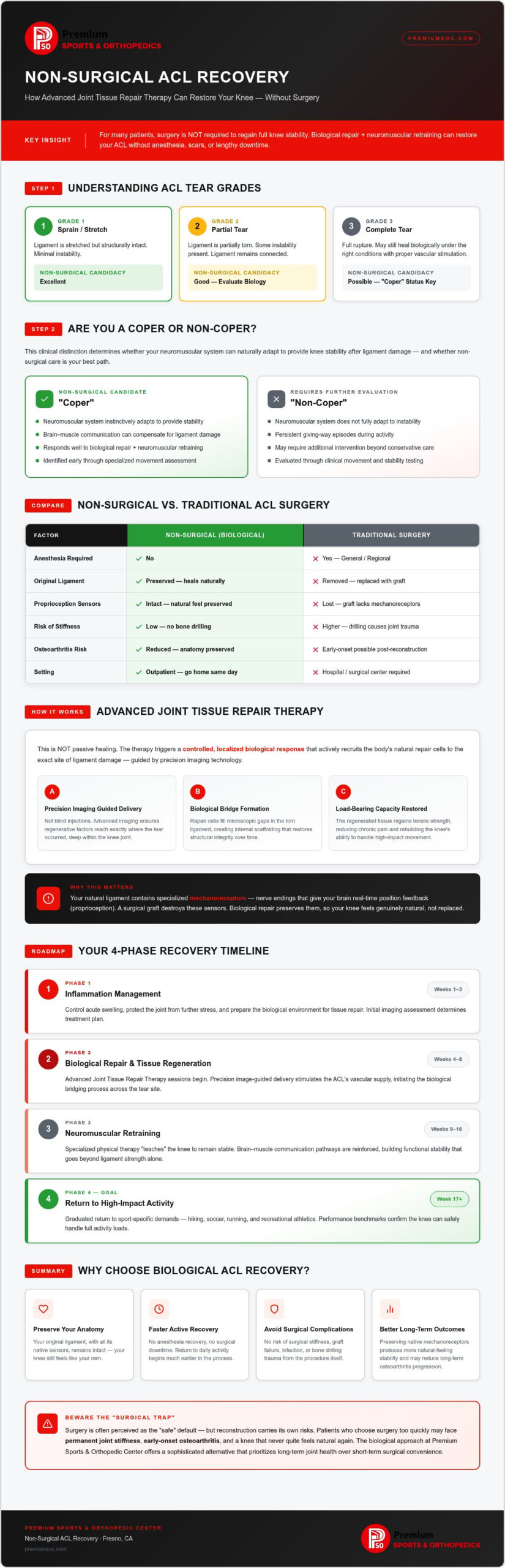
Grade 1 and 2 tears, which involve stretching or partial tearing, are the most common candidates for non-invasive care because the ligament remains largely intact. However, even Grade 3 (full) tears can demonstrate spontaneous healing under the right conditions. The secret lies in the vascular supply. The ACL has a specific blood supply that can be stimulated to bridge the gap in a tear. When we stabilize the joint and optimize the biological environment, the tissue can often reconnect and strengthen without a single stitch.
The Risks of Over-Surgicalizing Knee Injuries
Choosing surgery is often seen as the “safe” bet, but it isn’t a risk-free guarantee of health. Many patients fall into a “surgical trap” where the reconstruction leads to permanent joint stiffness or early-onset osteoarthritis. These complications often arise from the trauma of the procedure itself and the invasive nature of drilling into bone. Non-surgical ACL recovery Fresno at Premium Sports & Orthopedic Center offers a sophisticated alternative. This outpatient approach focuses on preserving your original anatomy, ensuring that your knee still feels like your own. By avoiding anesthesia and surgical scars, you maintain the integrity of the joint while pursuing a faster return to your active lifestyle.
Advanced Joint Tissue Repair: The Biological Bridge to Recovery
Recovery isn’t a passive event; it’s an active biological process that we can intentionally accelerate. While traditional approaches often wait for the body to heal on its own, Joint Tissue Repair Therapy works by triggering a controlled, localized inflammatory response. This isn’t the swelling you experience immediately after an injury. Instead, it’s a precise signal that recruits the body’s natural repair cells to the site of the ligament damage. By stimulating this response, we create a biological bridge that encourages the ACL to mend itself from the inside out.
Precision is the cornerstone of this modern approach. We don’t rely on “blind” injections that hope to reach the target. Instead, we use sophisticated image-guided technology to ensure that every treatment is applied exactly where the tear has occurred. This level of accuracy is vital because the ACL is a complex structure located deep within the knee joint. When we deliver regenerative factors directly to the source of the injury, we maximize the potential for successful non-surgical ACL recovery Fresno, helping you avoid the trauma of a full reconstruction.
The Science of Ligament Regeneration
Ligaments are essentially high-tension cables that require a specific internal scaffolding to maintain their strength. Advanced tissue repair for joint pain targets the microscopic gaps in a torn ACL, providing the necessary biological signals to fill those voids with healthy, functional tissue. These treatments reduce chronic knee pain while promoting structural integrity, allowing your original ligament to regain its load-bearing capacity. Unlike a synthetic or donor graft, your natural ligament contains specialized nerve endings called mechanoreceptors. These sensors provide “proprioception,” which is your brain’s ability to sense the position and movement of your knee. Preserving these natural sensors is why biological repair often feels more stable and “normal” than a surgical replacement.
Why Local Orthopedic Expertise Matters
Managing a biological recovery requires more than just a single procedure; it requires consistent, expert monitoring. A Fresno-based specialist can track your healing progress in real-time, adjusting your protocol based on how your knee responds to treatment. Many patients are initially offered generic cortisone shots, but these only mask symptoms and can actually weaken the ligament over time. Advanced tissue repair is fundamentally different because it focuses on long-term structural health. At Premium SOC, we coordinate your Orthopedic Care with on-site physical therapy and muscle recovery treatments. This ensures your leg muscles stay strong enough to support the joint while the ligament is in its most vulnerable stages of repair. This integrated model is designed to get you back to your peak performance without the need for a scalpel.
Comparing Outcomes: Non-Surgical vs. Traditional ACL Surgery
Choosing between a surgical suite and a clinical recovery path is a major decision for any athlete or active individual. Most people assume that a reconstructed ligament is inherently stronger, but the data tells a more nuanced story. When we look at 2-year and 5-year stability outcomes, patients who undergo non-surgical protocols often achieve functional results that match or even exceed their surgical counterparts. This is because stability isn’t just about the physical thickness of a ligament; it’s about how your brain and muscles work together to protect the joint.
The Proprioception Gap is perhaps the most significant difference between these two paths. A surgical graft, whether it’s from your own patellar tendon or a donor, is essentially “dumb” tissue. It lacks the complex network of nerve endings found in your original ACL. Your natural ligament acts as a sophisticated sensor, sending lightning-fast signals to your brain about the knee’s position. This natural intelligence is why many patients who choose non-surgical ACL recovery Fresno report that their knee feels more “normal” and responsive during high-speed movements like cutting or pivoting.
Stability and Functionality Metrics
We must also consider the health of the entire knee environment. Surgery is an invasive event that requires drilling into the femur and tibia, which can inadvertently damage the meniscus and surrounding cartilage. These structural changes are a primary reason why surgical knees often show signs of early-onset osteoarthritis. By opting for a non-invasive approach, you preserve the natural architecture of your joint. Your neuromuscular system learns to compensate for any minor ligament laxity through improved muscle firing patterns, creating a dynamic stability that protects your cartilage for years to come.
Downtime and Lifestyle Impact
The timeline for a surgical recovery is often measured in months of restricted movement and crutches. This period of inactivity leads to significant muscle atrophy, creating a “rehab debt” that takes a long time to repay. Non-surgical recovery offers a much higher degree of flexibility. Because there’s no surgical wound to protect, you can often begin gentle range-of-motion exercises and muscle-loading protocols almost immediately. This keeps your quadriceps and hamstrings engaged, which is essential for joint protection. If you’re currently managing an injury, exploring a comprehensive Knee Pain Treatment Fresno plan can help you maintain your mobility while your body focuses on biological repair. For those seeking a broader understanding of conservative care options, our guide on knee pain relief without surgery outlines the full spectrum of science-backed treatments available to active patients. This proactive approach ensures that when you’re ready to return to sport, your body is strong, balanced, and ready for the challenge.
The Fresno Recovery Roadmap: Your 4-Phase Timeline
Successful non-surgical ACL recovery Fresno relies on a structured, phased approach that respects biological healing timelines. We don’t just wait for time to pass. Instead, we guide you through specific milestones designed to rebuild your knee’s integrity from the ground up. This roadmap ensures you aren’t rushing back too soon or lingering in inactivity longer than necessary. Each phase serves as a building block for the next, moving you from initial protection to peak performance.
Phase 1 & 2: Building the Foundation
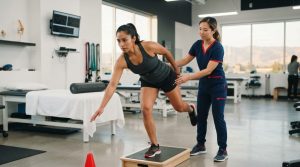
In the first four weeks, our primary goal is protection and inflammation management. We prioritize quad activation early on because the thigh muscles often “shut down” after an injury to protect the joint. By using muscle recovery treatments, we prevent atrophy and keep the surrounding tissue healthy. Unlike surgical paths that might require weeks of non-weight-bearing, the non-surgical route encourages early, controlled weight-bearing to stimulate the ligament’s repair initiation. Between weeks 4 and 12, we focus on restoring your full range of motion while the advanced joint tissue repair therapy begins to take hold at the cellular level. This phase is about creating a stable environment where the ligament can heal without being overstressed by heavy bracing.
Phase 3 & 4: Returning to the Fresno Lifestyle
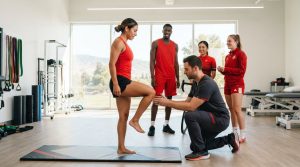
As you move into months 3 through 6, the focus shifts to progressive strengthening and proprioceptive training. This is where we prepare you for the unique demands of the Fresno lifestyle. Whether you’re planning to hike the uneven trails of the Sierra Nevada foothills or return to the local soccer pitches, your training must reflect those specific environments. We incorporate cutting and pivoting drills that mimic the chaotic movements of basketball or soccer to ensure your neuromuscular system is fully recalibrated. Before you’re cleared for full activity, you must pass a functional clearance test. A functional clearance test is a series of objective physical assessments that prove your injured limb has regained at least 90 percent of the strength and stability of your healthy side. This data-driven approach ensures you return to your favorite activities with total confidence.
Ready to start your journey? Contact us to schedule your Sports Medicine Consultation today and get your personalized recovery roadmap.
Why Choose Premium Sports & Orthopedic Center for ACL Recovery?
Choosing a partner for your recovery is about finding someone who understands both the science of the knee and the rhythm of your life. At Premium Sports & Orthopedic Center, formerly Green Sports Medicine, we’ve spent years building a legacy of excellence in the Central Valley. Led by Dr. Green, our clinic has evolved into a premier hub for non-surgical ACL recovery Fresno. We’ve transitioned our brand to reflect our expanded capabilities, yet our core mission remains the same: providing world-class orthopedic care with a personal, local touch.
Our “Friendly Expert” approach means we treat you as a partner in your own health. We don’t believe in one-size-fits-all protocols. Whether your goal is to return to competitive marathons or simply to enjoy a weekend of gardening without a brace, we customize every aspect of your recovery plan. By keeping diagnostics, advanced tissue repair, and physical therapy under one roof, we ensure your care is seamless and efficient. You won’t have to navigate a maze of different offices; instead, you’ll have a dedicated team that knows your story and your goals.
A Community-Focused Clinical Leader
Success in ACL recovery often comes down to the quality of follow-up care. Being based right here in Fresno allows us to monitor your biological response to treatment with precision. We are committed to non-invasive, outpatient solutions that respect your time and your body’s integrity. Our focus on Sports Medicine in Fresno ensures that every patient has access to elite-level treatments that were once reserved only for professional athletes. This community-first perspective is why so many local families trust us to keep them moving.
Getting Started with Your Consultation
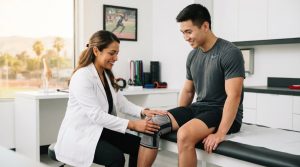
Your journey begins with a comprehensive orthopedic pain management evaluation. During this initial visit, we don’t just look at an MRI; we listen to how your injury affects your daily life. We use advanced imaging technology to map the specific architecture of your tear, allowing us to determine if you’re a candidate for our tissue repair for joint pain protocols. This detailed mapping is the first step toward a surgery-free future. We’ll walk you through every phase of the process, answering your questions with the clarity and compassion you deserve. It’s time to stop feeling sidelined and start moving toward a full, active recovery.
Reclaim Your Active Life Without Surgery
A torn ACL doesn’t have to mean a permanent detour from the activities that define your lifestyle. We’ve explored how modern biological advancements and structured neuromuscular training offer a powerful alternative to traditional reconstruction. By choosing a path of non-surgical ACL recovery Fresno, you’re opting to preserve your knee’s natural anatomy and its vital sensory feedback. This approach avoids the trauma of invasive surgery while focusing on long-term joint health and vitality.
At Premium Sports & Orthopedic Center, expert care led by Dr. Green ensures you receive specialized non-surgical joint repair tailored to your unique goals. Our convenient Fresno location provides everything you need, from initial diagnostics to follow-up physical therapy, all under one roof. Don’t let an injury dictate your future physical limits. Take the first step toward a stronger, more resilient knee today. Schedule Your Non-Surgical ACL Consultation at Premium SOC Today and start your journey back to peak performance with confidence.
Frequently Asked Questions
Is it possible to fully heal a torn ACL without surgery?
Yes, it’s possible for many individuals to achieve full functional stability without an operation. While grade one and two tears are the most frequent candidates, even full grade three tears have shown the capacity for spontaneous healing when supported by advanced biological protocols. By focusing on the body’s innate repair mechanisms, we help patients avoid the trauma of surgery while restoring the ligament’s structural integrity and natural sensory function.
How long does non-surgical ACL recovery take in Fresno?
Most patients find that non-surgical ACL recovery Fresno follows a timeline of approximately six to nine months for a full return to high-impact sports. Initial inflammation management takes about four weeks, followed by several months of intensive strengthening and proprioceptive retraining. Your specific duration depends on the severity of the tear and how quickly your body responds to tissue repair treatments. We monitor your progress closely to ensure a safe and steady return to activity.
What are the best non-surgical treatments for an ACL tear in 2026?
In 2026, the most effective path for non-surgical ACL recovery Fresno involves a combination of Advanced Joint Tissue Repair Therapy and targeted physical therapy. These medical protocols stimulate the ligament’s cellular regeneration while muscle recovery treatments prevent atrophy in the quadriceps and hamstrings. Using image-guided technology ensures these treatments reach the exact site of the injury, providing a more precise solution than older methods like generic cortisone injections or simple rest.
Can I still play sports like soccer or football without an ACL surgery?
You can definitely return to cutting and pivoting sports like soccer or football without undergoing a reconstruction. Success depends on becoming a “Coper,” which means your nervous system and muscles have learned to provide the stability the ligament once offered. We use objective functional clearance tests to ensure your injured leg has regained at least 90 percent of the strength found in your healthy limb before you step back onto the field.
Will I develop arthritis faster if I don’t get ACL surgery?
Research suggests that avoiding surgery doesn’t necessarily lead to faster arthritis; in fact, the opposite is often true. Surgical procedures involve drilling into the bone and can disrupt the natural environment of the knee, which sometimes accelerates cartilage wear. By preserving your original ligament and joint architecture, you maintain the knee’s natural shock-absorption system. This non-invasive approach focuses on long-term joint health and the prevention of early-onset osteoarthritis.
What is the success rate of non-surgical ACL management for athletes?
Success rates for non-surgical management are increasingly favorable, particularly for athletes who commit to a comprehensive rehabilitation roadmap. Many sports medicine professionals report that functional outcomes for non-surgical patients are comparable to those who choose reconstruction when measured over five years. The key is a dedicated focus on neuromuscular control, which allows the knee to remain stable during high-speed movements without the need for a synthetic or donor graft.
How does Joint Tissue Repair Therapy differ from traditional physical therapy?
While traditional physical therapy focuses on strengthening muscles and improving range of motion, Joint Tissue Repair Therapy targets the biological healing of the ligament itself. It’s a medical intervention that creates the necessary environment for tissue regeneration at a cellular level. At Premium Sports & Orthopedic Center, we integrate both approaches. This ensures that while your ligament is mending, your muscles are being trained to provide the dynamic support your knee needs for daily life.
Does insurance cover non-surgical ACL recovery programs in California?
Insurance coverage for these programs in California depends on your specific plan and the types of treatments included. Most policies cover standard orthopedic consultations and physical therapy sessions. However, some advanced tissue repair protocols might be considered elective or out-of-network. We recommend contacting your insurance provider to discuss your benefits for outpatient orthopedic care and muscle recovery treatments. Our team can also help you understand your coverage during your initial evaluation.