 14 Oct 2026
What if an orthopedic visit could help you understand your options without putting surgery on the table? If pain is lingering or an injury has disrupted your routine, it’s reasonable to wonder whether you need specialist care and what an appointment involves. An orthopedic evaluation Fresno patients seek can help clarify what may be affecting movement and which next steps could be appropriate.
An evaluation doesn’t automatically lead to surgery. The conversation may cover your symptoms, relevant health history, mobility, and everyday or athletic goals. A clinician can then discuss possible next steps, including non-surgical care when appropriate.
This guide explains what an orthopedic evaluation generally considers, what information to bring, and which questions can help you prepare. You’ll also learn how an assessment can inform an individualized care discussion in Fresno, so you can approach the next step with greater confidence.
Key Takeaways
- An orthopedic evaluation Fresno patients seek can help connect pain or limited movement with practical next steps for care.
- Describing how symptoms affect daily activities can make the appointment conversation more useful.
- A short checklist covering symptom timing, affected areas, activity limits, and care goals can help you prepare.
- Understanding how an assessment informs treatment discussions can make the process feel more manageable.
- Premium Sports & Orthopedic Center provides orthopedic care and sports medicine consultations, with physical therapy and non-surgical outpatient approaches among its care options.
When an Orthopedic Evaluation in Fresno Can Help Clarify Pain
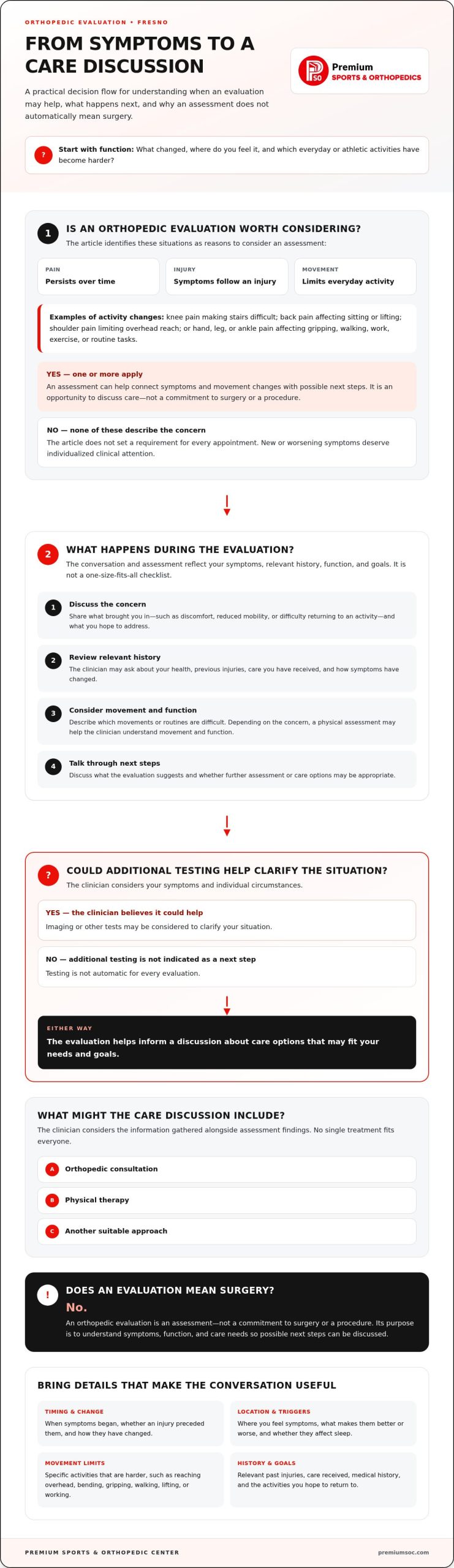
An orthopedic evaluation is a clinician’s assessment of musculoskeletal symptoms, function, and care needs. It can help make sense of pain, an injury, or a change in movement by considering how the issue affects you and what next steps may be appropriate. An orthopedic evaluation Fresno patients seek is not a commitment to surgery or a procedure. It’s an opportunity to discuss concerns and make informed decisions about care.
Consider an assessment if pain persists, follows an injury, or limits movement in ways that interfere with everyday life. Knee pain may make stairs difficult; back pain can affect sitting or lifting; and shoulder pain may limit reaching overhead. Hand, leg, or ankle pain can also affect gripping, walking, working, exercise, or routine tasks. The location of your symptoms and the activities they disrupt can help focus the conversation.
Musculoskeletal concerns can involve bones, joints, muscles, ligaments, and tendons. A clinician may consider your history and examine the affected area to understand the problem. Additional diagnostic techniques may be considered when appropriate. For an overview of the field, see Orthopedic pathology and diagnostic techniques.
Which symptoms and movement changes are worth discussing?
Share what you’ve noticed, even if the change seems small. Before your visit, consider noting:
- When the pain or movement change began, and whether it followed an injury.
- Where you feel symptoms, how intense they are, and whether they have changed over time.
- What makes symptoms better or worse, and whether they affect sleep.
- Which activities are harder, such as walking, lifting, working, exercising, or completing everyday tasks.
New or worsening symptoms deserve individualized clinical attention. A clear account of what has changed can help the clinician understand how your condition affects function and discuss appropriate next steps.
How is a clinical evaluation different from an orthopedic IME?
An independent medical examination, or IME, is often arranged to address a specific question connected to a claim or legal matter. Its purpose differs from a treatment-focused clinical visit, where the discussion centers on your symptoms, functional needs, and care goals. An IME’s findings or conclusions shouldn’t be assumed to determine what happens during routine clinical care. If you’re seeking help for pain or restricted movement, explain what you hope to understand and which activities you want to resume.
What Happens During an Orthopedic Evaluation?
An orthopedic evaluation is a conversation and assessment, not a one-size-fits-all checklist. The clinician works to understand what you’re experiencing, how it affects movement, and which care options may fit your needs. During an orthopedic evaluation Fresno patients can expect the discussion to reflect their symptoms, relevant medical history, and daily or athletic demands.
The visit may follow a sequence like this:
- Discuss your concern. Explain what brought you in and what you hope to address, whether that’s discomfort, reduced mobility, or difficulty returning to an activity.
- Review relevant history. The clinician may ask about your health, previous injuries, care you’ve received, and how your symptoms have changed.
- Consider function. Describe how symptoms affect specific movements and routines. Depending on your concern, a physical assessment may help the clinician understand your movement and function.
- Talk through next steps. The clinician can discuss what the evaluation suggests and whether further assessment or care options may be appropriate.
How should patients describe pain and activity limits?
Specific examples make the conversation more useful. Share when symptoms began, what seems to affect them, and whether they have changed. Explain which movements feel difficult, such as reaching overhead, bending, gripping, or walking your usual distance. Mention relevant past injuries, care you’ve received, and medical history. If symptoms affect an activity that matters to your work, exercise, or everyday routine, describe what has changed.
How do evaluation findings shape care discussions?
The clinician considers the information gathered alongside relevant assessment findings to discuss possible explanations and appropriate options. Depending on your needs, a plan may involve orthopedic consultation, physical therapy, or another suitable approach. No single treatment fits everyone, and the evaluation itself doesn’t guarantee a particular diagnosis or outcome. It helps create a more informed conversation about what may support your function and goals.
Additional testing isn’t automatic. Imaging or other tests may be considered when the clinician believes they could help clarify your situation, based on your symptoms and individual circumstances. The Social Security Administration’s guidelines for evaluating musculoskeletal disorders address evidence for disability determinations, a separate purpose from planning routine clinical care. They aren’t a required checklist for every orthopedic appointment.
Bring questions, explain what matters most in your daily life, and take time to understand the options discussed. Patients seeking orthopedic care and an individualized conversation about movement and function can explore orthopedic care in Fresno at Premium Sports & Orthopedic Center.
Does an Orthopedic Evaluation Mean You Will Need Surgery?
No. An evaluation is an assessment, not a commitment to surgery or a procedure. Its purpose is to understand your symptoms, how they affect function, and what matters to you before discussing possible care. For people seeking an orthopedic evaluation Fresno, the conversation can include non-surgical and outpatient approaches when appropriate. A recommendation depends on your individual assessment, not simply on the fact that you made an appointment.
Clinicians may consider your symptoms alongside relevant findings and goals. Your priorities might include returning to work comfortably, walking with greater ease, or rebuilding confidence in a sport. Sharing those aims helps frame a care discussion around your everyday life. If you have knee concerns, the Fresno knee pain treatment guide offers related information about care options.
What kinds of care may be discussed after assessment?
Depending on the evaluation, a clinician may discuss physical therapy, rehabilitation, or other appropriate non-surgical care. Premium Sports & Orthopedic Center also provides advanced joint tissue repair therapy as part of its orthopedic services. This may be one topic in an individualized care discussion, not a promised solution or a recommendation for every patient.
Ask how a proposed approach relates to your symptoms and goals, and what role you would play in the plan. You can also discuss how care might fit around work or daily responsibilities. Recommendations depend on the clinician’s assessment and your circumstances; a particular treatment may not be suitable for everyone.
How can the evaluation account for an active lifestyle?
Care goals aren’t limited to competitive sports. You may want to manage a physically demanding job, enjoy recreation, return to training, or move through daily routines with less difficulty. Explain which activities matter to you, what movements trigger concern, and what you hope to resume. This context can make the discussion more relevant to your life.
A sports medicine consultation can address activity-related concerns in the context of orthopedic care. The discussion may consider your sport or exercise demands as well as everyday function, then explore appropriate next steps without assuming surgery is needed. Patients interested in activity-focused orthopedic support can learn more about sports medicine care in Fresno.
It’s reasonable to ask questions and take time to understand the options presented. An evaluation gives you a setting to discuss what you’re experiencing, what you want to get back to, and which care approaches may be worth considering. The goal is an informed, individualized conversation, not pressure to choose a procedure.
How to Prepare for an Orthopedic Evaluation in Fresno
A little preparation can help you use your appointment time well. You don’t need to arrive with a diagnosis or perfectly organized records. Focus on what has changed, how it affects your routine, and what you hope to do more comfortably. For an orthopedic evaluation Fresno patients can make the conversation more useful by bringing concise notes and questions that reflect their concerns.
Use this checklist before your visit:
- Write down when symptoms began, where you feel them, and how they have changed.
- Note activities that worsen or ease symptoms, along with any limits at work, during exercise, or in everyday tasks.
- List relevant prior injuries, diagnoses, and care you’ve received.
- Gather available medical records or test results related to the concern, plus a current medication list.
- Identify your care goals, such as returning to a particular activity or managing a specific movement more comfortably.
What information should you bring or write down?
Include details that help explain the full picture: previous injuries, relevant health conditions, and treatments or care you’ve already tried. If you have related test records, bring what’s available so the clinician can consider them in context. Note what seems to improve or worsen symptoms and how they affect your usual routine. Brief notes are enough. If it would help, ask a trusted support person to join you or help remember key details.
Which questions can make the visit more useful?
Preparing a few questions can make it easier to follow the discussion and decide what you’d like clarified. Consider asking:
- What does the assessment suggest, and which findings should we discuss further?
- Are there other evaluations or tests to consider, and what would they help clarify?
- What care options may fit my symptoms and goals, and what are their purpose and trade-offs?
- How will we review progress and decide on next steps?
You don’t have to cover every question at once. Start with the concern that matters most, then ask for clarification if a term or recommendation isn’t clear. Understanding the purpose of an option can help you weigh it against your priorities, whether those involve work, recreation, sleep, or everyday movement.
Before leaving, make sure you understand any agreed next steps and what information you should keep track of. Your plan can reflect your individual assessment, without assuming a particular treatment or timeline. To discuss orthopedic care and your goals with a Fresno-area team, schedule an orthopedic evaluation with Premium Sports & Orthopedic Center.
Where to Begin With Orthopedic Care in Fresno
If pain or limited movement is affecting your routine, an orthopedic consultation can give you a focused place to discuss what’s happening and what you’d like to do next. Premium Sports & Orthopedic Center provides orthopedic care and sports medicine consultations for Fresno-area patients. An orthopedic evaluation Fresno patients pursue can guide a conversation about symptoms, function, and individual goals, without assuming that every concern calls for the same approach.
Care discussions may include physical therapy and other non-surgical, outpatient approaches when appropriate. Assessment and rehabilitation can be considered together: what you’re experiencing informs the discussion, while your mobility and everyday needs help shape which options may make sense. If back discomfort is part of your concern, the Fresno back pain care guide offers more information about care considerations.
How does local orthopedic care support ongoing recovery?
Orthopedic assessment and rehabilitation services can support a connected discussion about movement and function. For example, describe which everyday activities feel difficult and what you hope to work toward. A clinician can consider those concerns when discussing suitable care options. Progress and needs can vary, so treatment discussions should remain individualized and aren’t a guarantee of a particular recovery outcome.
This approach keeps the focus on more than a diagnosis or a single symptom. It makes room to discuss how your needs may change as you work toward greater comfort with daily movement, recreation, or work. A clinician can explain how a proposed approach relates to the concerns you brought to the appointment.
What should patients expect from a patient-centered next step?
Your questions and activity goals belong in the conversation. Dr. Green and the licensed clinical team at Premium Sports & Orthopedic Center serve as local resources for discussing orthopedic care in the Fresno and Clovis areas. Share what you want to understand, whether that involves a care option, physical therapy, or how symptoms affect your routine. The discussion can be shaped around your circumstances and priorities.
A consultation is a practical starting point for discussing your concerns and possible next steps, not a commitment to a procedure. If you’re ready to talk about your symptoms and goals, request an orthopedic consultation with Premium Sports & Orthopedic Center.
Take a Confident Step Toward Your Care Goals
Pain can make it tempting to postpone decisions until you know exactly what’s wrong. You don’t need every answer before starting a conversation. An orthopedic evaluation Fresno patients pursue can help clarify what you want support with and identify a practical path forward that reflects your priorities and daily life.
Think about the movement or activity you most want to make easier. That goal can focus your discussion and give you a meaningful point to revisit as care progresses. You can ask questions, weigh options, and explain what feels manageable. A thoughtful next step doesn’t require you to commit to a particular treatment; it begins with an informed conversation about your needs.
When you’re ready to discuss your concerns with Premium Sports & Orthopedic Center, request an orthopedic consultation. A clear conversation can help you move forward with greater understanding and confidence.
Frequently Asked Questions
Do I need a referral for an orthopedic evaluation in Fresno?
Referral requirements can vary by health plan, provider, and type of care, so review your plan’s current rules and any instructions from your referring clinician before scheduling. Premium Sports & Orthopedic Center provides orthopedic care and consultations in the Fresno area. If you already have a referral letter, bring it along. Having your plan details available may also help if you have questions about its referral process.
Can an orthopedic evaluation help if I want to avoid surgery?
Yes. An evaluation can help you discuss movement concerns and non-surgical options when appropriate. Surgery isn’t an automatic result of an assessment. Premium Sports & Orthopedic Center provides non-surgical and outpatient orthopedic care, including physical therapy. The clinician’s recommendations depend on your health history, individual findings, and goals, so no particular treatment is right for everyone. Be open about your preferences and ask how each option relates to your needs.
What should I bring to an orthopedic appointment?
Bring relevant medical records, available imaging or test reports, and a current medication list if you have them. A short note on when symptoms began, what affects them, and which activities you hope to resume can help you explain your priorities. You might also write down questions as they come to mind rather than relying on memory during the appointment. These notes can make it easier to focus on what matters most to you.
Will I need an X-ray or MRI during my orthopedic evaluation?
Not everyone needs imaging during an orthopedic evaluation. A clinician may consider your symptoms, health history, and assessment findings before deciding whether an X-ray, MRI, or another test could be useful. Bring existing reports or images if available, but don’t assume new testing is required. If a test is recommended, ask what it may help clarify and how the results could inform a discussion about appropriate care.
When should I seek urgent care instead of waiting for an orthopedic appointment?
Seek emergency medical help for a potentially life-threatening problem or severe, sudden injury. If you have a new injury or symptoms that are worsening rapidly, seek prompt medical guidance rather than relying on an online article to judge how urgent it is. This information can’t diagnose an emergency. A qualified clinician can help determine an appropriate level of care based on your symptoms and circumstances.
Can an orthopedic evaluation address sports-related pain?
Yes. Orthopedic care and sports medicine consultations can address musculoskeletal concerns affecting athletic activity. Before the visit, note what movement brought on the symptoms, which activities you hope to return to, and any changes in strength or function. These details can help focus the care discussion on your needs as an athlete. Premium Sports & Orthopedic Center serves athletes and residents in Fresno and Clovis.