 15 Jul 2026
For decades, you’ve been told to get at least 30 minutes of moderate activity each day to improve health as you age. Ideally, to be at your optimal fitness, you want to spend an hour or two mixing up different programs, such as strength training, aerobics, and low-impact options.
This leads people to leave work, drive to a gym, work out, go home, and still have time for meals, chores, and time with family and friends. What if you could skip those hours and compress everything into a short 20-minute workout?
It sounds too good to be true, but Electro Muscle Stimulation (EMS) training is a science-backed fitness program that works effectively in far less time. It uses electrical impulses targeted at your muscle groups, forcing them to contract without the need for added weights.
Learn how EMS works, why it’s beneficial, and what happens during an EMS session.
What EMS Is
Until EMS, your workouts went like this. You lifted a weight or moved in a specific way, and your brain signaled the central nervous system to contract the muscles in a specific group. Only a percentage of the muscle fibers contract, however, because the brain knows it must always account for possible emergencies.
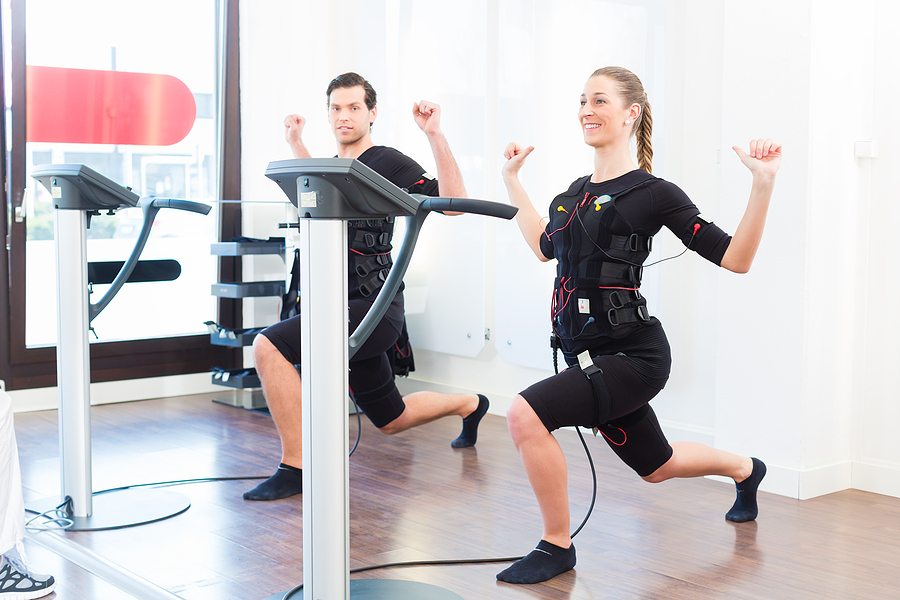
EMS technology doesn’t have to hold anything back. You wear a special bodysuit with embedded electrodes. Those electrodes emit low-frequency pulses that penetrate deep into the muscle tissue and force the muscle to contract at rates of up to 95%.
Plus, those muscle contractions happen simultaneously. Instead of working one muscle group and ignoring others, all muscles contract simultaneously, providing a balanced workout with all muscles engaged for the full 20 minutes. It may not seem like a long time, but your muscles experience an intense workout from start to finish.
What to Expect During Your EMS Workout
Before your EMS session begins, you have to put on the EMS suit. The electrode pads are damped to ensure conductivity. The vest and suit are strapped over all areas of your body. Once this is set, the workout follows these steps:
Calibration: The suit is connected to the EMS console and impulse levels are adjusted. You want to feel the pressure of the pulses without experiencing pain. Some people are ready to jump straight into higher levels, while others need to start at a beginner level. That’s why calibration is important.
Training: The 20-minute workout begins. Follow your trainer or monitor’s cues through the different low-impact movements. When the electrical impulse hits, you need to tighten your muscle and hold the pose until it stops.
Cool Down: After 20 minutes, the trainer switches settings to a low-frequency pulse that massages your muscles and gets blood flowing. It also helps with lymphatic drainage, which is important for preventing soreness the next day.
Why 20 Minutes Counts the Same as Hours in a Traditional Gym
When you go for a traditional workout, you have to wait for someone to stop using a machine, set it up to your needs, and then rest for a minute between sets before moving to the next muscle group. That eats up a lot of your time. A one-hour gym session often results in only 20 minutes of active exercise.
EMS takes the same time, but muscle contractions occur dozens of times per second. It’s also working out all muscles at the same time. You end up with a full-body workout in the same amount of time.
Average Duration: Up to 90 minutes (Gym) or 20 minutes (EMS)
Contraction Frequency: Dependent on speed (Gym) or around 85 per second (EMS)
Joint Strain Risk: High (Gym) or no risk (EMS)
Percentage of Muscle Activated: Around 60 to 65% of muscle fibers (Gym) or up to 90% (EMS)
You also have two types of muscle fibers that exercise targets.
Type 1 – Endurance
Type 2 – Sudden power and strength
Traditional exercise doesn’t always reach both types of muscle fibers. EMS does.
Advantages You Gain With an EMS Workout
EMS takes less time, and that is an advantage. However, an EMS workout provides distinct benefits that you cannot overlook.
Calorie Burn
Are you among the dozens of people who believe that a short workout burns fewer calories? It’s a common misconception. While you may burn a few fewer calories in a short EMS session than a 90-minute hike, it’s not that simple.
After your EMS workout, your muscles are dealing with tiny tears to all of the muscle groups targeted by the EMS suit. Repairing those micro-tears requires your body to keep working and burning calories.
Excess Post-Exercise Oxygen Consumption (EPOC) is the increased oxygen consumption and calorie expenditure during the recovery period. This “afterburn effect” can take up to 48 hours for the body to return to a pre-exercise state.
Your body essentially burns fat for as much as a couple of days after your workout. While you didn’t burn as many calories in the initial 20 minutes, you’re benefiting from a sustained calorie burn for days.
Joint Protection
One of the best reasons to try an EMS workout is that it’s much easier on the joints, ligaments, and tendons. Often, a traditional workout has you lifting heavy weights from a squatting position. This places tremendous stress on your ankles, knees, hips, lower back, and shoulders.
If you have arthritis or have experienced joint damage in the past, EMS doesn’t require you to hold heavy weights. Follow the instructions by doing things like standing still or gently squatting, and the suit’s electrical current forces the muscle to contract. It strengthens muscles without joint strain.
Who Is EMS Best For?
If you’re planning to use EMS to work out without putting in any effort, it’s not a good program for you. You need to be willing to maintain your fitness each week, eat a balanced diet, and stay hydrated.
In those 20 minutes of an EMS session, your muscles feel the burn. You’re going to work up a sweat. EMS is all about getting a full workout in a shorter amount of time.
It’s a perfect solution for people whose schedules keep them from a full workout. As it’s lighter on the joints, it’s a great choice for those with prior joint injuries. It’s ideal for the busy new mom who’s devoting most of her waking hours to her newborn but really wants to get back to her pre-pregnancy form.
All it takes is 20 minutes and a willingness to wear the suit and follow instructions. If you’re ready for a modern workout that effectively targets your muscles, book an appointment online with Premium Sports & Orthopedics.