 26 Sep 2026
For rotator cuff tear treatment without surgery Fresno, the right next step starts with an individual assessment. A rotator cuff tear doesn’t always mean surgery, but the best approach depends on your symptoms, shoulder function, and the tear’s features. If shoulder pain is disrupting sleep, work, or favorite activities, it’s understandable to want relief without an operation and to wonder whether conservative care is appropriate.
This guide explains how clinicians assess a tear and what factors may shape your options, including the tear’s size and your daily demands. You’ll learn how physical therapy and other conservative approaches may fit into a monitored treatment plan, why results can vary, and when to revisit the plan.
For Fresno and Clovis residents, an orthopedic or sports medicine consultation can help clarify the diagnosis and the options to discuss. The questions in this guide can help you prepare for an appointment and make informed decisions with your clinician.
Key Takeaways
- Rotator cuff tears differ, so treatment decisions depend on your symptoms, shoulder function, and clinical assessment.
- Your medical history, physical examination, and appropriate imaging can help clarify the diagnosis.
- Discuss the goals and limitations of conservative options, including physical therapy, with a clinician.
- Track changes in sleep, daily tasks, and arm use to help guide follow-up discussions.
- For rotator cuff tear treatment without surgery Fresno, prepare questions about diagnosis, treatment choices, and when to reassess your plan.
Can a Rotator Cuff Tear Be Treated Without Surgery in Fresno?
Shoulder pain can make reaching overhead, getting dressed, working, or sleeping difficult. It’s understandable to wonder whether a tear means surgery is inevitable, especially when your shoulder no longer works as it used to. In some cases, a clinician may consider starting with non-surgical care, but the right approach depends on an individual evaluation. There’s no single plan for every tear.
The rotator cuff is a group of muscles and tendons that helps stabilize the shoulder and lets you lift and rotate your arm. A tear may involve one tendon or part of a tendon, and tears vary in size, cause, and effect on everyday movement. The overview of rotator cuff tears describes common classifications and symptoms, but only a clinician can assess what an individual’s findings mean.
What does a rotator cuff tear mean?
Some tears follow a distinct injury, such as a fall or sudden strain. Others develop gradually as tendon tissue changes over time. Pain, weakness, or limited movement can occur with different shoulder problems, so symptoms alone can’t show how large a tear is. Imaging findings also need context: a clinician considers them alongside your history, examination, and shoulder function.
When may non-surgical treatment be considered?
A clinician weighs several factors before discussing options: your pain and strength, how well you can use the arm, general health, activity needs, and the tear’s features. For some people, the clinician may recommend a monitored trial of conservative care, which can include physical therapy when appropriate. The aim is to address pain and function while checking whether the plan is helping. Non-surgical care can’t guarantee that a tear will heal or that surgery won’t be needed.
For people exploring rotator cuff tear treatment without surgery Fresno, an orthopedic or sports medicine consultation can connect the diagnosis to practical options. Fresno and Clovis residents can ask which approaches fit their specific findings, how progress will be reviewed, and what might prompt a change in the plan.
Don’t rely on self-diagnosis if weakness, pain, or loss of function worsens. These changes deserve reassessment so a clinician can review your shoulder and decide whether the current approach still makes sense. This article provides general education, not a diagnosis or a substitute for personalized medical advice.
How Fresno Clinicians Assess a Tear Before Recommending Treatment
A useful evaluation connects your symptoms with how your shoulder moves and, when needed, what imaging shows. In Fresno, an orthopedic or sports medicine clinician can review your concerns and explain what further assessment may help clarify the diagnosis. The steps depend on your symptoms, examination findings, and circumstances.
What should you expect during a shoulder evaluation?
Expect questions about when the pain began, whether it followed an injury or developed gradually, and which movements make it better or worse. Your clinician may ask how symptoms affect sleep, work, sports, or routine tasks, as well as what treatments you’ve tried and whether you’ve injured the shoulder before.
A clinician-directed physical examination may include checking shoulder movement, strength, and function. You might be asked to move your arm in different directions while the clinician observes or applies gentle resistance. These checks are part of a broader evaluation, not a home test that can confirm a tear. Specific examples, such as difficulty reaching a shelf or lifting an object, can help describe how the shoulder affects daily life.
When might ultrasound or MRI help?
Imaging may be considered if your history and examination suggest it could add useful information. Ultrasound uses sound waves to create images of structures in the shoulder, while MRI uses magnetic fields and radio waves to produce detailed images of soft tissues. A clinician decides whether imaging is appropriate and which option best fits the question being investigated.
An image is only one part of the picture. Findings need to be considered alongside your symptoms, examination, and functional goals. An image alone doesn’t determine which treatment is right. Diagnostic services and access can vary, so ask your clinician where imaging may be arranged if it’s recommended. For a general overview of care approaches after assessment, see the Cleveland Clinic’s guide to nonsurgical treatments.
Assessment findings and daily function guide treatment planning. That helps explain why two people with similar imaging reports may receive different recommendations. Before agreeing on next steps, ask what the assessment suggests, whether imaging would change the plan, and how progress will be reviewed.
If you’re considering rotator cuff tear treatment without surgery Fresno, an individualized consultation can help you understand the reasoning behind your options. Fresno and Clovis residents can learn more about orthopedic and sports medicine consultations to discuss shoulder concerns and appropriate next steps.
Non-Surgical Rotator Cuff Tear Treatments: What Each Option Can and Cannot Do
Conservative care is shaped by your symptoms, shoulder function, and clinical assessment. Goals may include easing pain, improving movement, or helping you return to valued activities. Feeling better doesn’t necessarily mean a tendon has structurally healed. The Mayo Clinic’s overview of non-surgical rotator cuff treatments describes approaches clinicians may consider, including physical therapy and injections.
| Care category | Potential purpose | What to discuss |
|---|---|---|
| Activity adjustments | Reduce movements that aggravate symptoms while maintaining suitable activity. | Ask what to modify and how to avoid unnecessary loss of movement. |
| Physical therapy | Address mobility, strength, and shoulder function through guided rehabilitation. | Exercises should match your symptoms and progress, not follow a one-size-fits-all routine. |
| Pain-relief medicines | Help manage discomfort for some people. | Ask a clinician or pharmacist whether a medicine is appropriate given your health and other medications. |
| Injections or tissue repair approaches | A clinician may discuss these options for selected situations. | Ask about the specific method, potential benefits and risks, evidence, and whether it suits your diagnosis. |
Symptom relief can improve comfort and function, but it doesn’t by itself prove that a tendon tear has healed. A care plan should clarify the outcome being targeted and how the clinician will assess progress. The size and characteristics of a tear, your health, and your activity needs all matter. No option is right for everyone or guaranteed to avoid surgery.
How can physical therapy support shoulder function?
Physical therapy may use clinician-guided mobility and strengthening tailored to your examination, symptoms, and response over time. Exercises may be adjusted as your shoulder changes rather than prescribed as a fixed routine. Premium Sports & Orthopedic Center provides physical therapy. A clinical assessment is needed to determine whether it fits your needs.
Where may tissue repair approaches fit?
Advanced joint tissue repair therapy is another category to ask about, but clarify the specific approach, evidence, eligibility, and availability with the clinician. Don’t assume a particular procedure is offered or that tissue-focused care can repair every tear. For rotator cuff tear treatment without surgery Fresno, ask how each option’s expected benefits and limits relate to your diagnosis.
Fresno and Clovis residents can explore orthopedic and sports medicine consultations to discuss shoulder care options and whether physical therapy or tissue repair approaches may be clinically appropriate.
How to Track Progress and Revisit Your Treatment Plan
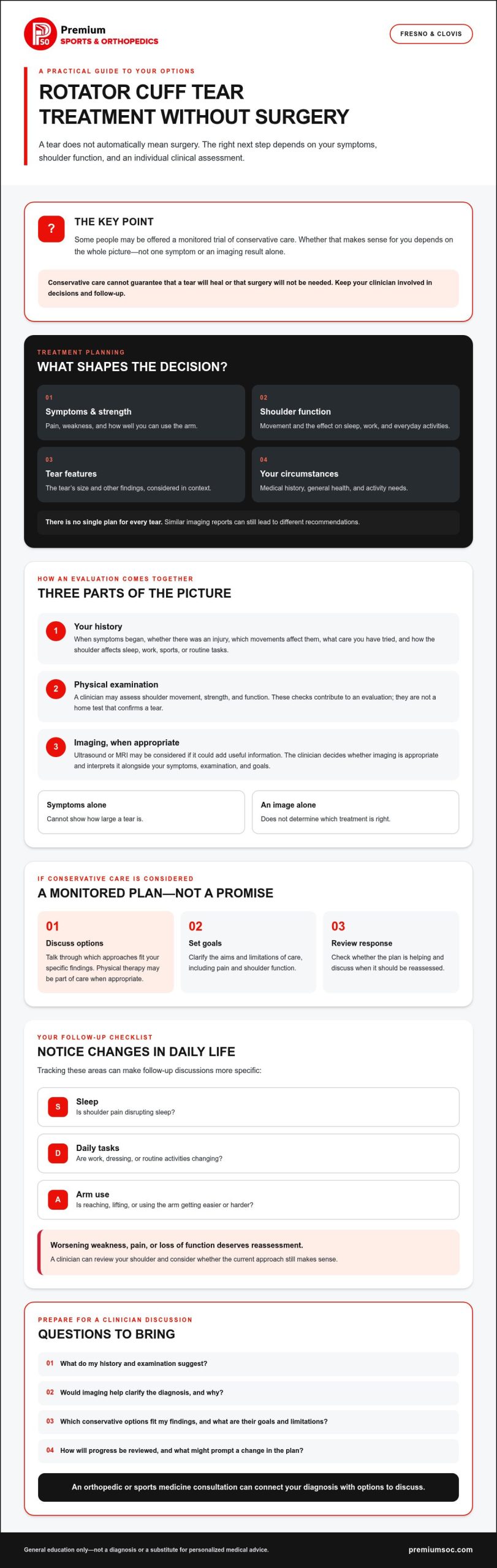
A conservative-care plan works best when you and your clinician agree on what progress should look like. Set goals tied to your daily life, such as sleeping with less disruption, reaching overhead more comfortably, or managing work tasks. Follow the plan you’ve discussed, record meaningful changes, and bring those observations to follow-up visits. Progress can be uneven, so one difficult day doesn’t necessarily tell the whole story.
Which changes are useful to track?
Keep brief notes about symptoms and what your shoulder can do. Record whether pain interrupts sleep, how reaching or dressing feels, or whether you can use your arm for work or sport. Note when symptoms occur and how they change over time. Share functional changes with your clinician, including tasks that have become easier or harder. These details add context to the clinician’s assessment of shoulder function.
A simple record can include:
- Sleep: whether shoulder discomfort wakes you or affects your usual position.
- Daily tasks: changes in reaching, dressing, lifting, or work activities.
- Arm use: movements you’re able to do and those that remain difficult.
- Symptom pattern: whether pain or weakness is improving, staying similar, or worsening.
Look for patterns rather than judging progress by a single flare-up. The Fresno sports medicine recovery guide offers additional context on recovery and active lifestyles.
When should the plan be reassessed?
Contact your clinician if pain worsens, new weakness develops, or you’re losing function instead of moving toward your agreed goals. A significant new injury or sudden, severe symptoms warrant prompt medical assessment. Don’t try to determine the tear’s severity on your own. A clinician can review what has changed and decide whether to revisit the diagnosis, rehabilitation approach, or other care options.
Reassessment isn’t a sign that you’ve failed at conservative care. It helps ensure the plan continues to fit your shoulder and needs. If progress stalls, share your notes and ask what the next step should be, whether the current approach needs adjustment, and when you should check in again. For guidance on rotator cuff tear treatment without surgery Fresno, consider an orthopedic or sports medicine consultation to discuss your symptoms and treatment plan.
Choosing Rotator Cuff Tear Care in Fresno: Your Consultation and Next Steps
A productive consultation should leave you clearer about what may be causing your symptoms, which options fit your goals, and how you’ll know whether the plan is helping. Recommendations can differ because people have different tear features, activity needs, health considerations, and priorities. Compare the reasoning behind each plan, how clearly your questions are answered, and whether follow-up progress will be monitored.
Questions to bring to a Fresno-area consultation
Write down your questions before the visit, along with the movements and tasks that have become difficult. Consider asking:
- What does my history and examination suggest about my shoulder?
- Would further diagnostic evaluation or imaging help guide the decision?
- Which non-surgical options may fit my goals and findings, and what are their limitations or uncertainties?
- How will we measure changes in pain, movement, and daily function?
- When should we review the plan, and what changes should I report sooner?
Clear answers should help you understand both the purpose of a recommended treatment and what it cannot promise. If something is unclear, ask the clinician to explain the reasoning in everyday terms. For rotator cuff tear treatment without surgery Fresno, a sound recommendation should be specific to your evaluation, not based on the assumption that every tear needs the same approach.
What happens after the first visit?
Next steps depend on the assessment and the plan you agree on with your clinician. They may include monitoring symptoms, discussing rehabilitation, or considering other approaches if clinically appropriate. Premium Sports & Orthopedic Center offers orthopedic and sports medicine consultations and physical therapy for Fresno and Clovis residents. A clinician can discuss whether physical therapy or joint tissue repair therapy is relevant to your situation. Neither is automatically suitable for every tear, and results aren’t guaranteed.
As you consider a provider, look for thoughtful clinical reasoning, open communication about benefits and uncertainties, and a clear approach to follow-up. Ask how the plan could change if pain, strength, or function doesn’t improve as expected. You can also read the Clovis sports medicine consultation guide for additional information about preparing for a local consultation.
Your shoulder goals matter. If pain or limited movement is affecting daily life, discuss your symptoms and possible next steps with the care team at Premium Sports & Orthopedic Center. An individualized conversation can help you understand your options and decide what to ask next.
Take the Next Step Toward a Clearer Shoulder Care Plan
A rotator cuff tear doesn’t automatically mean surgery, but non-surgical care isn’t a guaranteed fix for every injury. The right plan starts with an individual assessment of your symptoms, shoulder function, and tear features. Physical therapy or joint tissue repair therapy may be options to discuss when clinically appropriate, with progress reviewed and the plan adjusted as needed.
If you’re considering rotator cuff tear treatment without surgery Fresno, an orthopedic or sports medicine clinician can help you understand your diagnosis, compare options, and decide what questions to ask. Premium Sports & Orthopedic Center offers orthopedic and sports medicine consultations for Fresno-area patients, along with physical therapy and joint tissue repair therapy that may be considered based on clinical assessment.
Schedule a consultation to discuss your shoulder and treatment options. A thoughtful next step can help you move forward with more clarity.
Frequently Asked Questions
Can a rotator cuff tear heal without surgery?
Some people can manage pain and improve shoulder function without surgery, but symptom improvement doesn’t necessarily mean the tendon has structurally healed. Whether conservative care is appropriate depends on factors such as tear features, symptoms, health, and activity needs. A clinician can assess your shoulder and explain the potential benefits and limitations of available options. Non-surgical treatment can’t guarantee that a tear will heal or that surgery won’t eventually be considered.
What is the best non-surgical treatment for a rotator cuff tear?
There isn’t one best treatment for everyone. A clinician may recommend an individualized approach based on your assessment, which could include physical therapy, activity adjustments, or other options when appropriate. Physical therapy may help address mobility, strength, and function, while pain relief and restored movement don’t necessarily indicate structural healing. Ask what each option aims to improve, what uncertainties apply, and how your response will be reviewed.
How long does non-surgical rotator cuff treatment take?
There’s no set timeline that applies to every rotator cuff tear. The time needed depends on your symptoms, shoulder function, treatment approach, and how your shoulder responds. Your clinician can discuss when to review progress and what changes to monitor, such as sleep disruption, pain during daily tasks, or difficulty using your arm. If improvement stalls or symptoms worsen, contact your clinician rather than extending or changing the plan on your own.
When should I see a doctor for a rotator cuff tear in Fresno?
Arrange a clinical evaluation if shoulder pain, weakness, or limited movement interferes with sleep, work, sports, or everyday tasks. Seek prompt medical assessment for sudden severe symptoms, a significant new injury, or worsening weakness or function. Fresno-area patients can discuss their symptoms with an orthopedic or sports medicine clinician, who can evaluate the shoulder and explain whether additional diagnostic assessment or treatment options may be appropriate.
Can physical therapy make a rotator cuff tear worse?
Physical therapy should be guided and adapted to your symptoms and clinical findings, but an exercise that’s too demanding or unsuitable may aggravate discomfort. Tell your physical therapist or clinician if you develop sharper pain, worsening symptoms, or reduced shoulder function during or after an activity. Don’t push through concerning changes or copy exercises without guidance. The clinician can review your response and adjust the rehabilitation plan if needed.
Does every rotator cuff tear need an MRI?
No. A clinician decides whether imaging is useful based on your symptoms, medical history, and shoulder examination. If imaging could clarify the diagnosis or inform treatment choices, the clinician may consider an appropriate option, such as MRI or ultrasound. Imaging findings should be interpreted alongside your symptoms and function, not in isolation. Ask whether further imaging would change the recommended next steps in your particular case.
What happens if non-surgical treatment does not improve my shoulder?
If your shoulder isn’t improving, contact your clinician to review your symptoms and progress. They may reconsider the diagnosis, your rehabilitation plan, or other options based on your findings and goals. Worsening pain, new weakness, or declining function are reasons to ask for reassessment rather than continuing unchanged or self-diagnosing. In Fresno, an orthopedic or sports medicine consultation can help you understand the reasoning behind possible next steps.